
I’m pretty sure I never used the word “penultimate” in my life before the College Football Playoff was created and began referring to its second-to-last ranking as the penultimate rankings. So, thank you to the selection committee for expanding my vocabulary.
But that’s about the only compliment I have to offer them right now.
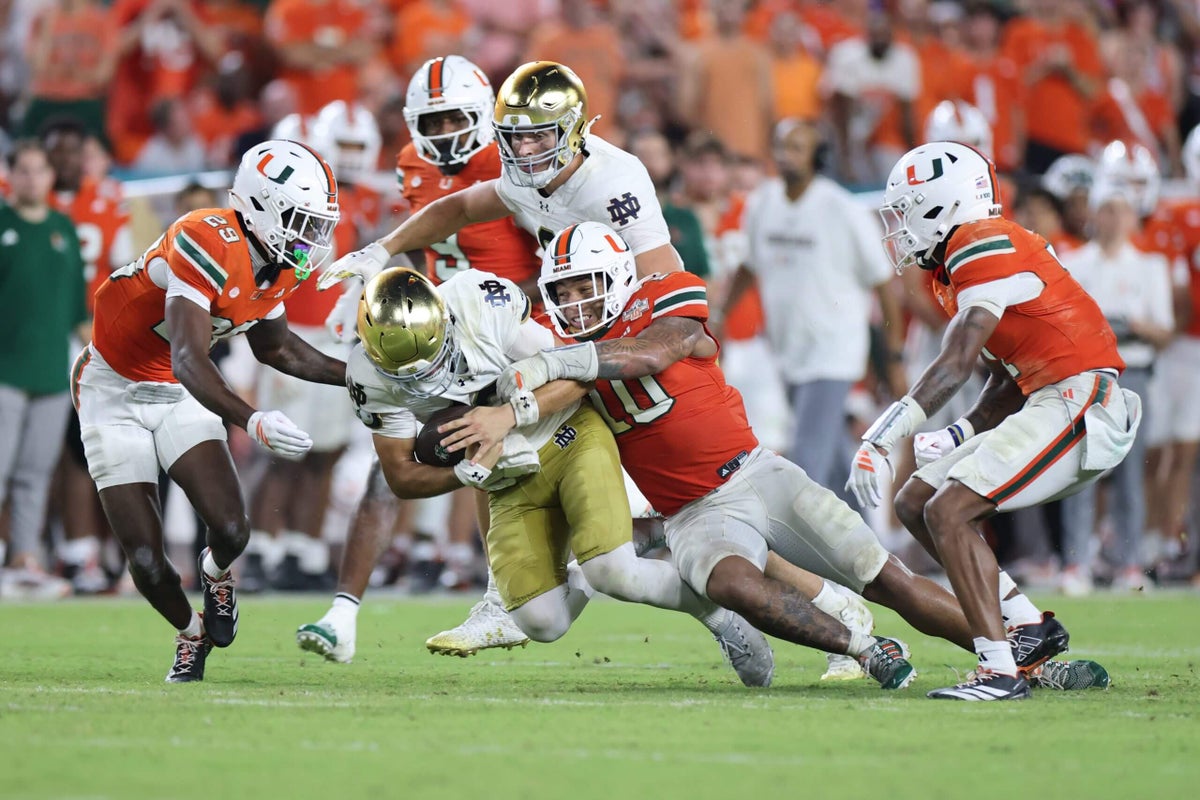
Assuming Notre Dame gets into the Playoff over Miami, is there any incentive left for teams to schedule difficult nonconference games? There are two glaring examples this year of the reason not to schedule these games:
1. Texas will be left out for a third loss to No. 1 Ohio State
2. Miami will (likely) be left out after beating ND head-to-head and having an almost identical resume.
Why would any (sane) university want to schedule these games? — Stewart G.
This question came in before Tuesday night’s rankings reveal, where Notre Dame dropped behind Alabama to No. 10. I would no longer assume the Irish stay above the Canes on Sunday, though it will depend on the results of two conference championship games.
Notre Dame and Miami are now just two spots apart, with No. 11 BYU in between them. Should BYU lose handily to Texas Tech, it will almost certainly drop behind both. Which would put Notre Dame and Miami right next to each other, competing for the last at-large spot. Were that to happen, I am 92 percent certain the committee would finally invoke the head-to-head tiebreaker. That’s what it’s for.
Though it’s also possible, if Alabama loses to Georgia, the committee could move the Irish back up to No. 9 but keep the Tide between Notre Dame and Miami. Or, if Alabama gets blown out, maybe the Tide are the unlucky ones out. (Though if this happens, there may never be another SEC Championship Game.)
Of course, if BYU beats Texas Tech to claim an automatic berth, and the Red Raiders remain in the field, both Notre Dame and Miami are probably out, and this whole discussion is moot.
You’re not wrong about the nonconference thing. The fact Alabama is one of the highest-ranked 10-2 teams despite losing by two touchdowns at 5-7 Florida State tells me Texas would be in, too, even with a loss at 4-8 Florida. However, I think the risk-reward is different for teams outside the SEC and Big Ten. The only reason Miami is even in the conversation is because the Hurricanes beat Notre Dame.
But I do worry that SEC and Big Ten schools are reaching the point where they’ll decide high-profile home-and-home series just aren’t worth it.
Do you think Oklahoma deserves a closer look when comparing that glut of two-loss teams? If you use the “watch the games” test, the Sooners easily would be at the bottom of that tier, as their offense might be the worst unit of any team in the top 12-15. From a resume standpoint, their best win is great (at Alabama), but the rest of their wins have lost some luster as Michigan is No. 19, and Tennessee and Missouri are no longer ranked. — Anthony V.
Yes, but it appears that’s not going to happen. The Sooners had yet another awful offensive performance against LSU (including three John Mateer interceptions), but remained right where they were at No. 8. They’re going to the Playoff.
I’d bet if there were no weekly rankings and the committee started from scratch right now, Miami would be in and Oklahoma would be out. Their resumes changed over time in different ways. Just as Miami’s “bad” losses to SMU and Louisville lost much of their stigma, some of the Sooners’ best wins became devalued. But the committee had already established a pecking order and, as always, has a hard time quitting it, especially when the Sooners beat the team right behind them (Alabama) on the road.
I find it particularly frustrating that Oklahoma is safely in and Notre Dame is living dangerously, because I consider the Irish on the short list of teams capable of reaching the national title game, whereas Oklahoma does not inspire much confidence at all. But objectively, it’s hard to deny the Sooners have a better resume than the Irish.
Some good 10-2 teams will get left out this year. It would not bother me if Oklahoma was one of them. But thanks to the weekly anchoring, the Sooners are the highest of the bunch.
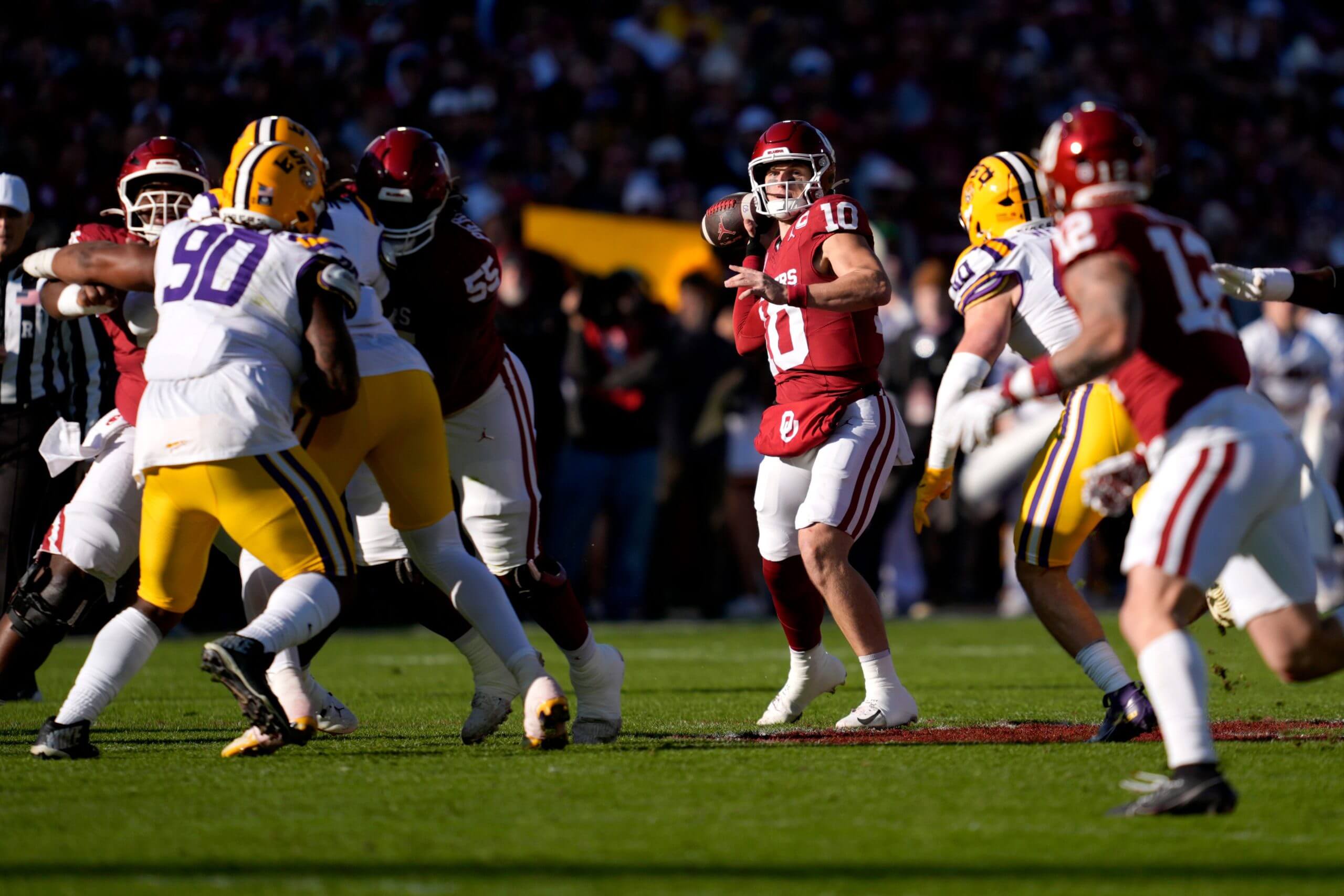
The Sooners offense has struggled and might not pass the eye test, but it’s hard to argue against their resume. (Bryan Terry / USA Today Network via Imagn Images)
What would you have done if you were Ole Miss? Let Lane Kiffin coach the team, knowing that this is a great chance at a run that doesn’t happen all the time? Or not let him because you know that each game would be a four-hour commercial for LSU football? — John L.
I would have done exactly what they did. In fact, based on the backlash we’ve seen since he left, Ole Miss’ chances in the Playoff may actually be better with Pete Golding than with a corrosive, lame-duck coach hanging around for another month.
Picture this. First-round Playoff game at sold-out Vaught-Hemingway Stadium. Arguably the biggest sporting event in the history of the state. Great day for the Rebels, until the time comes for Kiffin to lead his team out onto the field, and all 64,000 people boo as loudly as you’ve ever heard anyone boo. Then do it again every time he comes on the Jumbotron, all game long.
Does that seem like an ideal recipe to win a national championship?
Then there are longer-term implications. You’d be giving the next coach of one of your three SEC annual rivals another month (at least) of direct access to any players he might want to take with him. While he’s calling recruits and portal candidates on behalf of LSU that Ole Miss is trying to land, too.
I give Ole Miss AD Keith Carter a lot of respect for how he handled what seemed like a no-win situation. First of all, he did not succumb to some serious public pressure from high-profile analysts on ESPN trying to do Kiffin and Jimmy Sexton’s bidding by painting Ole Miss as the villain and Kiffin as the victim for not wanting him to coach in the Playoff. Not only was that never realistic, for the reasons I cited above, but it’s so patronizing to Ole Miss.
I don’t envy Golding, a first-time head coach, having to make his debut in a Playoff game with a depleted staff. Maybe the Rebels struggle because of it. But I’d rather have Golding trying to win a national championship at Ole Miss than a guy who apparently decided he couldn’t win one and bailed.
How should “Lame Kitten” have handled it when LSU and Florida came calling? If he waits until after Ole Miss is eliminated from the Playoff, the offers will be withdrawn because of missing Signing Day. If he truly believes that LSU offers better resources, especially NIL money, over the long run than Ole Miss, how else could he have handled it? — Greg S.
There’s been a lot of weird elements to the coverage of this saga. One of which is the framing by certain media types that Kiffin’s bind was something being done to him rather than something of his own making. Sometimes we miss out on great opportunities because the timing isn’t right. But that has never, ever been a consideration of Lane Kiffin’s.
I completely understand why he coveted the LSU job. That program has numerous inherent advantages over Ole Miss, starting with the wealth of in-state talent. Plus, the national championships, the Heisman winners, the NFL stars, the iconic stadium, the rabid fan base, etc. But it was either arrogance or delusion (or both) on his part to think everyone would just be so understanding of what an obvious career move this was for him that there would be no consequences for accepting the job while his current team remains in active contention for the national championship.
He really only had two choices. Choice A: Tell those suitors he’s interested in talking to them, but the timing just isn’t right. Call back if the job is still open once Ole Miss is out of contention. Choice B: Go ahead and accept the job at one of his current employer’s rivals, even if it means missing a chance to coach his current team in the Playoff. There was never a choice C, despite Kiffin’s best effort to concoct one.
The ACC is openly campaigning against Notre Dame. ND “joined” the ACC for bowl game access in a now-defunct system. Finding opponents will not be a challenge for the Irish. Why should they maintain their relationship with that conference? — Matthew M.
They still need somewhere to park their other sports.
Also, they’re 18-3 against ACC opponents under Marcus Freeman. You’d want to keep playing that schedule, too.
With this Lane Kiffin drama at Ole Miss, why doesn’t the NCAA set up a hiring period for coaches like the NFL? It would avoid the race-to-the-bottom by teams. The NCAA already has signing periods and a transfer window, so just modify those to accommodate this new schedule. — Drew
I’ve spent the past couple of days asking around about the possibility of something like that. The consensus is the NCAA itself wouldn’t want to get involved because it’s another antitrust challenge waiting to happen. But you might be able to accomplish the same thing differently.
One, the SEC could set parameters preventing schools from poaching each other’s staff during the season. That seems defensible because it’s the conference’s job to protect all of its members’ interests, but also both the schools and the coaches still have plenty of other options. And then if other conferences do the same thing, at least they’re not colluding with a competitor.
Another interesting idea would be for the College Football Playoff itself to instill some rules tied to participation in the event. For example, if School A hires School B’s coach before School B is eliminated from the Playoff, then School A is ineligible the following year, or has revenue withheld, etc. That would absolutely prevent another Kiffin situation. But to this point, the CFP (which is run by the conferences) has not attempted to establish any investigative/enforcement process of its own. See Michigan.
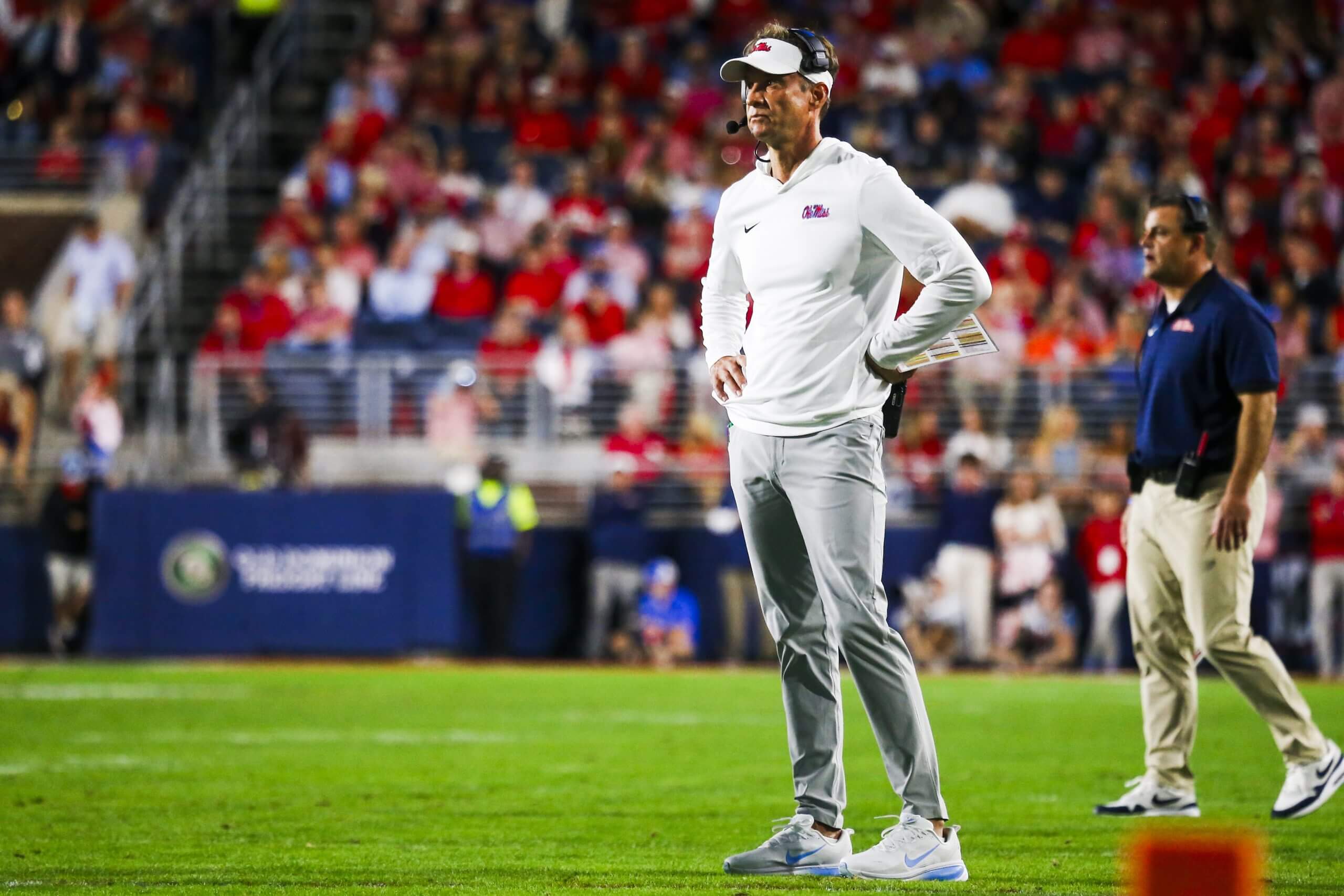
A hiring period for coaches could prevent another Lane Kiffin situation from happening, but it could be tough to pull off. (Petre Thomas / Imagn Images)
What do you think of Michigan State firing Jonathan Smith after just two years so that it could hire Pat Fitzgerald? Connor Stalions is praising the hire. Fitzgerald finished 3-9 or worse in three of his last four years at Northwestern and he has been out of college football for three seasons after a scandal. — Daniel H.
(Unfortunately) Michigan State made the best hire of this cycle. Pat Fitzgerald is the only available head coach who’s done more with significantly less on a relatively consistent basis.
— Connor Stalions (@cpstalions) December 1, 2025
Fitzgerald earned a lot of respect over his 17-year Northwestern tenure, and rightfully so, but I erroneously assumed he’d have to prove himself again in the G5/FCS. It appears his last couple of years there have been washed from people’s memories. While the abbreviated 2020 season was one of his career high points — 7-2, Big Ten title game appearance, No. 10 ranking — the Wildcats backslid considerably after that, going 3-9 in 2021 and then 1-11 in 2022.
Can you imagine if Michigan State, or any other Power 4 program, hired a coach who’d just finished 1-11 this season? It would never happen. But those three years in exile, followed by Northwestern exonerating him for any role in the hazing scandal as part of its lawsuit settlement in August, apparently came with the bonus of resetting his coaching reputation. Michigan State was not the only school interested in him.
I do think the hire might be a case of right match, right time. Jonathan Smith’s brief tenure was even more demoralizing for Spartans fans than his 9-15 record indicates. The low-key SoCal native just did not fit at a Midwestern program with a perpetual chip on its shoulder. Enter Fitz, a high-energy, blue-collar Chicago guy who will rip off one-liners at press conferences and rile up the faithful while also employing an old-school, smashmouth style of football that shares a lot of similarities with Mark Dantonio’s.
Fitz is a great defensive coach. I have little doubt the Spartans will be very good on that side of the ball. Offense was his Achilles’ heel throughout the back stretch of his Northwestern tenure. He’ll need to hire a good offensive coordinator and hit on some quarterbacks in the portal.
Side note: It is really, really hard for me to picture him in green. I’ve only ever known him in purple, from his time as a player (and me as a student reporter) in the mid-’90s, through his time as a coach there beginning in 2001. I’m fascinated to see how it goes.
Why is the Miami outrage solely focused on Notre Dame and not on how broken the ACC’s own tiebreaker process is? If we think Miami is a top-10 team, why is everyone OK with the ACC putting a team with a significantly worse resume into the championship game? Why should the CFP selection committee “do right” by Miami when its own conference is screwing it over far more egregiously? — Jeff S.
You mean to tell me a 17-team football conference, where each team plays only half the others, ended up with a completely random 7-5 team playing in its championship game? Who could have ever seen that coming?
Not that the ACC could have predicted the exact scenario of Duke losing three nonconference games, going 6-2 in conference play and finishing in a five-way tie for second. But the whole issue stems from having too many teams, resulting in too few crossover games. Case in point, Virginia went 7-1 but only played one of those five second-place teams (Duke). The Blue Devils went 6-2 but played only two of the top-six teams (Virginia and Georgia Tech). They lost to both.
But I’m not sure Miami has a great case to say it’s being “screwed.” It did beat one of the top six teams, 6-2 Pitt, but after that it’s 4-4 NC State, 3-5 Stanford, 2-6 Florida State, 2-6 Virginia Tech and 1-7 Syracuse. The Canes’ CFP candidacy is primarily due to its impressive non-conference resume (beating Notre Dame, USF and Florida), but those games aren’t meant to determine the conference standings.
I’m sure the ACC will change its tiebreakers this offseason, perhaps emulating some of the G5 conferences that employ either the CFP rankings (American) or computer ratings (Mountain West) to ensure the best candidates play in the title game. But I’m sure some other controversy will ensue because of that.
The solution, as I’ve preached repeatedly since last year: Bring back divisions. Note that five of those top six teams — Virginia, Georgia Tech, Pitt, Miami and Duke — are from the old Coastal Division. They would have all played each other. Imagine that.
Does home-field advantage change your pick for the American title game, Tulane vs. North Texas? How do each of these squads match up with potential opponents in the CFP — Jon
I’m sure it will be a great atmosphere in New Orleans, but I like North Texas. The Mean Green have been a machine all season, save for one bad game against USF. Drew Mestemaker and friends have scored 50-plus points in five of their last six games. I’m not sure Tulane has the firepower to keep up.
The challenge for the winner, though, is it’s likely going to be the No. 12 seed, and the teams most likely to fall into that No. 5 seed are far better than them. If it’s Texas Tech, those American offenses have not faced guys like David Bailey and Jacob Rodriguez. If it’s Oregon, you’re facing one of the best QBs in the country in Dante Moore. And if Alabama beats Georgia, you might get one of them. Good luck.
How many national titles is LSU going to win under Lane Kiffin and why is it infinity? Why y’all so mad tho? I’ll hang up and listen. — Patrick V.
Appreciate the optimism, LSU fans. I’m setting the over/under at 0.5. I think he’s fully capable, but if you haven’t noticed, the shelf life for Lane Kiffin Coaching Tenures is far lower than infinity.
It’s just a question of whether this one has a fired-at-the-tarmac ending or a getting-run-off-the-road ending.