
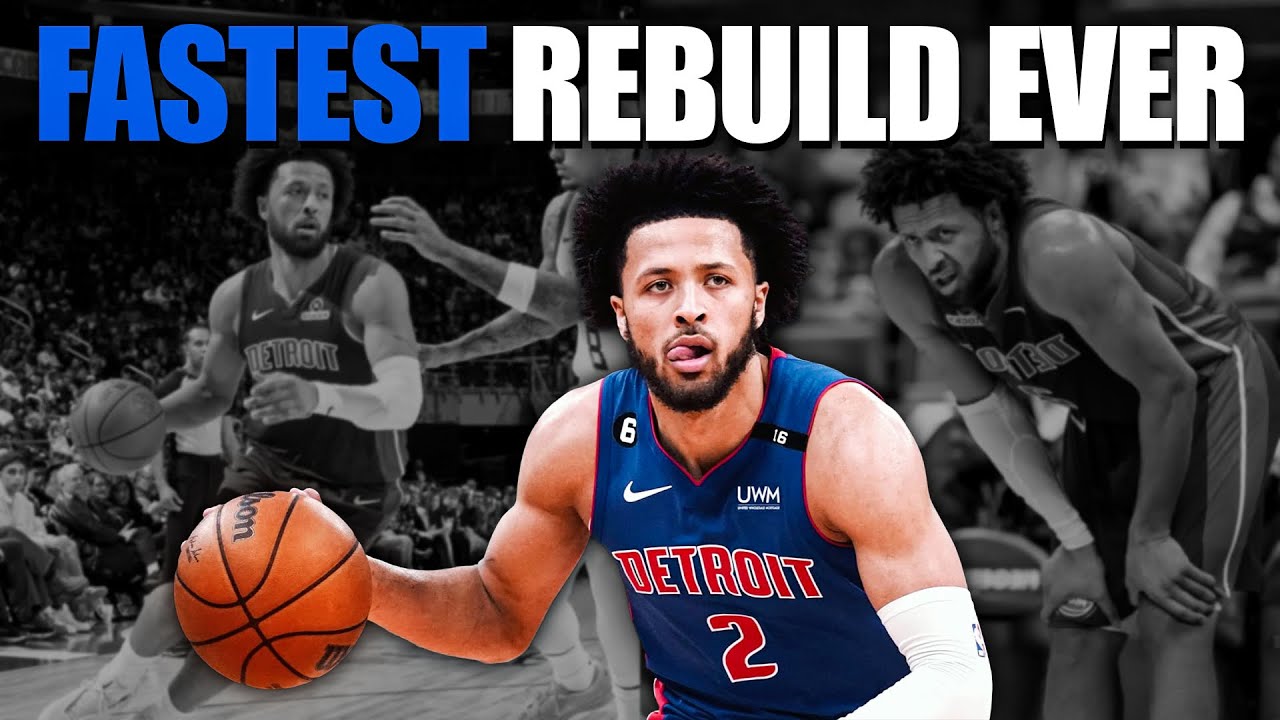
How the Detroit Pistons Completed the FASTEST Rebuild in NBA History
The Detroit Pistons were just about irrelevant for a span of 15 years. From the years of 2009 to 2023, they only appeared in the playoffs two times and got swept both times. They went 14 years without a single playoff win. The grit was gone. The direction was gone. Detroit basketball felt completely hopeless and lost the identity of the bad boys and the 2004 championship team. The stretch in the 2010s wasn’t just a failed rebuild. It was a collapse. Years of bottom feeding, multiple head coaches, top 10 picks like Stanley Johnson and Killian Hayes that never developed the way they were supposed to. A record- setting losing streak, no spacing, no structure, no identity. The franchise that once terrified the league had become the team everyone circled on the schedule for an easy win. The Pistons were over, or so everyone thought. But real franchises, the ones built on culture and the right people, don’t stay down forever. And if the 2004 Pistons defined how to build a champion, the mid2020s Pistons might just redefine how fast you can build one again. Because in just two seasons, this team went from rock bottom to the number one seed in the Eastern Conference. Powered by a franchise star, a new culture, and an identity that has finally resurrected Detroit basketball. This is how the Detroit Pistons completed the fastest rebuild in NBA history. Before we break down the masterclass of roster building and development that fueled this Detroit Pistons resurgence, we need to understand just how bad things had gotten and why the franchise needed a complete organizational overhaul. In the years leading up to their collapse, the Pistons weren’t just losing, they were lost. Like we mentioned before, from 2010 through 2024, Detroit had two playoff appearances and no playoff wins, all while cycling through draft picks and head coaches at a rate that made continuity impossible. The low point came in the 23-24 season when the Pistons suffered a record-breaking 28game losing streak, finishing 14 and 68 in one of the worst seasons in NBA history. Nobody questioned the effort of the players or the intentions of the front office, but the structure was broken. Monty Williams, hired on a massive contract to stabilize them, never found workable rotations, never established an identity, and never built an offense suited to the young core. Detroit was 29th or 30th in nearly every meaningful metric. Offense, defense, shooting, halfcourt scoring, you name it. And just like the Patriots whiffing on draft picks, Detroit had their own string of misses and missteps. Killian Hayes never became the lead guard they envisioned. Seek Dumbya washed out of the league entirely. Even Kate Cunningham, Jaden Ivy, and Jaylen Duran, undeniably talented, were trapped in a system that didn’t develop them, didn’t maximize them, and didn’t give them veterans who could help them grow. But it wasn’t just draft issues. Detroit’s roster construction had become a puzzle with missing pieces. No shooting, no spacing, no defensive identity and very little veteran leadership to guide the young core. By the end of the 23-24 season, the Pistons weren’t simply rebuilding. The franchise was depleted across the board. The losing streak was embarrassing, the development stalled, and the culture in disarray. Fixing it would require not just new players, but a new direction entirely. That responsibility fell on the man brought in to replace the outgoing front office. Tan Langden. Langden was hired to reshape Detroit’s basketball operations from the ground up. A modern executive known for patience, talent evaluation, and roster efficiency. And while he handled the front office overhaul, Detroit made another crucial change. Monty Williams was fired just one year into his six-year $78 million deal. He was replaced by JB Bickerstaff, a coach known for discipline, structure, defensive identity, and elevating young cores. Someone who could take a team with raw talent and finally give it shape. Together, Langden and Bicker Staff were tasked with dragging Detroit out of one of the darkest eras in franchise history and into something resembling stability. What happened next, nobody saw coming. Heading into the 2024 off season and a horrendous 14- win season, JB Bickerstaff needed to make a statement. And unfortunately, the lottery odds didn’t go their way and they landed the fifth overall pick in the 2024 NBA draft to help them do it. That selection became Ron Holland, one of the highest upside wings in the class. an explosive defender, transition weapon, and culture setter whose athleticism fit perfectly into the Pistons new defensive identity. He wasn’t the polished offensive prospect some fans hoped for, but he was a foundational piece for the future. Detroit’s 2024 draft didn’t produce instant contributors across the board. Holland showed flashes, but he wasn’t ready to be an offensive engine. The rest of the rookie group consisted of developmental players who weren’t expected to impact winning immediately. The early returns were modest at best. So, the Pistons turned to something more reliable than rookie upside, free agency, where they found pieces far more impactful in the short term. The most important addition, Tobias Harris. His arrival gave Detroit a stabilizing veteran scorer, someone who could punish mismatches, hit big shots, and bring structure to an offense that desperately needed an adult in the room. Next came Malik Monk, whose energy, playmaking, and microwave scoring became essential to Detroit’s second unit. Finally, Langden brought in multiple winning role players, floor spacers, defenders, and high IQ veterans who complimented the young core instead of crowding it. There were no over-the-top franchisealtering splashes in the first off seasonason with Langden and Bicker Staff. Instead, Detroit did something far more practical. They surrounded their young stars with competent NBA players and extended key long-term pieces like Kate Cunningham and Jaylen Duran to cement the foundation. Because the truth is, the 2024 Pistons were clearly one of the NBA’s least functional rosters. And it showed. The offense struggled to find spacing. Cade Cunningham was forced to create every advantage on his own. Jaden Ivy and Assur Thompson flashed brilliance, but neither had the structure or lineup stability they needed. And even with improvements from Duran, Detroit often lacked the physicality and versatility to compete for four quarters. The early stretches of the 24-25 season were particularly rough. Harris was still adjusting. Holland was raw. The spacing was still inconsistent. and Cade was asked to carry a burden that simply wasn’t sustainable. The Pistons younger players weren’t ready to lead a winning team. Not without help, not without structure, and not without a system tailored to their strengths. But unlike previous regimes, Langden and Bicker staff didn’t panic. They didn’t force roles that weren’t ready. They didn’t chase headlines. They didn’t blow assets frivolously. Instead, they built a foundation. They rebuilt the spacing around Cade. They unlocked Ivy with better matchups and cleaner lanes. They gave Assur a simple, defined role as a defensive stopper. And they let Duran blossom into the two-way anchor he was drafted to be. Little by little, the Pistons repaired the fractures that had held them back for years. The structure, the culture, and the identity were being rewired slowly, quietly, methodically. And all of that groundwork set the stage for what came next. Because the Pistons weren’t just getting better, they were about to explode. But early in the 24-25 season, it became painfully obvious that Detroit’s young core, despite its talent, needed more than flashes. The Pistons opened the year with inconsistency, offensive droughts, and growing pressure on a roster that was still learning how to win. The fan base was eager. The new front office was watching closely and JB Bicker staff was searching for something, anything that could ignite the team. It was time to stop waiting for a miracle. It was time for Kate Cunningham to fully take control of the franchise. And what did Kade do? He broke out and completely exceeded expectations. From the moment he settled into Bickerstaff’s structured offense, Cade looked like the star Detroit drafted him to be. His pace, his command, his mid-range mastery, everything clicked at once. And while the Pistons weren’t winning every night, Cade was delivering something Detroit hadn’t seen in years. A true number one option, a franchise cornerstone, a leader. It didn’t matter that Ron Holland was still raw or that Ivy and Assur were still growing into their roles. Cade elevated everyone. Night after night, he gave Pistons fans something they hadn’t felt in over a decade. confidence. By mid-season, the inevitable became a reality. Kate Cunningham was named an NBA All-Star for the first time in his career. The numbers were strong. The impact was undeniable. The leap was real. He wasn’t just surviving poor spacing, inconsistency, and a developing roster. He was thriving in spite of them. Detroit entered the All-Star break as one of the grittiest, hardest playing teams in the league, even if the roster was still incomplete. But even with the roster improvements, the Pistons still had flaws. The spacing was streaky. The bench lacked consistent scoring. Holland was learning on the fly. Assur was elite defensively but limited offensively. And Duran, despite his dominance, was still young and adjusting to nightly physical battles. Even with Cade’s rise, Detroit’s margin for error was small. But with Bickerstaff’s defensive structure taking hold, role players settling in, and Tobias Harris stabilizing the offense, something surprising happened. Detroit started winning close games, games they would have lost the year prior, games they used to collapse in. And suddenly, the Pistons, the same team that won just 14 games the previous year, were climbing in the standings. They didn’t have the firepower to win the East. They didn’t have the depth to dominate contenders, but they had enough structure, enough discipline, and enough brilliance from Kate Cunningham to make a push. And for the first time in 16 years, the unthinkable happened. The Detroit Pistons made the NBA playoffs. The six seed ending the longest playoff drought in the league, silencing years of memes, mockery, and misery. It wasn’t glamorous. It wasn’t easy, but it was real progress. And it was the clearest sign yet that Trejan Langden’s reset was working. Detroit walked into the postseason with an all-star point guard, a developing two-way core, a modern defensive identity, a coaching staff with purpose, and a franchise that finally felt like it was heading in the right direction. The Pistons weren’t contenders yet, but they were no longer a joke, no longer a bottom feeder, no longer trapped in the NBA’s basement. They were a team with real promise. And although the Pistons got bounced in the first round by the Knicks, the 2024 season proved exactly why the rebuild was about to accelerate faster than anyone expected. Because while the playoff return was sweet, the 2025 season would change everything. With their franchise player already established, the 2025 offseason became the Pistons chance to add the finishing touches. The pieces that would take a playoff breakthrough and turn it into something real, something dangerous. Tjan Langden didn’t swing for a superstar. He didn’t chase a flashy name. Instead, he targeted fit players who complimented Cade Cuttingham and amplified Detroit’s identity on both ends of the court. The most immediately impactful addition was Duncan Robinson, a veteran sharpshooter who brought exactly what the Pistons had lacked for years. Reliable spacing, gravity, and a constant offball threat. His presence alone transformed Detroit’s half-court offense, opening driving lanes for Cade, cutting lanes for Ivy, and lob windows for Duran. Next came Caris Levert, a skilled secondary playmaker who added shot creation and scoring punch off the bench. Detroit struggled for years with offensive droughts. Levert became the steadying presence who prevented those collapses. But the most surprising development didn’t come from free agency. It came from a rookie. Danish Jenkins, an undrafted free agent in 2024, quickly became one of the breakout young guards in the East. Tough, fearless, adaptable, Jenkins brought exactly the kind of poise and intensity Bickerstaff’s system thrives on. His defense at the point of attack, his improving playmaking, and his ability to slot next to either Cade or Ivy gave Detroit lineup flexibility they never had before. Suddenly, the Pistons weren’t just young and scrappy. They were deep, balanced, organized, and dangerous. For Kate Cunningham, the upgrades were transformative. With real spacing, dependable veterans, and a functioning offensive ecosystem, Cade’s game leveled up again. from all-star to legitimately one of the best guards in the league. His reads got sharper. His efficiency climbed. His control of the game reached new heights. By the first quarter of the season, Cade wasn’t just leading Detroit. He was leading the entire Eastern Conference in lategame scoring, clutch assists, and total offensive impact. Meanwhile, Jaylen Duran continued evolving into an interior force. Thompson became a true alldefense candidate. Even piece by piece, everything Tan Langden envisioned began clicking into place. And then the moment came. The moment that confirmed Detroit wasn’t a fluke. The Pistons climbed to the number one seed in the Eastern Conference. The same franchise that won 14 games two seasons earlier now sat at top the East. Backed by a superstar point forward in Cade, a physically overwhelming big endurance, an elite defensive wing in Assar, a revitalized scoring unit with Robinson and Levert, a fearless rookie in Jenkins, and a coach who finally built an identity that fit the roster. It didn’t take 5 years. It didn’t take a tearown. It didn’t take lottery luck. It took two seasons of precise front office moves, disciplined coaching, and internal development, and the Pistons became one of the NBA’s biggest threats. Detroit didn’t just rebuild, they detonated expectations. And with Cade Cunningham reaching true superstar status, this isn’t just a good team. This is the beginning of something real and something the league can no longer ignore. The Pistons were supposed to be years away. a young team, a project, a roster full of potential, but nowhere near contention. But instead, they’ve rewritten the timeline from dysfunction to discipline, from the basement to the top of the East. From a record- setting losing streak to one of the fastest rebuilds the NBA has ever seen. The Detroit Pistons are back. And now the question becomes, can they actually finish the job? Can this team not only grab the number one seed, but win the entire conference? Let us know what you think in the comments. And if you enjoy deep dives into stories like this, make sure you subscribe. It truly helps us keep creating more NBA documentaries just like this.
🔥 Join the Official Hoop Dungeon Patreon! 🔥
We’ve officially launched our Patreon, and this is where the real community lives. Members get to meet me and be part of a private community where we talk all things basketball, do exclusive events where you can win premium Hoop Dungeon merch, jerseys, cash prizes, and even get a chance to win $1,000 NBA courtside tickets!
Join today and be part of the movement:
Link to join HERE: https://www.patreon.com/c/HoopDungeon
32 comments
6 years is not fast. That shit was f**king brutal
Sekou reference!!
Blake Griffin is one of my favorites ever but we've been rebuilding since '09😅
16 years was fast? Quit playing with us. 🤣🤣🤣 that was a struggle. I was 25 the last time we won a playoff game before last season. I'm 41, now…fastest rebuild…nah.
They DOG WALKED the Hawks tonight. Great team!… Go Pistons!.
15 year rebuild 😭
Not talking about Stew and how hes being one of if not the best defensive big is just crazy. Also adding 3pt shooting to this roster, Stew is one of the mos important pieces of detroit
Correction there—they still have NOT extended Duren
The issue with Monty Williams, he was trying to make the Pistons a 3 point shooting team without any great 3 point shooters.
it's BEASLEY not MONK
They made Atlanta (14-11) look like a high school team tonight. Pistons nearly had a dozen guys in double figures…the starters didnt even play in the 4th. They are going to give OKC all they can handle in the finals….theyre that good.
2 decades, wow thats so fast….
@5:49 it wasn’t Malik Monk, but Malik Beasley.
Good video! Detroit Basketball, let’s go!
They were not bounced by the knicks, they lost in 6 and 3 of their losses were 3 points or fewer
SVG was the worst coach/GM ever. He released 18 or more Pistons that out lived his existence in the league. Some still playing. Some went full circle.
Fast😂😂? Gang our rebuild was not fast but a long awaited moment for true Detroit fans
And they are already considering tearing it down based on the ridiculous trade rumors.
Fastest rebuild ever? Wtf are you smoking. Theyve been rebuilding for forever 😂 theyve already had cade for how many years like 5? Theyve been building all of those pieces for years regardless of regime change. You have to start with cade and stewart as start of rebuild
#detroitbasketball we back baby❤💙
No stew in this vid. How disrespectful. Good vid besides that.
Great work at getting basically nothing right at how and why this happened. Was this created by AI?
Malik Beasley not Malik monk. Also they haven't extended Jalen duren yet
I came here just to laugh at the title. I'm a Pistons fan. This rebuild took over 15 years.
Malik Beasley you mean? Dog said Malik Monk.
JB Bickerstaff took in charge Detroit in 2024 similar to Ken Carter took in charge of Richmond Oilers; a team that finished dead last in their division. Unlike the Oilers, Pistons didn’t have blame game between each another its just management failure
Detroit showed us how important is a GM who has ideas how to rebuild and also a head coach who has idea to build a system and lead young players
You mean Malik Beasley not Monk lol
stick to making videos you know more about you misnamed someone twice come on
What do you mean the fastest rebuild? The Pistons have had losing seasons 14 out of the past 16 seasons. Stop gaslighting the people. haha. Jokes.
How the Detroit Pistons Completed the FASTEST Rebuild in NBA History ? NBA is RIGGED ! Hard question . WTF :
As a piston fan this rebuild has taken about 15 years…….
Fastest rebuild???