
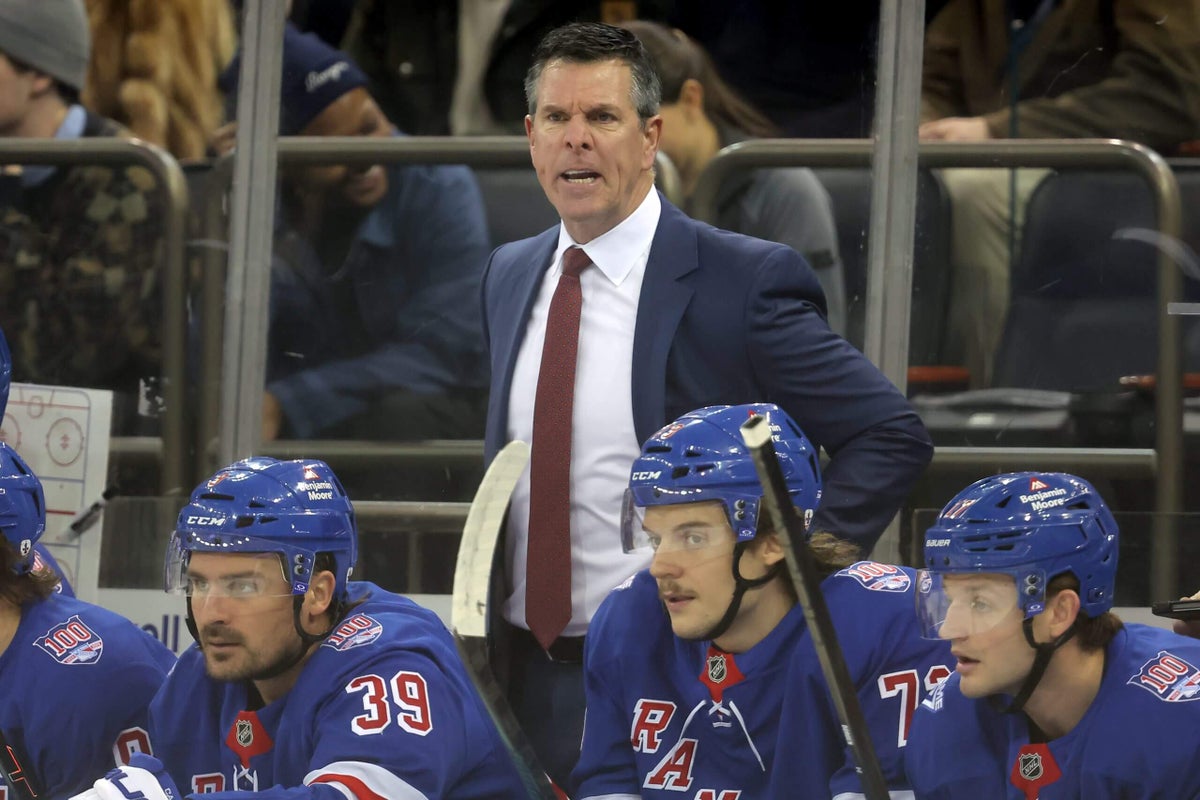
TARRYTOWN, N.Y. — A fast-paced New York Rangers practice came to a sudden halt on Dec. 1 when coach Mike Sullivan skated to center ice and demanded his team’s attention.
“Make people defend you!” he bellowed loud enough to be heard in every corner of the MSG Training Center rink.
Sullivan was imploring the Rangers to hold onto pucks while entering the offensive zone, which would, in turn, force defenders to commit. Patience creates playmaking opportunities, he explained, either by opening up passing lanes for teammates joining the rush or by clearing space to advance it yourself.
The scene spoke to New York’s struggle to achieve a balance between prudence and risk. Playing a straight-ahead game and establishing a swarming forecheck were themes throughout training camp, with players eager to please their new coach. They opened the season by frequently flinging pucks down the boards once they crossed the offensive blue line to create foot races deep in opponents’ territory — the dump-and-chase play, as it’s commonly referred to. But it may have been an overcorrection. The constant chipping often handed possession right back to opposing teams while stifling the creativity that comes from attacking off the rush.
Sullivan wants the Rangers to do both, depending on what the situation calls for, in an effort to diversify an offensive attack that’s hit a wall the last year and a half. But recognizing the right play in real time remains a work in progress.
“What we’re trying to build here is a hybrid game between possession and pursuit,” he explained. “It’s essential that we have the ability to create offense in different ways.”
It’s all part of adjusting to a new coaching staff and a largely different system than the Rangers ran under previous bench boss Peter Laviolette. It’s been a smooth transition in some respects, especially as it pertains to defensive coverage. New York has gone from 29th in the NHL with 12.2 high-danger scoring chances allowed per 60 minutes at five-on-five last season to first with only 9.33 HDCA/60 through the first 35 games of 2025-26, according to Natural Stat Trick. But its offensive production has fallen into a ditch.
The Rangers are averaging only 2.51 goals per game in all situations, which ranks 30th in the league, while being shut out an NHL-worst seven times. Some power-play woes, especially since Adam Fox went down with a left-shoulder injury, contribute to that — but the more pressing issue is five-on-five scoring. The Rangers have scored at the third-lowest pace in the league with just 2.04 goals per 60. And while the team’s scoring chance generation is far from perfect, the most glaring problem is not converting on its chances. New York has scored 16.3 goals fewer than expected, which puts them ahead of only the Detroit Red Wings and Calgary Flames.
Just a season ago, the Rangers ranked sixth in five-on-five scoring with 2.70 goals per 60. That’s a drop of 0.66 season-to-season, which is the most severe in the league. Tuesday’s 3-0 loss to the last-place Vancouver Canucks underscored the offensive dilemma, prompting an exasperated Sullivan to admit they’re still searching for solutions.
“Is it a little bit concerning at this point? Yeah,” he said.
The larger problem is a roster that’s thinned on skill over the years due to a combination of an aging core, several drafting and developing snafus, and a series of trades that shipped away lineup staples for meager returns. That falls on team president Chris Drury, who’s trying to squeeze another playoff run out of what remains from a successful 2021-24 era in spite of the glaring need for young talent.
Meanwhile, Sullivan is attempting to work around those personnel issues. To assess how he’s doing, we’ve examined what he’s trying to accomplish through systematic changes and how the Rangers are adapting while putting it into the context of this season’s scoring woes.
The ‘puck-pursuit game’
Going back to camp, Sullivan’s messaging has been consistent. Given the Rangers’ limitations, he believes they must incorporate an element of what he describes as “a grind game.”
“One of the first conversations we’ve had around this whole idea of what type of team we want to be, a.k.a. an identity,” Sullivan said. “We want to be a team that’s hard to play against. And the reason for that is because it’s hard to win if you’re not.”
That all starts with what Sullivan labeled “a puck-pursuit game” — a forecheck that’s designed to pressure opponents for the full length of the ice, making them “work to exit zones and gain access to our zone.”
The goal is to force mistakes that flip possession.

The 1-2-2 deployment begins with a lead forechecker (F1) aggressively pursuing the puck, while the other two forwards (F2 and F3) work to take away the nearest options, much like cornerbacks covering wide receivers in football. The two defensemen serve as the final layer, with the freedom to jump passing lanes if the opportunity presents itself. They’re positioned along opposite walls, with forwards instructed to guide opponents to the outside so the D can pinch down and disrupt their advancement.
“F1 typically pressures on the guy with the puck. F2 and F3 are reading off of that, but we have a structure,” center Vincent Trocheck explained. “When it goes (defenseman to defenseman), we’re supposed to jump to D and make sure that we’re staying above their third forward, and our D are supposed to stay above their wings. And when we do that, it’s seamless.”

The key is for all five skaters to be on the same page. If anyone drifts into the wrong position, the whole structure can crumble.
“To be honest, only one of the forecheckers has to make a real hard read,” said forward Conor Sheary, who has more experience than any current Ranger under Sullivan after spending four-plus seasons together with the Pittsburgh Penguins. “One’s on the puck, one’s on the wall, and then the other guy’s making a read. With everything we do, I think if you’re aggressive with it, you’re moving your feet, you’re not really gonna make too many mistakes. They might make a play through you, and at the odd time, they’ll get an odd-man rush or three-on-two up the ice because we’re so aggressive. But I think the important thing is to move your feet and to keep working. As soon as we lay off and start skating backwards or giving them ice to play on, that’s when we get in a lot of trouble.”

Sullivan has largely been pleased with that effort, calling the forecheck “one of our better attributes in this early part of the season.”
Playmaking vs. ‘No B.S.’
The emphasis on forechecking lends itself to a lot of the “north-south” chatter we’ve heard from Sullivan and several players.
Multiple coaches have lamented the Rangers’ east-west tendencies, with star winger Artemi Panarin the primary culprit of what he’s described as “stupid s— at the blue line.” Those risky cross-ice passes often left them vulnerable to turnovers, which is why they graded out as one of the league’s worst teams against the rush for years.
Sullivan has asked them to limit that risk by playing more directly and using the forecheck to win pucks back in safer areas of the ice. That’s where the dump-and-chase comes in, with the idea to win pucks back through hustle and physicality, then wear teams down with a low-cycle game that makes opponents play below their own circles. There’s an emphasis on working in the high-danger areas around the net and in the slot — “the good ice,” as Sullivan calls it — and battling for tips and rebounds that will offset their lack of finishing talent.
But it doesn’t mean that he wants the Rangers flipping pucks every time they come through the neutral zone. It’s preferable to enter the O-zone with possession, as opposed to the coin flip that occurs after every chip.

If they have even numbers, or especially an odd-man advantage, Sullivan is giving the green light to hunt for quick-strike opportunities. That means attacking with speed, drawing defenders — hence “make people defend you!” — and connecting passes that lead to easy finishes.

“That conversation is going on in every locker room in the league,” Sullivan said. “The reality is, when you have offensively gifted people, part of their DNA is they want to make plays, right? And my experience has been, we certainly don’t want to discourage our best players from making plays. We want to give them the latitude to do so. Having said that, there is inherent risk in playmaking, and we just want them to be calculated on when and how they do it. We try to build a little bit of a criteria around that to give them some clarification or what the expectation is on the game we’re trying to play.”
Laying out that criteria during practice and video sessions is one thing, but making those decisions at game speed is something entirely different. It’s proven difficult for a group that spent the preseason rocking “No B.S.” T-shirts but leaned too far in the cautious direction and became predictable.
“There’s a decision to be made every time you have a puck,” captain J.T. Miller said. “I think we struggled there in the middle part (of the season) with no bulls— and just chipped everything in. Where the hell is the line? No bulls— doesn’t mean you grab the puck and you chip it in and go to chase with your head cut off. That’s not what that means.”
Finding the ‘middle ground’
That exact problem was on display Nov. 29 against the Tampa Bay Lightning, when Alexis Lafrenière’s dump-in burned the Rangers and led to a Brandon Hagel goal against.

It’s worth noting, though, that Lafrenière has actually been recovering dump-ins at a team-high rate of 5.68 per 60 at five-on-five, according to All Three Zones’ tracking. It’s a major uptick for a player who was below league-average last year, with just 2.31 recovered dump-ins per 60.
That generally wasn’t a strength for the Rangers last season, outside of the fourth-liners (led by Sam Carrick in particular), Miller post-trade and Chris Kreider. The fourth line is still pretty active this season, but a couple of new faces are helping chase down pucks more often.

Taylor Raddysh is contributing, but the real standout is rookie Noah Laba. His skating is a real advantage here, considering how many speed bursts he has relative to the rest of the team (and league) this season. Laba ranks in the 98th percentile for bursts of 22 miles per hour or higher, according to NHL Edge, and has the jets to beat opponents to the puck. He’s done a little bit of everything so far in a third-line role.

Even Panarin is playing a chip-and-chase game a little bit more, with 4.19 recoveries per 60. In seasons past, that generally hasn’t been a strength of his game — he’s elite in transition and tends to enter the zone with control. And lucky for the Rangers, it hasn’t come at the expense of that side of his game, either. Panarin’s 17.3 controlled entries per 60 are still some of the best in the league and tend to lead to scoring chances off the rush. That ability to generate scoring chances in transition stacks up to players such as Nathan MacKinnon, Evgeni Malkin, Connor Bedard and Kirill Marchenko.
Panarin maintaining that element, and overall strength in his game, highlights what this team still has to find: balance between the types of zone entries.
“When you have your feet moving and there’s a time to take a guy wide, take him wide. When you have the puck in the corner, don’t just grab it and rim it to the D,” Miller explained. “Those are situations where we got away from that. We were just like, auto rim, auto chip, and we weren’t valuing possession of the puck. Then we got away from that, and we’re turning the puck over too much. We’re just trying to find the middle ground.”

That middle ground is clearly still a work in progress because the Rangers aren’t generating much in transition. If anything, the team veered too far away from last year’s tendencies. Panarin, Lafrenière and Zibanejad are the only three consistently creating off the rush, and that leaves the bottom nine without many playmaking options when those three get stacked together. That problem is even more pronounced with so few puck-moving defensemen.
Just look at the spread last year, with All Three Zones’ tracking, between shots off the forecheck and cycle versus the rush.

And how that compares to the team so far this season.

That clear split represents two things: the shift in playing style and the limitations of this roster as currently constructed.
Lack of offensive solutions
Sullivan has arranged his forwards recently with the intention of setting clear roles for each line.
He’s used Panarin, Zibanejad and Lafrenière in what amounts to the Rangers’ play-driving line, with that trio given the latitude to take more chances than others. Lafrenière, in particular, is one of the players Sullivan has been urging to hold onto the puck longer.
Their underlying stats have been encouraging, with a 56.63 percent expected goals-for rate while doubling their opponents with a 38-19 edge in high-danger chances across 155:09 time on ice together at five-on-five, according to Natural Stat Trick. But those numbers ring hollow given the results. They’ve been outscored 6-3 while registering a lowly average of 1.16 goals for per 60. It’s a microcosm of the finishing issues that have plagued the entire team.
While the Panarin-Zibanejad-Lafrenière line is designed to play in open ice and make more east-west plays, the other top-six trio is decidedly north-south. Miller and Trocheck have skated together lately, with Sheary and Will Cuylle taking turns at left wing. “We’re like this in the O-zone,” Miller said while clenching his fist, his way of explaining that they stay tight on the forecheck and try to overwhelm defenses by loading up the middle of the ice.
In theory, those lines should play to individual strengths. But it also leads to predictability due to the redundant skill sets.
Regardless of the combinations, the results simply haven’t been there. Each of the top-six forwards has experienced dips in production this season, while the bottom six is devoid of proven scoring touch. Those lines have little choice but to dump, chase and hope for a greasy goal.
It’s difficult to generate that way without defenders who can shoot the puck through traffic and set the forwards up in the net-front area. The Rangers’ defenseman with the highest rate of unblocked shots this season? Matthew Robertson, who sits in 49th. The next best, Fox, ranks 64th. No one else on this blue line is even in the top 100 among the position. Compare that to a team like the Colorado Avalanche, who have two top-30 defensemen in shot volume, or the Lightning, with four in the top 100. Having that kind of shooting presence from the back end would set the forwards up to grind out more chances.
Drury pushed the panic button Wednesday by recalling first-round picks Brennan Othmann and Gabe Perreault, and while there’s hope they’ll provide a jolt, expectations should be modest after both struggled in previous NHL stints.
Outside help will almost certainly be required to achieve consistent offense. The problem then becomes whether there will be enough high-end options on the trade block — and if the Rangers can even put together competitive offers given their depreciated pool of assets. Someone like Alex Tuch could make sense, but with few true top-six players available (and a thin free-agent market in 2026), the price will be high. Yegor Chinakhov could be an interesting option, but he’d come with uncertainty compared to a more established contributor.
The other issue is that it remains unclear who this year’s sellers will be. The Penguins could move Bryan Rust, a Sullivan favorite, but his availability depends on whether Pittsburgh falls out of the playoff race. Given the weakened state of New York’s roster and prospect pipeline, there’s a compelling case that they shouldn’t be making go-for-it moves, anyway.
It’s a tough spot for Sullivan, who’s done an admirable job in covering up some of the Rangers’ warts but will be hard-pressed to fully implement his hybrid strategy without reinforcements.