
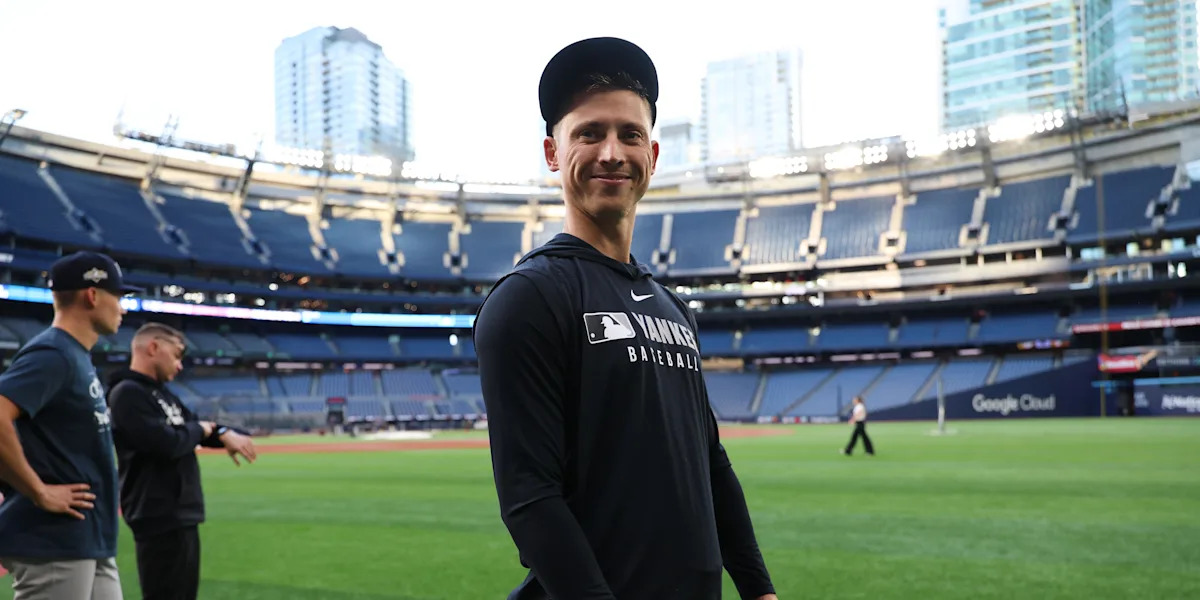
The Mets continued both their bullpen revamp and their seemingly endless conquest to steal good players from the Yankees, signing Luke Weaver to a two-year, $22M deal. Weaver, a 32-year-old right hander, has been a key member of the Yankees’ bullpen the past two seasons and actually took the closer’s job from Devin Williams at times last season. Now the two will be reunited at the back of the Mets’ 2026 bullpen.
Depending on how long you’ve been paying attention to this sort of thing, you may remember Weaver as a frustrating arm from the mid-2010s, one who fit well into many of the public-facing pitch analysis debates of the time. His velocity was middling (low-to-mid 90s as a starter) yet it consistently induced whiffs, exemplifying the newly mainstream importance of fastball ride and shape. He had a plus changeup but lacked a true breaking ball, making him yet another test case pushing the conventional wisdom on arsenal depth for starters. He also consistently got hurt by damage on contact. something that might’ve been hand-waved away as luck.
Advertisement
Needless to say, we know better about a lot these things now (well, not grading changeups, that pitch type still confounds many models). Weaver’s fastball had good traits, but he’d bleed velocity and didn’t always command it well. That made it easier for hitters to square him up and largely substantiating the results he allowed on batted balls. More recent stuff models – for instance, Baseball Prospectus’s, which includes surprise figures – have also captured how having more good pitches has clear value, provide they’re, y’know, actually good.
Couple those limitations with a lengthy injury history (multiple bouts of forearm, elbow, and shoulder strains) and you can piece together why Weaver never really worked out as a starter. That didn’t stop plenty of teams from trying though, because there was clearly something here. He was a piece in the Paul Goldschmidt trade, spent some brief time as a Royal, had two separate stints with the Mariners, and also spent time in Cincinnati. Aside from a 12-start run in 2019, however, it never really came together.
Weaver landed with the Yankees at the end of the 2023 season and made three spot starts down the stretch. His performance earned him a spot in the Yankee bullpen for 2024, and it quickly became apparent that Weaver had figured some stuff out. Top of the list, he added 1 – 2 MPH across his arsenal. That drove a corresponding increase in induced vertical break on his fastball, making it an even more effective swing-and-miss offering. He also tweaked the shape of his cutter and began deploying it as a legitimate third pitch (22% usage), particularly against right-handed batters where it actually became his most used secondary.
The results of all of this were sterling. Weaver’s stuff metrics improved significantly across all public models, and he saw big increases in both chase and whiff rates. Critically, the revamped arsenal also did a better job of limiting damage on contact; not necessarily to a level you’d call “good”, but better than the “horrible-to-disastrous” range Weaver had lived in for much of his career, with a particular penchant for limiting pulled fly balls. He ended the season with a 2.89 ERA and a 23.3% K-BB% as a key part of the Yankees’ late-inning relief corp.
Advertisement
While the overall approach carried into 2025, there was some backsliding. Weaver threw all his pitches roughly half-a-tick slower than in 2024, something that made his fastball just a bit more hittable in the zone. He also seemingly lost the feel for his cutter, reducing it’s usage back down below 10% despite the success he had with the pitch in 2025. The end result was an ERA in the high 3s rather than the high 2s and K-BB% that dipped back under 20%. Weaver also struggled with a hamstring injury in the middle of the season, pitching to an ERA over 5 from late-June onward as he likely returned too early.
The velocity loss is notable, as is the reduced cutter usage, but more than anything Weaver’s fastball command is what undermined him in 2025. For reference, here’s where Weaver through his fastball in 2024:
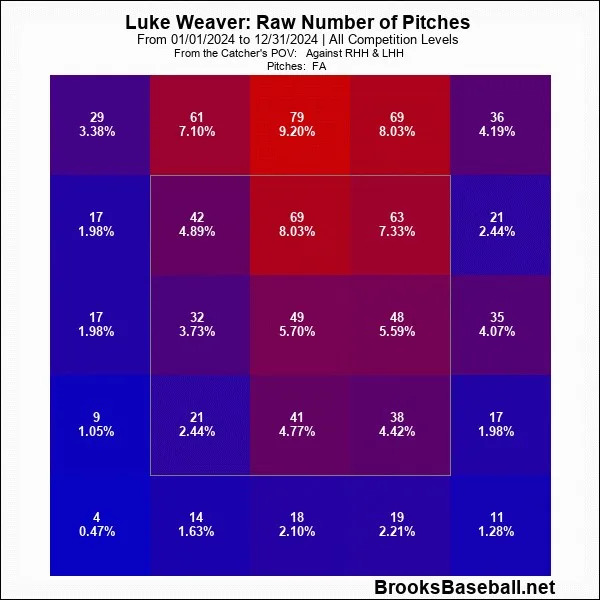
Hardly surprising. If you’ve got a high-ride fastball, you want to throw it up in the zone. Now here’s what that zone profile looked like prior to his 2025 hamstring injury:
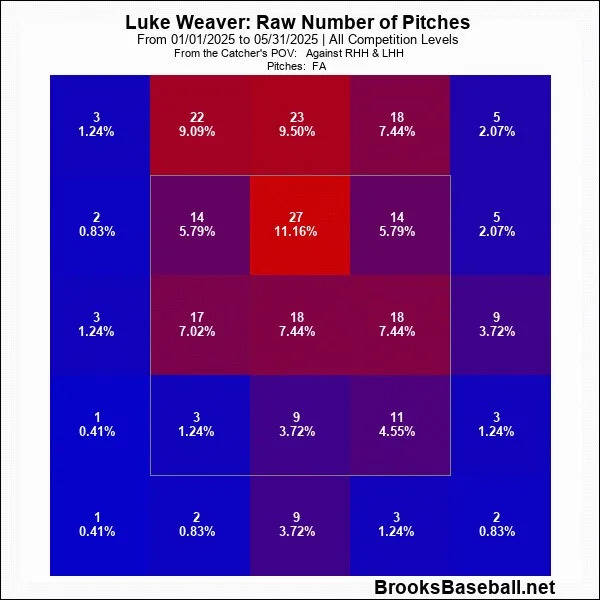
Not totally dissimilar, but you can see a greater number of pitches in the zone rather than above it. That trend got worse after Weaver returned from his hamstring strain:
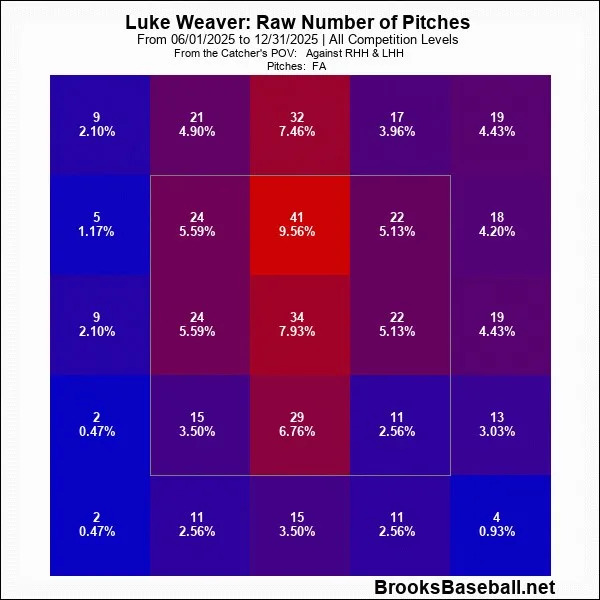
Doesn’t really matter how good your fastball shape is, throwing mid-90s right down the middle against major league hitters is usually a bad idea.
Advertisement
Put more quantitatively, Weaver’s Zone% on his fastball went from 50% to nearly 55%, matched by a similar Zone% increase across his whole arsenal. That’s something that’s hopefully correctable and potentially comes more easily with a healthy posterior chain. Combine that with bringing back the cutter and there’s no clear reason why Weaver couldn’t be more similar to his 2024 self than the 2025 iteration.
Hardly a conclusive analysis of course – there’s definitely risk here. We’re running into the fundamental problem of projecting relievers here, particularly non-elite ones, in that it’s largely a fool’s errand. Given that, it’s important to consider the broader market context. Weaver is not comparable to the top tier of arms (Devin Williams, Edwin Diaz, Robert Suarez), but fits comfortably into the second tier with Tyler Rogers, Brad Keller, and Ryan Helsley. Here’s what those guys have signed for:
Helsley – 2 years, $28M w/ an opt-out (Baltimore)
Rogers – 3 years, $37M w/ 4th year vesting option (Toronto)
Keller – 2 years, $22M (Philadelphia)
With the exception of Rogers (who has an inflated deal in large part because that’s how Toronto has to operate), Weaver’s contract is in-line with the rest of the market here. Both Helsley and Rogers got more, while Keller – who has the best case here as a better value contract – has all of one year of high-level success as a reliever. You can split hairs endlessly of course about preferring any arm over another, but the big-picture takeaway is that the Mets paid what looks like the low-end of the market rate for a good late-inning arm.
A good reliever signed to right-about market rate without guaranteeing term is a totally solid move, a necessary-if-not-flashy addition to build out the back of the bullpen. The Weaver signing receives a B+.