

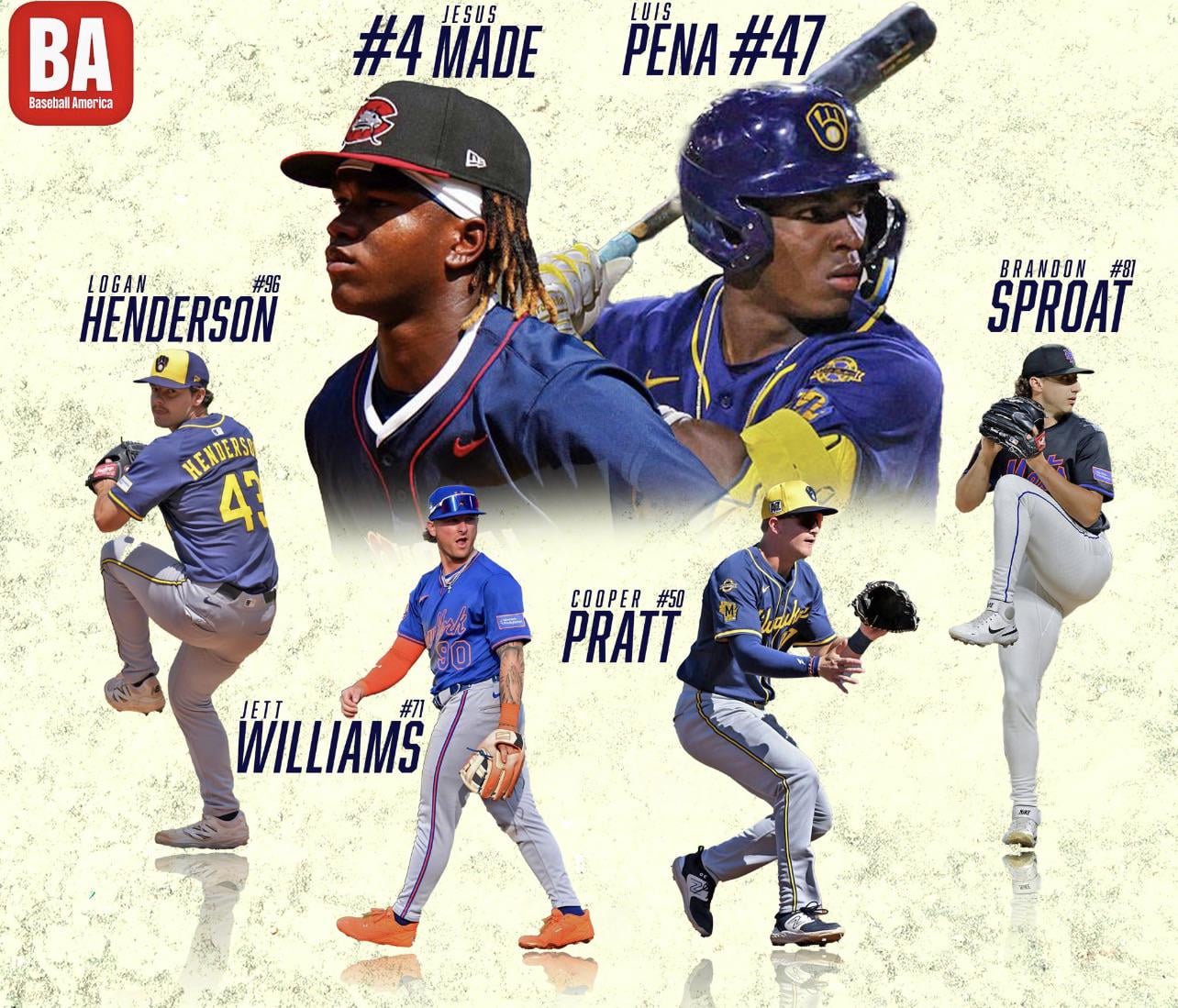
Can any experts tell me about these guys and what they bring and how the “farm” works
For some context, I started heavily watching baseball at the beginning of last season, I’ve been much more of a basketball and football guy until then, and I went in pretty blind when I did start watching baseball. Was very astonished on how the MLB drafts and prospects work, that you don’t get drafted and play for the team that drafted you… players instead go through all the minor leagues and such and most draft prospect never reach the MLB, so I’m very uneducated when it comes to potential brewers players in their farm system
Please help
12 comments
While I’m not gonna give a full spiel (Kawhi Leonard voice) I just wanted to add you do actually play for the team that drafted you just a minor league affiliate of theirs. It would be like if the NBA had 4 other levels below the G League and had 14 additional draft rounds.
These are all players that are playing in their minor league system. The ranking itself is of the players who are currently in the minor leagues (any league really) who projects to be the best players in the majors. To my understanding it’s important to know that some of these guys still won’t be playing on the Brewers for a year or two still that’s oftentimes referred to as a MLB ETA (or that’s at least how they say in on MLB the Show lol).
COOP!!!!!!
There are many different levels of competition in the minor leagues which players will move up when they show mastery of their current level. If starts with Arizona/Florida Complex League(ACL/FCL) or Dominican Summer League (DSL). Both leagues are roughly the same level of competition mostly for players right out of high school. The US based ones are for American players while the DSL is for international players. Then comes A ball, some college players will start here, then A+ ball. The jump from A+ to AA is considered the biggest jump in competition in the minors. AAA is the last step before the majors although these days it’s used more to stash veteran players than develop younger prospects.
Now a little bit about our top 6 prospects
Jesus Made is that dude. He’s only 19 and he’s flying through the minors and made it all the way to AA last year. He can hit for contact and power, he’s fast and his defense is good enough to stick at shortstop. There’s a possibility he gets a cup of coffee in the majors this year, but most likely you’ll see him in Milwaukee in 2027. He has the chance to be one of the best players in baseball.
Luis Pena is not quite on Made’s level but he’s close. He was on the same development track, but stumbled a bit in A+. He needs to tap into his power a bit more and there’s some question if his defense is good enough to stay in the infield. Despite all that, he has the chance to be a star for the Brewers.
Cooper Pratt has a good chance make the majors some time this year. He’ll likely start the year in AAA. He’s a very good defender at shortstop, but the bat might just be okay.
Jett Williams was just acquired in the Freddy Peralta trade. He’s only 5’7”, but has enough power to maybe push for 20 homers per season. He takes his walks and doesn’t strike out much. He’s fine defensively in the infield, but considering the depth and quality the Brewers have in the infield he may end up in Centerfield, which he still has some learning to do in. He got a little run in AAA last year, so you might see him midway through this next season.
Brandon Sproat was also in the Freddy Peralta trade. He’s a pitcher with a lively arm who had a cup of coffee in the majors last year. He can rev it up to around 100mph on his fastball and has a slew of breaking balls. There’s a high chance he makes the opening day roster.
Logan Henderson was used to make a few major league starts last year when we had pitching injuries or a long stretch of games without an off day. He was very good in his limited starts. He has a good fastball and change up, but he will need to develop his slider if he wants to stick as a starter. The Brewers have a lot of depth at starting pitching, so he may not make the initial rotation, but with his pitch mix he may work in a bullpen role for the time being.
A run down of the farm – there are multiple levels of the minor leagues that players going through, usually in succession but sometimes good players skip a level. It looks like this:
MLB
AAA
AA
A+
A
Rookie ball
The rookie level is a shorter season and anything A and higher is considered ‘full season’ ball.
Young players signed internationally like Made or Pena start at rookie ball typically because they’re usually like 17 years old. Because Made and Pena are so good, however, they advanced to A quickly.
Players drafted out of high school usually go to A ball and players drafted out of college usually go to AA but that all depends on skill level and none of that is a rule. Just explaining how things typically go.
Every jump from one level to the next is significant and AA is considered the first really advanced level. However the leap from AAA to MLB is absolutely massive – think skill level difference between like college football and the NFL. Lots of players get to AAA and never sustain themselves in the MLB (they’re jokingly referred to as AAAA players)
Every year there is an international signing period in January where teams are signing teenagers they’ve been scouting for years in other countries like the Dominican Republic and Venezuela. Those guys are wild cards usually because they’re so young
The MLB draft happens in July and is a draft of American players in high school and college. So those players are usually 18-24 and there’s usually more info on their scouting than the internationally signed prospects
The value of a highly ranked farm system is powerful for two reasons.
1. the likelihood of your future mlb roster being good is higher
2. you have assets to improve your current roster by making a trade
The Mets landed Freddy because they had a loaded farm where they could trade from a position of strength (many middle infield and pitching prospects).
The caveat of prospects is not knowing if players will actually be good. This is why if you hear people complain about Mark A hoarding prospects and not making “win now” moves. It’s fans wishing they’d take a risk by trading from their farm to improve today’s MLB roster. In a small market, the Brewers usually need to hoard as many prospects as possible and hope they end up producing in MLB.
There are 3 levels of minor leagues ( A, AA, AAA). The better a player performs as they progress through the leagues typically is used as an indicator for if they end up being a strong major league player.
From the list above, Jesus Made is seen as essentially a “can’t miss” prospect. People are just waiting for him to “graduate” the system before joining the mlb team (he’s only 18). He is seen as more of a “sure thing” than Chourio was, and Chourio was doing things in the minors that had scouts comparing him to Andrew jones, Griffey, etc (all time greats). Chourio was widely known for being a “can’t miss) as anyone the Brewers have ever had.
Long story short: the Brewers appear to be in a great spot for short and long term. The major league roster just won 97 games and the upcoming talent is one of the highest rated farms in the league. Three of those players will likely contribute this season (Henderson, Sprout, Williams).
The jewels of the system are Made and Pena.
Both the draft and International Free Agency are how you acquire new talent every year.
Both are very weird, and all you really need to know is that each team gets a set amount of money to spend. The Brewers tend to pay less to individuals, and spread that money around to as many guys as possible. All these kids are a crap shoot and the more chances you have, the better.
We do that, and we are very good at it.
The downside is that the guys that take that lesser money are less heralded, and tend to be projects. However, it kind of grows exponentially in that if you have that track record of turning those guys in to players, those guys are easier to sign.
We are currently at that point.
With that, we’ve also switched to signing only the youngest players possible because they’re even less heralded, more risky, and even more of a project… but with higher ceilings. Combining that shift to extreme youth with spreading the money around has resulted in the youngest minor league system in the modern game (I’m sure due to WW2 or child labor laws or something there have been younger in history, but not by much). Our A-ball team last year was basically U-18’s vs U-21’s.
It’s a pretty awesome time to be a Brewer fan.
If you want to really get into prospects, follow websites and scouting reports that really talk about risk and future roles, etc. Additionally I would recommend getting less into the flashy rankings (you could have a real argument about what top 100 means).
To get a really good grasp on this, go back in time and look at the Brewers Top 10 prospects for the last decade, and see how many of those guys are actually contributing to the team now. You can do the same with Top 100 lists. A lot of prospect stuff is hype, your goal is to cut through the hype.
One thing I haven’t seen mentioned is that high school players can get drafted by a team, and then they have to agree on a contract. If they can’t come to terms, or the player doesnt like the organization, they can instead go to college. At that point the MLB team loses their rights to the player, and the player goes back into the draft pool after college.
How is your health? Is your heart alright?
I hope Jett Williams gets Devin’s old number some purchase wasn’t a waste. 😂😂🤣
^in ^truth ^the ^only ^jersey ^I ^ever ^regret ^getting ^was ^Ben ^McDonald’s ^and ^I ^got ^that ^one ^for ^free
if you watch soccer/football the system is somewhat similar to how academies work – you get signed to the organization, and they try to develop you until they think you’re ready to play on their first team or they cut bait and let someone else take you. the difference being that a lot of these guys in the minor leagues stick around there through their early to mid 20s, whereas there wouldn’t be any point to doing that in soccer.
basically think of it as a way to develop players but also as a way to evaluate them and minimize the risk of bringing them up to the top level. you won’t get stuck with a guy who isn’t ready or at that level usually, because of how much flexibility there is in the system. it’s not perfect for those mid-tier prospects who spend their prime trying to prove themselves in the minor leagues because you don’t get paid a lot, the travel is a lot, and it’s not like you get any of the name recognition or other perks that being a professional athlete usually gets you. but it’s a job, and you may get an opportunity to move up to a higher level if you get lucky/are good enough. thats enough for a lot of these guys, not only because baseball is their whole lives/livelihoods in most cases, but also because the benefits are pretty solid if you ever actually get to the major leagues, even if for just a game (a cup of coffee, as the saying goes).
long story short – the farm system/minor leagues are a tool that franchises (meaning, not only the team of the brewers, but also their affiliated teams like the timber rattlers) use to manage investments in players in order to (hopefully) make better players to add in to their top team. guys can be young like Jesus made (18) or pretty old for professional sports like drew Maggi who was 34 when he got called up to the big leagues for the first time a couple of years ago. top players are usually younger and come through quickly, but there are players who don’t get called up until their late 20s who still end up being really good ball players.