
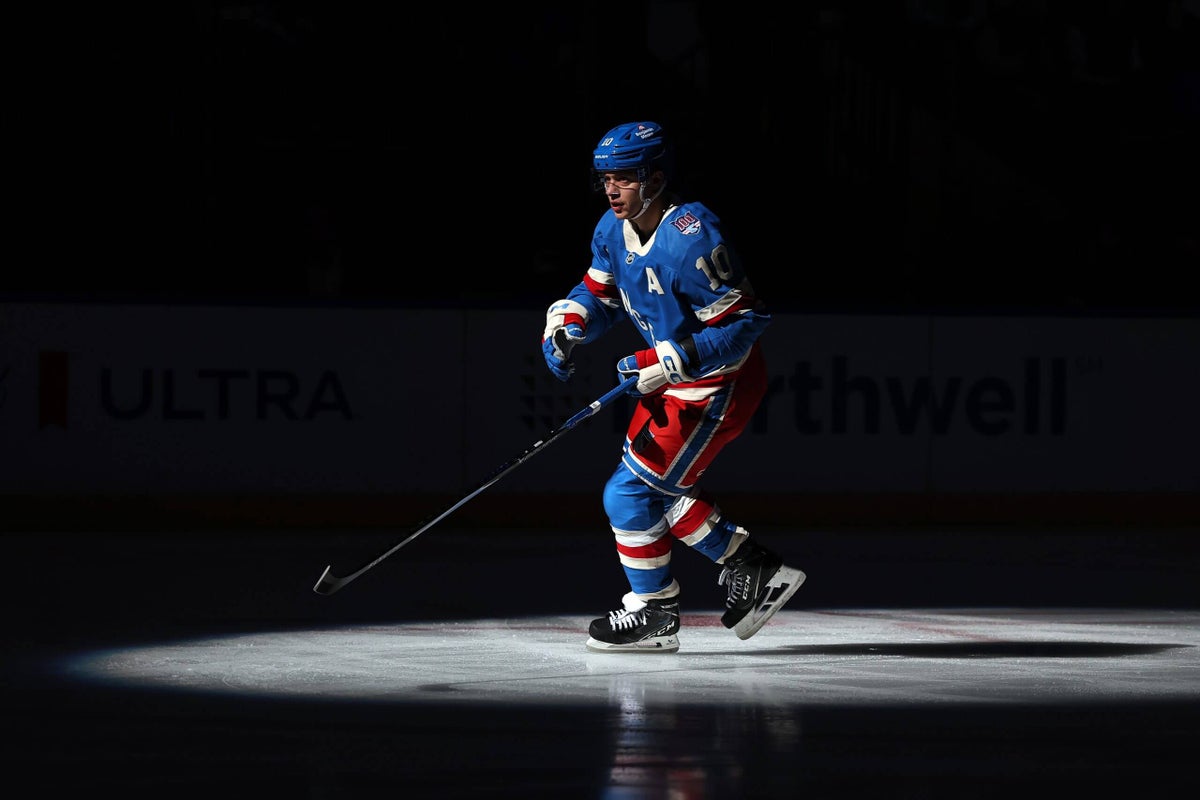
NEW YORK — It’s not hyperbole to label Artemi Panarin as the New York Rangers’ greatest free-agent signing.
After countless swings and misses from a franchise with a checkered history of chasing over-the-hill stars, particularly during the early-2000s — a list that includes Scott Gomez, Bobby Holík and Wade Redden, to name a few — they finally got one right when they inked the dynamic winger to a seven-year, $81.5 million contract in the summer of 2019.
The deal came less than a year and a half after the Rangers issued their original rebuild letter, sparking internal debate about the timing of such an aggressive splurge. But with Panarin signaling his preference to come to New York and willingness to take less money to get it done, they decided they couldn’t pass up on the chance to land the uniquely talented Russian.
It never resulted in the ultimate prize, but they came close a couple of times with runs to the Eastern Conference final in 2022 and 2024, while consistently icing one of the NHL’s most dangerous offensive threats.
Scoring has been an issue for much of the post-1994-championship era, which caused the Henrik Lundqvist-led Rangers to repeatedly fall short in the 2010s, but in Panarin, they found the elite gamebreaker who had eluded them for so many years.
Now that era has come to an end.
The 34-year-old was traded to the Los Angeles Kings on Wednesday in exchange for forward prospect Liam Greentree and a conditional 2026 third-round draft pick, ending a saga that consumed the NHL rumor mill for the last few weeks.
Panarin will leave New York sitting ninth on the franchise’s all-time list for points (607) and first in points-per-game (1.26) among qualified players. He led the Rangers in scoring each of his first six seasons and was on pace to do it again, with 57 points (19 goals and 38 assists) through 52 games at the time of the trade. He also finished top-five in Hart Trophy voting twice, including a 120-point campaign in 2023-24 that nearly broke Jaromír Jágr’s team record for a single season. That came after a disappointing first-round exit the year prior, prompting Panarin to use the self-described “empty” feeling as motivation throughout an exhaustive summer and show up to training camp with a shaved head. (He joked that he did it to save money on shampoo.)
It’s amazing to think Panarin went undrafted. Scouts were primarily concerned with his slight 6-foot build — that’s probably a generous measurement — but he overcame it with remarkable vision, dazzling hands and a level of creativity that perhaps no one in Rangers history can match. He sees plays that few others do, then has the deft touch to execute them as well as any player in the league.
Reaching that lofty perch required a dogged commitment to his craft. Former captain Jacob Trouba once described a scene to me that he would regularly find early in the morning at the MSG Training Center.
“I’ll look out the window, and he’ll be on the ice by himself, passing to nobody,” Trouba said at the time. “It’s like 7:30 in the morning, and he’s the only guy here.”
Panarin was visualizing situations that might arise in games and experimenting with different ways to manipulate the puck. That inventiveness led to some spectacular goals, but also inherent risk-taking. The latter was a constant source of give-and-take with coaches.
One of Panarin’s most memorable quotes came during the 2022 playoffs, when he told us, “I would love to do some stupid s–t on the blue line, but I can’t.” That was a direct message from then-coach Gerard Gallant, who wanted him to cut down on the costly turnovers.
Panarin’s freewheeling, perimeter style made him less effective in tight-checking postseason settings, where his point-per-game average dipped to 0.76 (35 points in 46 appearances) during his time with the Rangers. He was unable to will the team over the Stanley Cup hump, which stands as the biggest on-ice blemish on a resume that should merit Hall-of-Fame consideration, but pushing those playmaking limits is what makes him special.
It also makes him a joy to watch. From the moment Panarin arrived on Broadway, he captivated the Madison Square Garden audience with his skill and flair. Referees signaling for a power play made the arena buzz with anticipation. His signature high-kick celebration after scoring a goal became a crowd favorite. Fans started showing up with oversized loaves of imitation bread, a playful nod to his “Breadman” nickname.
Panarin embraced it with a combination of zeal and naivety that endeared him to the Blueshirts faithful. He savored the bright lights but never took himself too seriously. He’d tell you with a grin that he doesn’t understand English, then drop a one-liner that suggested he knew exactly what you were asking. And he wasn’t kidding about his Nokia flip phone. Many players say they don’t read their clippings or scroll social media, but it was genuinely true with Panarin, who came from humble beginnings in Russia and never longed for internet gratification. He might be the only professional athlete without a smartphone.
It became a running joke. Panarin was always willing to poke fun at himself or make silly gestures to help the locker room feel looser. Even in my most recent interaction with him, with all the trade rumors swirling, he pointed to a bag of dog food he was carrying to take home and quipped, “I bought the team lunch.” He greeted countless fans with the same humor and affability over the years.
Panarin married his goofy persona with hockey wizardry, making him a largely beloved Ranger, but his story is more complicated than that.
For all of the good times, his final two seasons in New York were filled with turbulence. The team’s underlying flaws came to the forefront during a calamitous 2024-25, prompting president and general manager Chris Drury to begin an arduous dismantling process that caused friction throughout the organization and cast several core players aside.
While Panarin watched popular teammates go and the Rangers sputtered to the finish line last April, a report from The Athletic called into question the character of the team’s most likable personality.
It revealed that Panarin and Madison Square Garden Sports, the company that owns the team, paid financial settlements to a Rangers employee in August 2024 after she alleged that Panarin sexually assaulted her. Both MSG and the accuser, who was later placed on paid leave for sharing anti-anxiety medicine with a player and eventually left the team after signing non-disclosure and no admission of wrongdoing agreements, issued identical statements reading: “The matter has been resolved.” The NHL echoed that sentiment, noting that the Rangers “retained an outside law firm to conduct an independent investigation, which the League was fully apprised of.”
The league and the team declined to say whether Panarin was subject to any discipline, nor did they share the findings of the investigation. Panarin also repeatedly declined comment. The lack of transparency left an unresolved stain, adding a layer of complexity to an otherwise indelible tenure.
While all parties involved tried to sweep the allegations under the rug, the Rangers continued to crumble. The downfall culminated on Jan. 16, with Drury releasing a letter announcing plans to “retool” a depleted roster and informing Panarin of their intention to move on. The decision hit Panarin hard, dashing any hopes of finishing his career with the team he handpicked less than seven years earlier.
The Kings gave him 22 million reasons to get over it — the total dollar value of his new two-year contract extension — leaving Rangers fans as the ones who truly got the raw deal. Panarin gave them a long-awaited star and provided many great memories, cementing his place as one of the best and most entertaining players in franchise history. But his final chapter was both disappointing and unceremonious, casting a shadow over a legacy that seemed destined for a happier ending.