
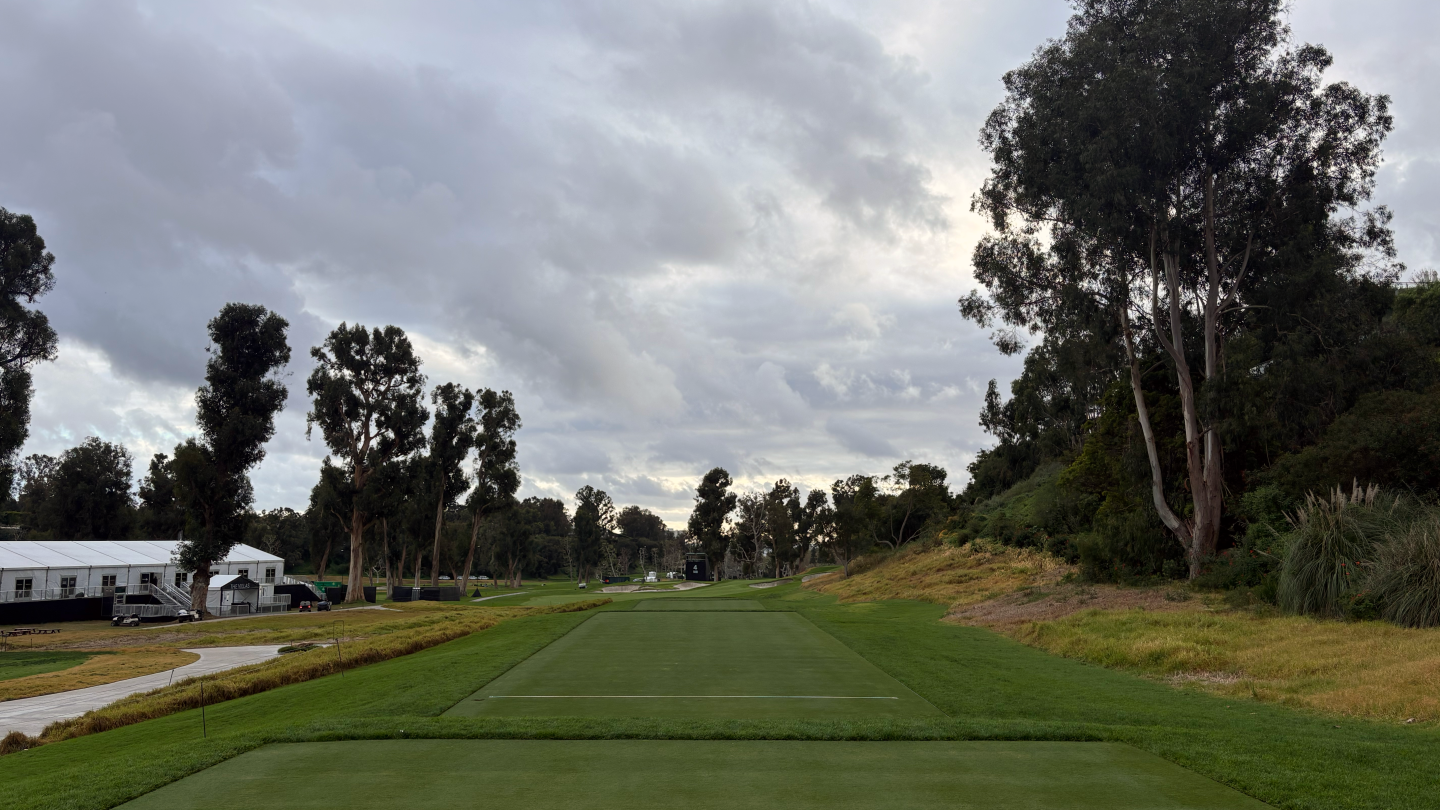
LOS ANGELES – Ben Hogan once called it, “The greatest par-3 hole in America.”
Now, it’s the longest par-3 on the PGA Tour.
Riviera Country Club’s par-3 fourth hole, George Thomas’ take on the famed Redan hole at North Berwick, was lengthened nearly 40 yards, from 236 to 273 ahead of this week’s Genesis Invitational.
That new yardage pushes No. 4 past Puntacana Resort’s 265-yard 11th hole as the longest among regular Tour stops. Since 2003, only Cherry Hills’ eighth hole has been longer, playing 276 yards for the 2014 BMW Championship.
The concept of the Redan is a hole that requires a longer club to a green set at a 45-degree angle that slopes front to back. There is typically a large bunker in front of the green, another, more penal bunker behind the green, and a big, kicker slope that helps feed balls toward middle and back hole locations.
The recent changes to Riv’s No. 4, which were done under the direction of both the USGA and the club, not only saw added length, but the tee box was moved about 30 yards right to accommodate the new tee box for No. 18. This shift eliminates some of the classic Redan angle, though there was a thought that moving the tee laterally, along with some modifications greenside, would help promote more ball movement on the ground. But as Rico Hoey, a Riv member while at USC, noted, the kikuyu rough and soft conditions around the putting surface (this week especially) continue to hinder the true Redan style.
A source with knowledge of the project said that the USGA, which will bring the U.S. Women’s to Riv this summer and the U.S. Open in 2031 (the 2028 Olympic golf competitions will also be played there), also requested the grass on the approach to the green be changed to something more conducive to bounce, but ultimately that was not part of the final plan, nor were options to raise the tee box or steepen the slope.
“I’m not sure it’s going to change much,” said Jordan Spieth, who led Texas to the 2012 NCAA Championship at Riviera and has two top-10s as a pro on the layout. “Instead of a 2-iron or hybrid, you’re hitting 3-wood. It was always kind of a crapshoot if you were going to hit the green anyway. … It’s the only weak spot on the course, in my opinion, but it’s just this time of year. When we played the national championship (in late May), you could land a 4-iron on the right and have a chance to funnel the ball back there.”
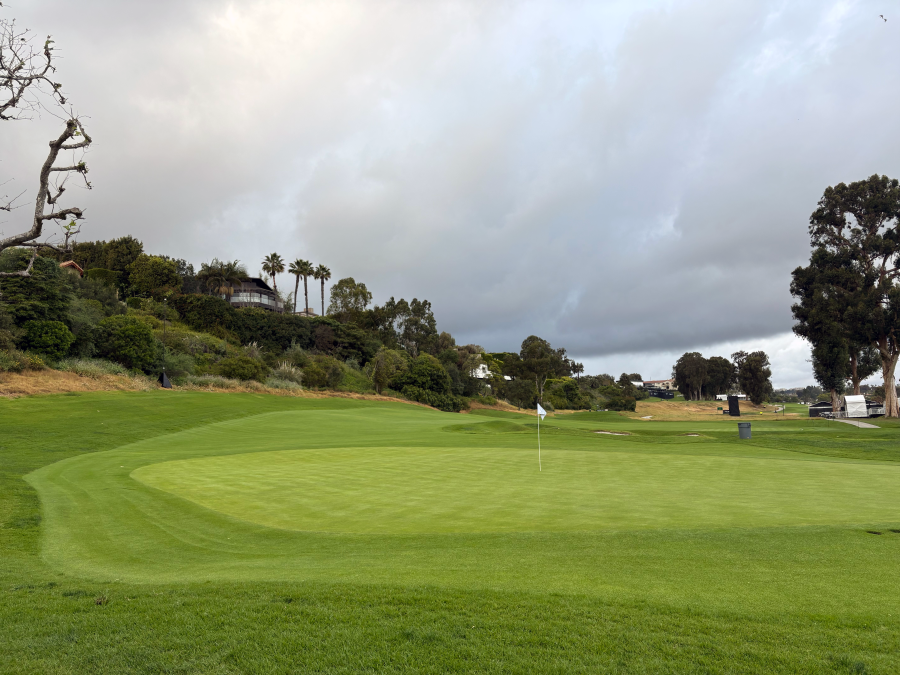
Two years ago, the last time Riv hosted the Genesis, No. 4 played 0.204 shots over par, ranking it third toughest for the week. It yielded just 11 birdies, while the pros hit the green just 15% of the time and played it to a combined 49 over. Surprisingly, there were no doubles made.
Typically, what makes the hole most challenging is that the greens are Tour-level fast and firm, so tee shots landing on the green have difficulty holding.
“If you want it to be a 275-yard par-3, you have to change the apron leading up onto the green,” Rory McIlroy said. “It can’t be kikuyu, it has to be another type of grass that can help you run it onto the green because again, in the right conditions, you try to fly that ball on the green with a 3-iron, it’s going to finish up on the fifth tee box.”
This week, however, even with guys hitting lumber in – Hoey hit mini-driver into the wind late Tuesday with the hole playing about 270 – the rains have made conditions receptive enough to allow hope for hitting and holding the green on the fly.
Still, that probably only negates the distance gain and doesn’t make things any easier.
“Too long,” Nico Echavarria said. “It’s just unnecessary to have a par-3 that long.”
McIlroy, above all, didn’t mince words: “I actually think it’s a horrible change.”