
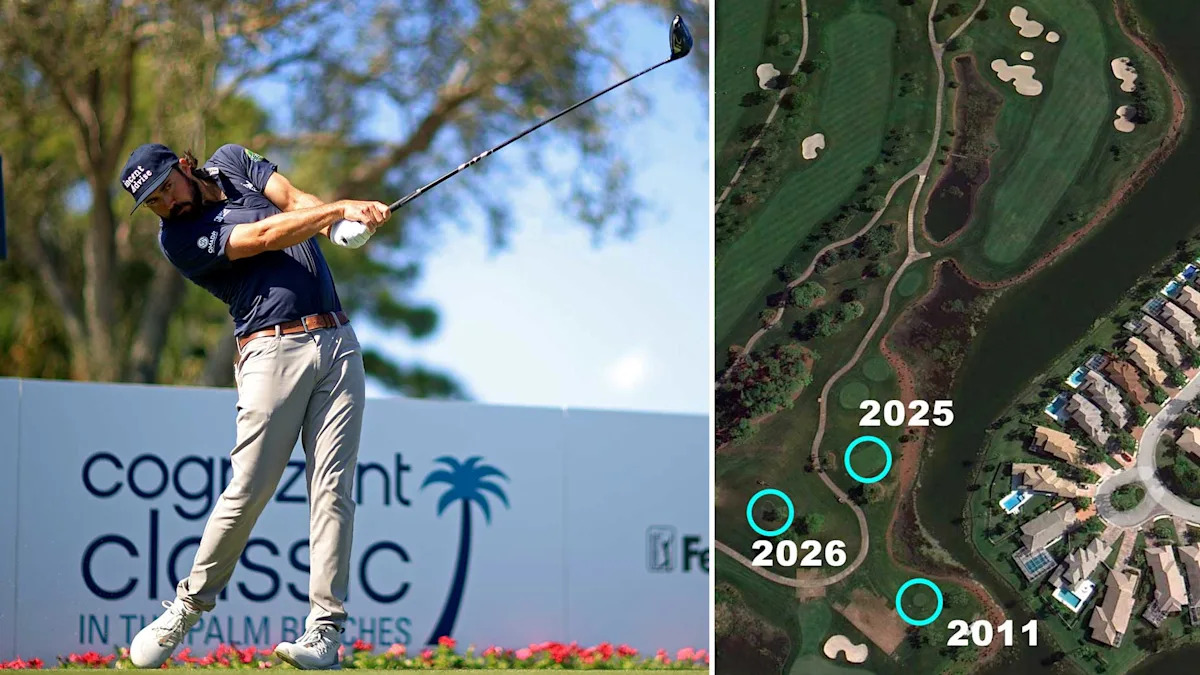
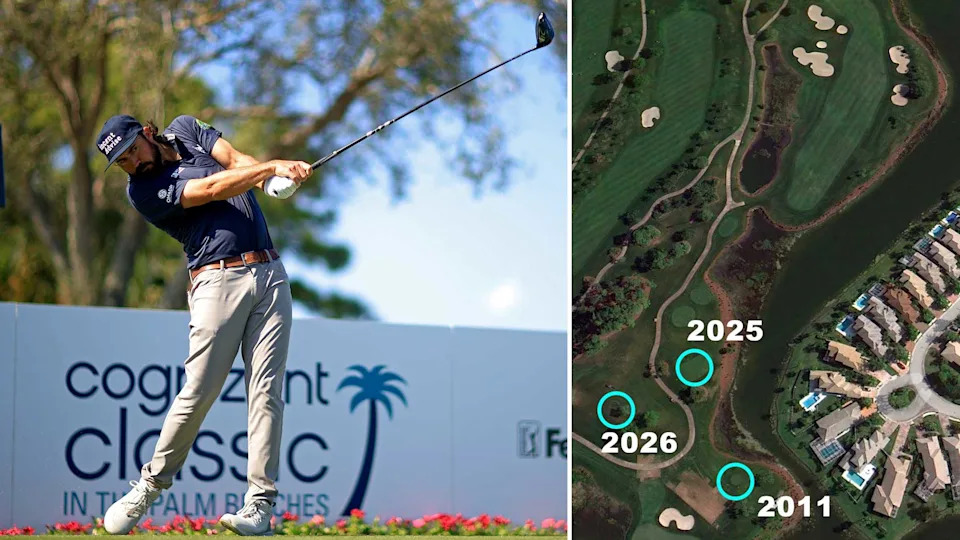
The history of shifting teeing grounds (right) for the 18th hole at PGA National.Getty Images
Despite a life built in journalism, the arts, the humanities and fashioning myself — please forgive — as a creative, at my core I’m a numbers guy. I think best through the lens of digits, decimals and bell curves. Yes, I greatly enjoy seeing brilliance inside the ropes at a Tour site. But I also really love sitting in Mark Broadie’s university office talking about various skillset Z-scores of the 104th-ranked player in the world.
Advertisement
All of which makes it so hard for me to look past some of the golf course conversations of the last week. Two tracks that host the PGA Tour this month — The Riviera Country Club and PGA National’s Champion course — both had to make multiple changes to the scorecard ahead of the tournament. And can you guess which direction those changes moved?
Longer. Of course, longer! Always longer. (Fifty-six yards longer this week!)
Such is the way of pro golf at the highest level this year, last year, next year and every year for decades. Changes in equipment, fitness, strategy, course setup, etc., have almost exclusively forced Tour players to play this game as long as they possibly can. The story isn’t new. The direction is never shorter.
So let’s dive into this week’s changes at the Cognizant Classic. For starters, the 2nd tee at PGA National has increased in size and been lengthened by 20 yards, tipping that par 4 out to 484 yards. It played to a 4.1 average last year, with the premier strategy being to draw a driver and set up a short iron. The alternative would be laying back with a 3-wood to a mid-iron approach.
Advertisement
With an extra 20 yards on the card, will the 2nd play more difficult? Maybe just a touch. But optically, this is a great example of how golf course setups start to swallow golf course property bit by bit. As you can see in the image below, a red star has been placed at last year’s teeing ground, and a blue circle reflects the new teeing area, situated more directly behind the 1st greenside bunker.
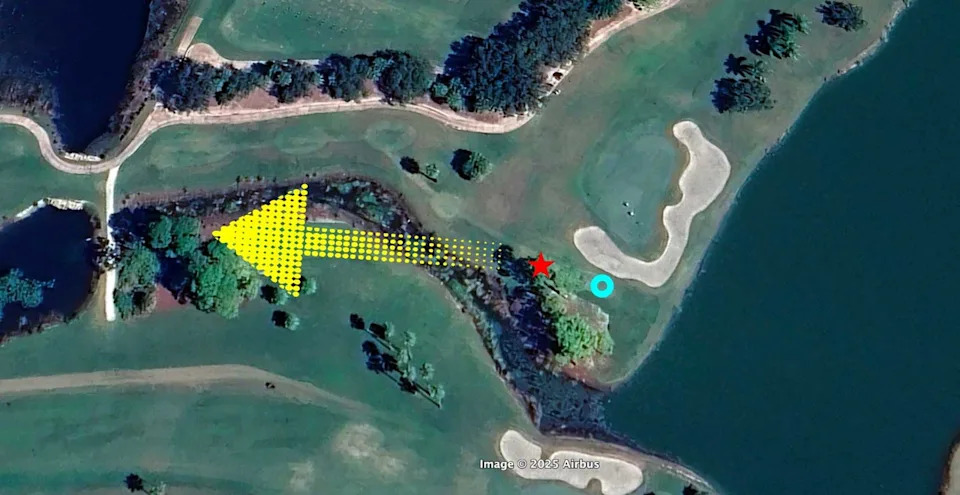
The 2nd hole will play 20 yards longer during this week’s event. Google Earth
Can we comfortably call the 2nd hole fully maxed out now? Or will the future call for a teeing ground that extends into the hazard like a peninsula? Who is going to build that dock? This longer, longer, longer pursuit has seemed to reach its peak on the 2nd hole. But how does that impact the 1st? Will it force players to pause in the 1st fairway as they wait for competitors, caddies and volunteers to shuffle into place around the 2nd tee, with it directly in their eyesight approaching the 1st green?
These are the questions we can ask on GOLF.com, hoping only that the people making these decisions ask those questions, too. (Leaving the discussion on equipment rollback aside, of course.) Let’s move to the 18th.
Advertisement
The finishing hole at PGA National has also been lengthened this year, adding an extra 36 yards and tipping the par 5 out to 592 yards. It has routinely played around 556 yards over the last 14 years, with players averaging between 4.49 and 4.78 strokes in the last six years. It is, by par, one of the easier holes on the course. But does that mean it should get longer? We ask, again, because Joe Highsmith’s 26-under won the tournament a year ago in record-breaking fashion.
As a proxy, the 18th hole can stand for so many of the talking points around course setup of a PGA Tour event. When it has played soft, the longest players can reach the green in two with irons in hand. One path toward eliminating that trick would be to firm up the course and not overseed it in pursuit of a green-green-green aesthetic.
“It’s going to play easier than I prefer,” Shane Lowry said Wednesday ahead of this week’s event. “It’s going to look great on TV, lovely and green. But I probably would like to see a bit more of the old traditional setup. I like that the rough is a bit thicker this year.”
Another path to making the hole play more difficult is, as ever, simply adding length. Though it’s not the only path, it’s the one the Tour and PGA National have landed on, building a new tee box in an area where a hospitality entrance existed last year. This new course setup very literally is causing tournament operations to shift things around, which you can see in the image below.
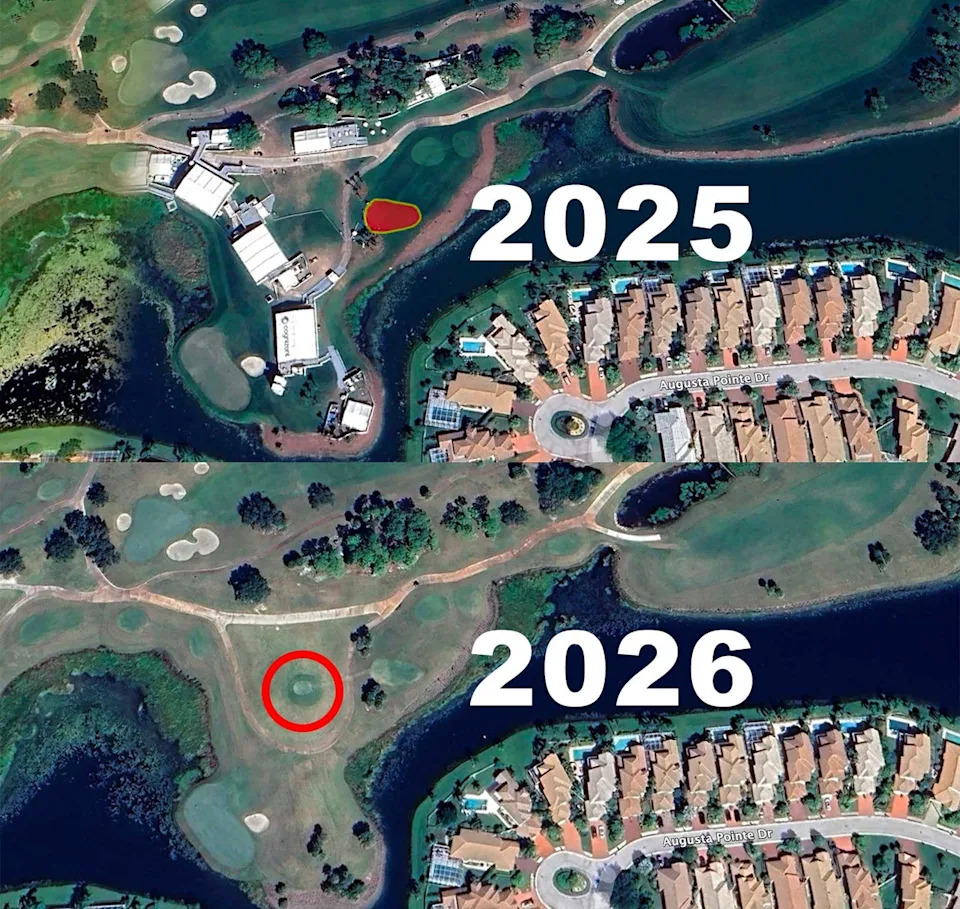
The 18th hole will play 36 yards longer this year. Google Earth
To that end, the hole will unquestionably play to a higher scoring average this year. We can say so because there’s some evidence from the earliest days of this tournament. The 18th at PGA National actually used to play to 604 yards back in the 2000s and early 2010s. In 2011, players averaged 4.99 strokes on the 18th, thanks to a tee that had been pushed out onto a peninsula. Again, that land is now commandeered by hospitality infrastructure.
Advertisement
Given all that, it’s fair to ask, is this the longest the 18th hole will ever play for Tour events? Yes, it is likely maxed out now. There is nowhere else to go, which has become a far too common six-word refrain regarding staging pro golfers. The 17th tee on the famous Road Hole at St. Andrews was pushed backward across a walking path for the 2022 Open. The 14th tee was pushed back off the property of the Old Course, too, and onto the edge of the Eden Course. Longer, longer, always longer. Just like last week.
Already one of the most difficult par 3s on the PGA Tour, the 4th at Riviera Country Club pushed players back to 273 yards for last week’s Genesis Invitational, nearly 40 yards longer than the previous time it was played in 2024. What was a plenty difficult hole at 236 yards — playing to an average of 3.2 in 2024 — had, you guessed it, nowhere to go backward! Lengthening it as is would have run into the teeing ground of the 18th hole rather quickly, as you can see in the images below. Instead, Riviera cut into the hillside beneath its mega-million-dollar neighbors and fashioned five brand new tee boxes in a straight line alongside the 18th.
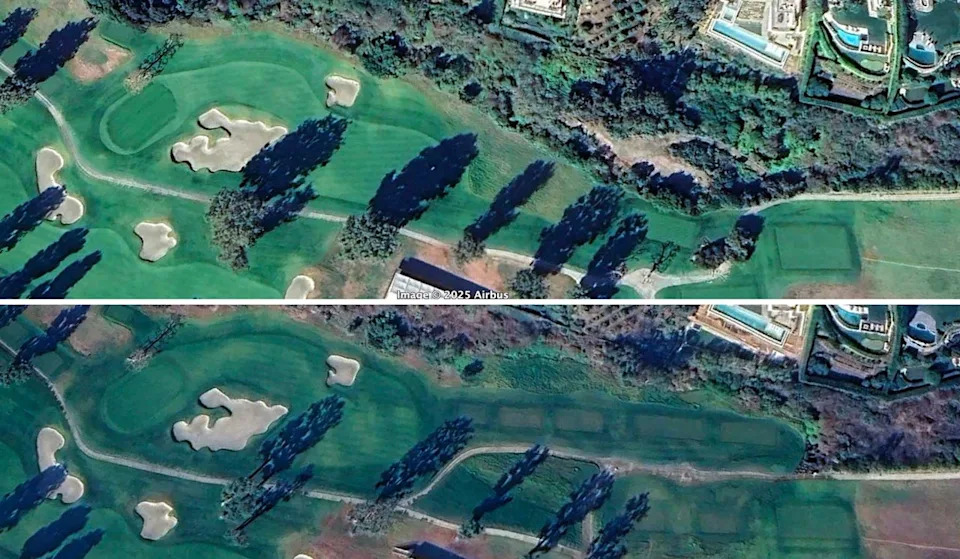
The bottom half of the photo illustrates the current version of Riviera CC below what it looked like in 2024. Google Earth
How did that suit the players last week? The hole bounced between 220 and 262 yards during the event, but with soft, wet conditions, the scoring was largely unchanged: 3.11. Players attitudes, however, mostly dipped.
Advertisement
The real takeaway may rest in the event’s timing. Played during the winter, the conditions of the grass surrounding the green can be a bit softer and grabbier than what many would prefer. In July and August, per se, Riviera should play a lot firmer, and thus the run-up area to this redan hole would allow for greater creativity and shot-making. As well as greater punishment for poorly struck shots. The good thing: we’re about to see that play out a lot. Riv will host the U.S. Women’s Open in June, the Olympics in August of 2028 and, if the Genesis Invitational moves around on the PGA Tour calendar, possibly in many summers of the future.
The post For second straight week, PGA Tour course moves in troubling direction appeared first on Golf.