
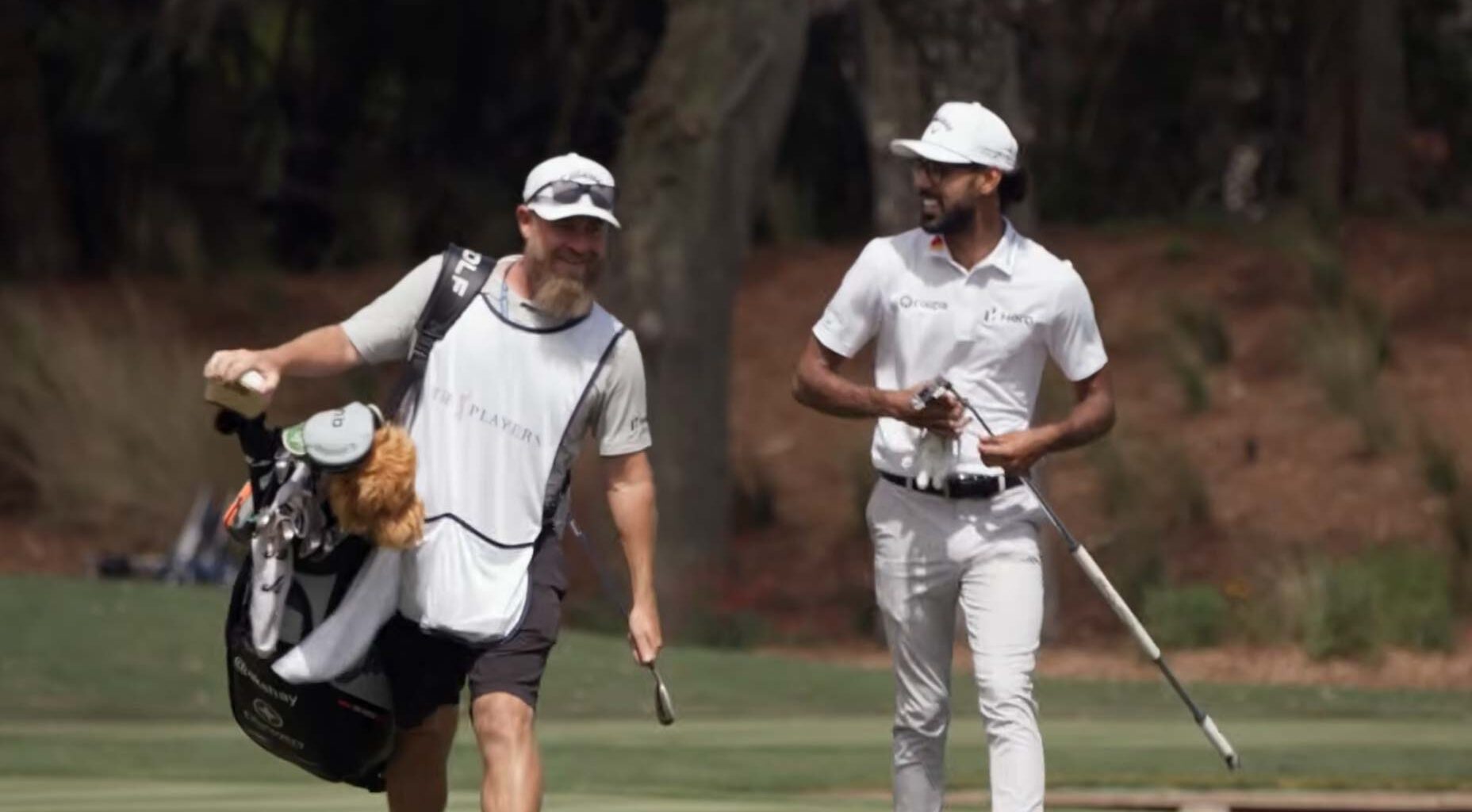
There’s a meaningless golf shot late in the PGA Tour’s brand-new Players Championship film, Chasing Sunday, that illustrates and encompasses its brilliance.
The shot serves as the off-ramp from a montage of final-round failure and self-flagellation from its four mic’d-up main characters. It’s a break from their collective downward slide; the show’s pace suddenly slows to allow one of its longest continuous scenes to play out.
A golf ball belonging to Akshay Bhatia lands on top of a ridge bisecting the green of the par-3 13th. It catches the correct side of that ridge, takes the slope, picks up speed and zips down towards the cup, just skirting by before settling in kick-in range.
Bhatia’s caddie Joe Greiner — who’s an absolute show-stealer from start to finish, in a good way — walks off the tee well ahead of his player, saying nothing but thrusting both hands in the air, a moment of pure joy amidst the slow-motion rollercoaster that is 72-hole stroke-play golf. Behind him, Bhatia is giddy.
“What a freaking shot, man. I mean, exactly how I saw it,” Bhatia says, racing to catch up with his looper. “Like — absolute greatness right there.”
“At this very moment, could you love golf any more?” Greiner asks, practically floating. “Than this one second? After doing something like that?”
Bhatia brings them back to earth. “Uh, yeah. I could have made it.”
In the context of who wins the biggest PGA Tour event of the 2026 season, this moment of greatness is meaningless. But in the moment it feels raw and real and honest, a genuine turning point in his round, which combines with two more late birdies to help Bhatia secure a T13 finish. That’s a lucrative and impressive and praiseworthy position — it’s just not traditionally the focus of an hour-long film.
“>
That’s the brilliance of Playing Sunday, though. Its guiding principle appears to be trust. Trust that the golf will be enough, that the access will be enough, that with the right players and the right caddies plus about a thousand of the greatest cameras in the world, you can make T13 interesting, and T42, and T50, and T56. That’s where our four mic’d-up golfers finish — Bhatia, Rickie Fowler, Si Woo Kim and Chris Gotterup, respectively — but watching them get there just two days after the real thing is an absolute treat.
(One point of objection before I go further: The title. All-caps “NO FILTER, MIC’D UP AT THE PLAYERS” feels sort of like the Tour shouting at the algorithm. Trust your best stuff! I understand we’re all shouting at the Great Algo one way or another, but in this case…)
The little stuff is the big stuff. That’s mostly what I mean by trust. What makes this behind-the-scenes movie work is the belief that what is at its core is something multidimensional and fundamentally interesting. That this event is coproduced by NFL Films is somewhat ironic; did it take pros from another sport to help the Tour believe that golf is interesting enough on its own? However they got there, it’s terrific, exactly what golf fans have been asking for for years, since the invention of the NFL’s mic’d up segments or Hard Knocks TV show. And now it’s here.
If I sound as giddy as Bhatia that’s because I love seeing how this all works. Hell, I started a show just so I could ask these guys how it all works. But this is even better because they’re not being interviewed, they’re just being. And that’s how we get micro moments of micro tension. Bhatia’s wife has his sandwich somewhere in the crowd — will Greiner be able to track her down? Kim’s looking to repair a ball mark on the border between green and fringe; is he allowed to do so? There’s a restraint to the whole thing, a minimalism, a sense that you’re watching these guys as they actually are, which makes doing so immensely satisfying.
“Real” is, on its own, no guarantee of success. The who and the how matter tremendously, too. The cast of characters is an important starting point; the ensemble of Bhatia-Fowler-Kim-Gotterup is a good mix of youth and wattage.
The caddies are important connective tissue, too; Greiner and Ricky Romano (Fowler’s caddie) and Manny Villegas (Kim’s) and Brady Stockton (Gotterup’s) strike up conversation, lighten the mood, help draw feelings and intentions and precise golf shots out of their respective players. I found the entire thing to be an incredible reinforcement of just how important the right caddie can be — there’s no one way to be a good caddie, and every player’s needs are different, and whether or not a caddie’s in there for a green read, that person serves as an extension of your brain, there to help and challenge you; that’s a powerful position.
There are elements of hope and luck in choosing four players to spotlight from a field of 123. In some ways producers got unlucky that their marquee players weren’t in the mix come Sunday; you can imagine the drama of Ludvig Aberg being mic’d up as he hit back-to-back water balls as he yielded the final-round lead, for instance, or Cameron Young and Matthew Fitzpatrick mic’d up as they dueled down the stretch.
But in other ways they got lucky, particularly with their weekend pairings; we got secondhand access to the tournament’s biggest stars and defining moments.
Take Kim, for instance. For the first two rounds he was paired with Aberg and World No. 4 Collin Morikawa, whose back-injury WD was arguably Thursday’s biggest story; we get to see the entire scene play out, painful and then uncomfortable.
“It’s kind of awkward. Like, I don’t know what to say,” Aberg says as Morikawa is driven up in a cart to officially announce his round is over just two swings in. (“Get well, man,” Aberg offers, which seems about right.)
Kim also gets paired with Scottie Scheffler on Saturday; the two are frequent sparring partners at home in Dallas, so this is a good chance to get a snippet of the World No. 1 away from a press conference setting.
“Are you guys besties?” asks Scheffler’s caddie Ted Scott.
“He doesn’t accept it,” Kim says glumly.
Fowler gets paired with Jordan Spieth, which means he gets to walk alongside as Spieth delivers a monologue on the virtues of the mini driver as the perfect club to hit off the 18th tee. This show doesn’t shy away from spin rates.
And then there’s the revelation of the show, as Bhatia realizes in real time that Brooks Koepka, five-time major champ and reinstated PGA Tour peer, doesn’t use a yardage book at all. He’s eager to share that bit of news with Greiner.
“Do you know another player that doesn’t carry a yardage book?”
Sure, Greiner says. J.T. Poston. But as he says it he realizes that Bhatia is being literal, which leads to this.
Greiner: “Oh, he doesn’t even have the book.”
Bhatia: “He doesn’t even have it.”
Greiner: “I love it. That’s how I think I would play best. [Pause.] Doesn’t even have one.”
Bhatia: “I was like, ‘You don’t even carry a book?’ He goes, ‘Nah.’”
Greiner: “That is remarkable.”
And in the very next scene Greiner sidles up alongside Koepka’s caddie Ricky Eliott. Greiner is earnest and curious and remarkably engaged; he’s a fun guy to talk to, so he’s an excellent sidler.
Greiner: “So he doesn’t ever carry a yardage book?”
Elliott: “No. Never has.”
Greiner: “So what does he, like, ask? On this hole, is he just like, ‘Driver?’ And you just say yes?”
Elliott: “I say to him, ‘You f—- like driver up there, do you?’ He goes, ‘Yeah.’”
That’s the beauty of watching golfers talk about golf and about other golfers. We see in real time: there’s more than one way to do it.
But it’s not all machismo and yardage books.There are moments of real vulnerability sprinkled in.
“God, I’m so bad. I’m the worst player in the world,” Kim says at one point. And golfers will recognize themselves in Chris Gotterup’s style of self-talk, which is relatable and endearing but borders on despondent throughout.
“I’m just having a hard time,” he tells the even-keeled Stockton at one point. “Everything just feels off. I’m trying to hit a hard draw, it cuts. [Pause.] Alright. Up and down.”
It’s that final four-word reset that makes him a pro.
So let’s do this every week, eh?
Probably not. None of this happens by accident, particularly on this timeline; the video’s Tuesday 9 p.m. ET release meant just over 48 hours from the end of the tournament to publish. There is an unthinkably large team involved in making things happen. I scanned the closing credits and counted 265 names — two hundred sixty-five! — involved in its production. The fact that that many people were involved and somehow nobody overstepped to muck it all up is remarkable and encouraging.
There’s a reason this feels bigger than just a video. New PGA Tour CEO Brian Rolapp has been eager to push the envelope, to reshape the schedule, to make every event the Tour plays feel bigger. But if this video is any indication, he wants to do so by doubling down on the golf and the golfers. There’s not an influencer to be found, the action barely spills outside the ropes and they only address the actual tournament result in the final few minutes.
They trust that the golf is enough. They treat it as a big deal. They treat the details around it as a big deal, too. And because they do, we’re more likely to do the same.
Dylan Dethier welcomes your comments at dylan_dethier@golf.com.
“>