

Tristan H. CockcroftApr 22, 2026, 10:15 AM ET
CloseTristan H. Cockcroft is senior writer for fantasy baseball and football at ESPN. Tristan is a member of the FSWA Hall of Fame. He is also a two-time LABR and three-time Tout Wars champion.
Multiple Authors
Happy draft week, everyone!
Wait, what’s that? Oh… so my editor tells me that all the draft chatter this week pertains to the NFL draft. Whoops, my mistake.
Editor’s Picks
2 Related
But — hold on — why should footballers get to have all the fun? We fantasy baseballers love a good draft as much as the next person, and simply because most of us completed our drafts four short weeks ago doesn’t mean we can’t appreciate — or even reminisce about — the excitement of draft day. (Heck, if you’re really gung-ho with draft excitement, you can still draft a brand-new ESPN fantasy baseball team right now!)
With that in mind, I thought: What if, today, we all were granted a “do-over,” a chance to completely redraft our teams? How much would really have changed with our player valuations in what has been only 28 days of action (or 15% of the 184 days with scheduled MLB regular-season games in 2026)? And where our valuations have changed, are we truly on the right track with the changes we’d have made?
To find out, I informally polled ESPN fantasy staff, as well as compared ESPN league ADP (average draft position) data over the past seven days to that from the preseason’s final weekend (March 21-22) — the most popular for drafting — to see which players have moved the most. The nine players examined below stood out most.
Before we get to them, however, let’s first take a look at how my top 25 overall players for points leagues have changed compared to that same March 21-22 weekend. I’ve included notes for those where their ADP has also significantly since shifted.
(All stats, ADP and roster rates are through Monday’s games.)
Shohei Ohtani (no change)
Aaron Judge (no change)
Tarik Skubal (up from 6th)
Jose Ramirez (up from 7th)
Juan Soto (down from 3rd)
Paul Skenes (down from 4th)
Bobby Witt Jr. (down from 5th)
Cristopher Sanchez (up from 12th; ADP has gone from 18th to 12th)
Kyle Tucker (no change)
Ronald Acuna Jr. (down from 9th)
Garrett Crochet (down from 8th)
Vladimir Guerrero Jr. (up from 24th)
Fernando Tatis Jr. (no change)
Bryan Woo (up from 20th)
Corbin Carroll (up from 17th)
Yoshinobu Yamamoto (up from 19th)
Mason Miller (up from 37th; ADP has gone from 36th to 27th)
Yordan Alvarez (up from 30th; ADP has gone from 29th to 20th)
Ketel Marte (down from 11th)
Logan Gilbert (down from 16th)
Junior Caminero (down from 15th)
Max Fried (up from 27th)
Gunnar Henderson (down from 18th)
Kyle Schwarber (up from 26th)
Jesus Luzardo (up from 31st)
Falling out of my March 21-22’s top 25: Cal Raleigh (14th), Hunter Brown (21st), Manny Machado (22nd), Julio Rodriguez (23rd), Logan Webb (25th).
 Michael Busch, 1B, Chicago Cubs
Then: 149th pick overall (175.1 ADP, rostered in 68.6% of ESPN leagues)
Now: 185th pick overall (223.9 ADP, rostered in 44.3%)
Start a free fantasy baseball league

The 2026 fantasy baseball season is here! Get the gang back together, or start a brand new tradition.
Start or reactivate a league >>
A standard league go-cheap choice at first base, after he added 6% to his Barrel and 7% to his hard-hit rate last season, Busch has given back all of his 2025 gains and then some this year. His already below-average bat speed has slipped into the fifth percentile, having lost a shocking 2.2 mph in that department. Additionally, his hard-hit rate has plummeted to the 10th percentile and he’s hitting grounders more than half the time he makes contact.
The Cubs have been remarkably patient with him nevertheless, and while Busch’s numbers have almost nowhere to go but up, the team could soon consider giving Matt Shaw or Carson Kelly more looks at first base. Busch’s valuation drop-off is appropriate, from late-rounder to an (ESPN) undrafted wait-and-see.
 Oneil Cruz, OF, Pittsburgh Pirates
Then: 130th pick overall (155.0 ADP, rostered in 78.4%)
Now: 104th pick overall (139.2 ADP, rostered in 90.3%)
Among my worst moves so far this season was my preseason bet with a longtime points-league rival of mine — OK, let’s call him “Bro Stat” — taking the Jackson Chourio side over Cruz. It’s not that I dislike Cruz as he’s been a staple of one of my roto keeper leagues, but his penchant for strikeouts and occasional bumps and bruises make him ill-fitted for points play. Cruz’s offseason work to improve his performance against lefties (.393/.433/.786!) has paid off big-time, justifying what’s been an effective 2-3 round valuation bump. Go ga-ga in roto leagues, but in our game, a 30%-plus whiff rate precludes his vaulting into the game’s elite.
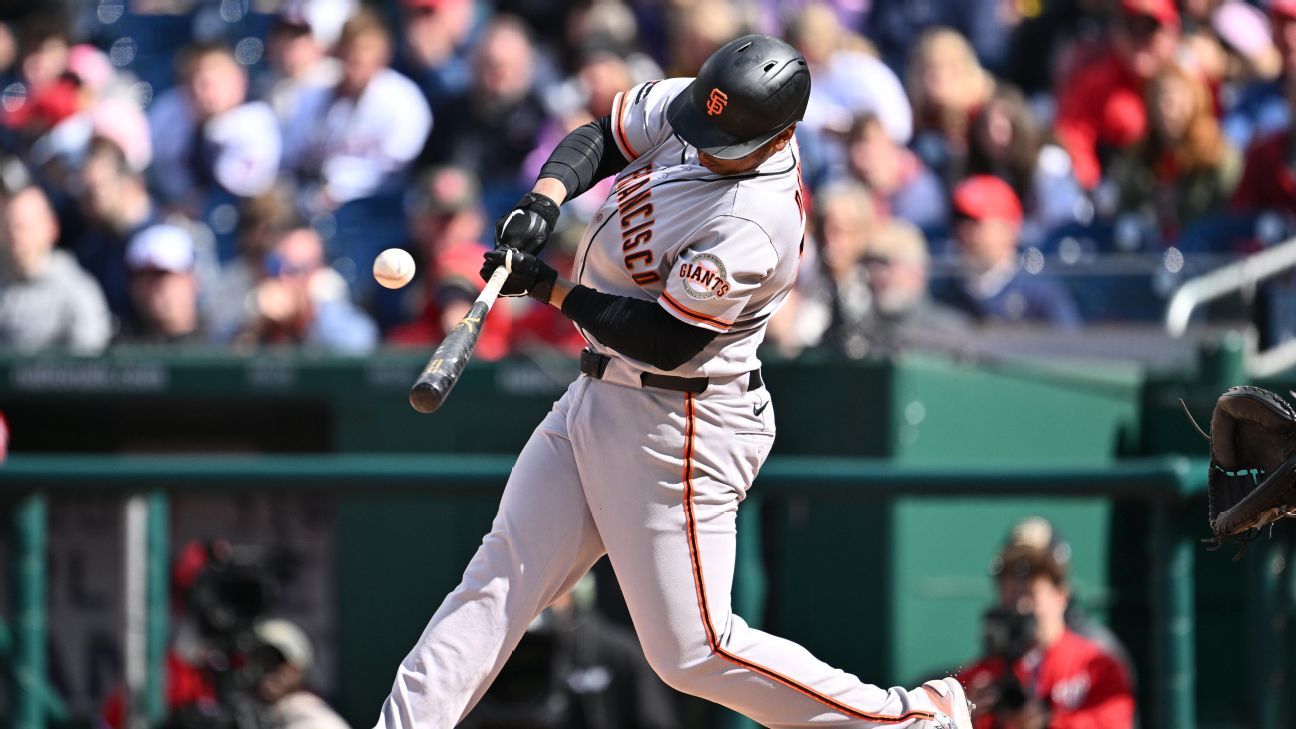
 Rafael Devers, DH/1B, San Francisco Giants
Then: 81st pick overall (94.7 ADP, rostered in 93.1%)
Now: 110th pick overall (144.1 ADP, rostered in 80.8%)
An ADP qualifier as he wasn’t nominated by a single staffer, Devers’ precipitous plummet is puzzling. Have we all forgotten that he has had numerous quiet Aprils throughout his career (it’s his fifth with a sub-.800 OPS in eight years)? On this date last year, Devers was batting .209/.345/.352 with two homers. He’d end up hitting .260/.377/.502 with 33 homers the rest of the way.
 Josh Naylor, 1B, Seattle Mariners
Then: 79th pick overall (92.7 ADP, rostered in 93.3%)
Now: 90th pick overall (126.3 ADP, rostered in 71.7%)
I wrote about him in this space last week, and since then, he finally stole his first base of 2026 on Monday night. Nevertheless, Mariners manager Dan Wilson’s 5.9% rate granting baserunners green lights ranks 18th, unusually low comparative to his 2025 aggressiveness in that department. Putting that aside, Naylor’s underlying metrics aren’t far off what they were last year, and so long as you don’t expect another 30 stolen bases from him (or even close to it), he’s a possible trade bargain today.
 Riley O’Brien, RP, St. Louis Cardinals
Then: 357th pick overall (259.6 ADP, rostered in 6.3%)
Now: 179th pick overall (221.0 ADP, rostered in 75.1%)
Mason Miller is the majors’ top-scoring relief pitcher with 99 fantasy points. How many of you would’ve guessed that it’s O’Brien who places second, and with 84 points that are much closer to Miller’s number than to the No. 3 man in the category? Better yet, how many would’ve expected his Cardinals to be four games over .500 four weeks into the season?
Initially one piece in a closer-by-committee, O’Brien nailed down the victory in the Cardinals’ fifth game and hasn’t ceded the singular role since, thanks in large part to a 10% increase in sinker usage and greater break with his sweeper. I try not to get attached to closers, but O’Brien now looks like a reliable mid-tier option.
 Kazuma Okamoto, 3B, Toronto Blue Jays
Then: 164th pick overall (192.1 ADP, rostered in 64.2%)
Now: 207th pick overall (241.7 ADP, rostered in 38.2%)
Another of my worst-so-far calls this season was preferring Okamoto and his superior plate-discipline metrics overseas to those of Munetaka Murakami, who entered play Tuesday tied for third in the majors in homers (8). Examining the underlying metrics, I’d expect that gap to significantly narrow, and soon. Though, the adjustment making Okamoto an undrafted wait-and-see is fair. In any league deeper than standard, I’d consider trading Murakami for Okamoto and a useful/greater second piece.
 Jose Soriano, SP, Los Angeles Angels
Then: 232nd pick overall (244.8 ADP, rostered in 19.9%)
Now: 101st pick overall (137.6 ADP, rostered in 93.8%)
NBA Playoff Challenge

Pick the winners and crown your NBA champion! Create A Bracket
Entering Tuesday, Soriano was only one fantasy point shy of Ohtani for the major league’s lead (122-121). It’s the most by any pitcher through his team’s first 24 games since Jacob deGrom in 2021 (140), and it makes Soriano one of only 10 pitchers this century to score at least 110 fantasy points through 24 team games without having previously had a 400-plus-point season on his career résumé.
Six of the previous nine went on to score 450-plus fantasy points in those years, and a seventh scored 416 (Wade Miller, 2001). The scariest examples (as far as Soriano is concerned) are Clay Buchholz, who finished with 290 points in 2013, and Sean Manaea, who scored 295 in 2018. Considering Soriano’s hot start coincides with his having greater reliance upon his 98-mph fastball and splitter, however, he’s another of the adjustment-driven breakthrough candidates who can probably put up a total akin to Miller’s.
 Sal Stewart, 1B/3B, Cincinnati Reds
Then: 224th pick overall (240.6 ADP, rostered in 28.1%)
Now: 133rd pick overall (168.0 ADP, rostered in 89.7%)
He’s a hitter through and through, and I’m glad the Reds didn’t use Eugenio Suarez‘s signing as a means to slow Stewart’s service-time clock. Stewart’s Barrel, hard-hit and walk rates are all in the 79th percentile or better, and to those who point out the Cincinnati park factor, he has been pretty good on the road, too (.262/.319/.524, 3 HR, 5 SB). He’s one of the National League Rookie of the Year favorites with good reason.
Jordan Walker, OF, St. Louis Cardinals
Then: 664th pick overall (260.0 ADP, rostered in 1.4%)
Now: 152nd pick overall (190.2 ADP, rostered in 87.5%)
I’d say I wish I had known about Walker’s adjustments before all of my drafts, but there’s no way I could have, considering he had a pedestrian Grapefruit League campaign in which he looked entirely ordinary. Walker’s time in the Cardinals’ hitting lab in Jupiter, Fla., however, has paid massive dividends thus far and makes him an unquestionable superior hitter to the one we all evaluated in March.
I still see regression and some lengthy slumps in his full-season future, meaning there’s a price at which you should trade him, but his massive boosts to his launch angle and quality of contact make him a bona fide power standout. He’s not going to hit .300 — or perhaps even close to it — but I’d be shocked if he didn’t finish with 30-plus homers.