
After unceasing complaints from drivers, fans, teams, and team principals, along with a healthy dose of outside humiliation, the FIA and various Formula 1 manufacturing authorities took the opportunity of no April races to implement overhauls to the vastly unpopular 2026 regulations. The “refinements,” as the official FIA news release calls them, were released on Monday, April 20, and are—with one exception—to be implemented immediately in the Miami Grand Prix on the weekend of May 3. They focus on three main issues: the prevalence of superclipping in qualifying, safety concerns with energy deployment, and race start procedure.
F1 technical details are usually quite confusing and overly particular, but with the minutiae of the new engine regulations, they feel especially ticky-tacky this year. There have also been a lot of separate complaints that are a bit difficult to wrap your head entirely around. So, here is an explainer of all the upcoming changes to the sport, previous technical knowledge not required.
Are the 2026 regulations actually ass, or is it shameless politicking?
Well, it depends on who you ask. The regulation hatred isn’t entirely universal, and it’s easy to say that the drivers talking about how much the rules suck are only doing so because their teams are bad. The Ferrari drivers in particular have been vocal about finding enjoyment with the cars, especially with the racing—Charles Leclerc said so explicitly over race radio—though some might say that the toll of racing for Ferrari recently is influencing this rosy-eyed view now that the team is performing comparatively better.
But, yes, it is pretty broadly agreed that drivers are unhappy and the regulations need changing.
Why are the regulations so ass?
The 2026 rules overhaul changed two important parts of the car: the aerodynamics package and the power unit. Almost all of the problems this year stem from the power unit, not the new aero rules, which have been successful (you can read up on the aero changes at the start of the preview here).
To be specific, the problems stem from the power split of the hybrid power units. Since 2014, F1 power units have consisted of a V6 internal combustion engine (or ICE) and an electric motor (Motor Generator Unit–Kinetic, or MGU-K). Prior to the 2026 regulations, cars received 85 percent of their power from the ICE and 15 percent from the MGU-K; in 2026, while the max power output remains the same at 750 kW, the power split is much closer to 50-50, with the ICE providing 400 kW of power, the MGU-K providing 350 kW. Should the car run out of electrical energy, it would be running at 50 percent its max capacity, rather than 85 percent.
At the same time, the amount of energy the power unit can regenerate and deploy per lap has gone up to 8.5 MJ (kind of—this number can change depending on the circuit and the session) from 4 MJ, while battery capacity has remained at 4 MJ, meaning that cars are constantly regenerating and deploying energy throughout the lap. If the MGU-K is running at a full 350 kW, it would burn through 8.5 MJ of energy in 24 seconds, which is notably less than the amount of time F1 cars take to complete a lap.
The power split, deployment, and energy recharge quirks are the root of almost all of the problems this year. The energy recharge quirks are particularly damaging to the qualifying experience, though racing is also not immune. Though the phenomenon of cars overtaking and re-overtaking each other on track looks fun, McLaren driver and reigning World Champion Lando Norris said after the Japanese GP that it was yo-yoing: According to Norris, the drivers cannot control energy deployment, and so are at the whims of software.
That’s a lot of numbers at once.
Yup. That’s about the vibe of the 2026 regulations.
I just jumped ahead and skimmed through the new changes, and that mostly also just seems like a bunch of numbers?
Any fundamental changes to how the engines function would be really, really difficult to make during the season, and, if they will be made, would need to wait until next year. Midseason changes have to work with what teams and the FIA can conceivably implement, which mostly has to do with numerical tweaks at the moment. Still, those numbers may have a significant impact on the look and feel of racing.
OK, I’m ready to get into it. What’s going on with qualifying?
For qualifying, the FIA’s primary goal is to reduce the time spent superclipping—
Wait, what’s superclipping again?
So, F1 cars are capable of charging the battery in two places: first, in braking zones, when a portion of the braking force comes from the MGU-K converting kinetic energy into electrical energy, and second, on straights, where the MGU-K can be programmed to steal power from the ICE while the car is still at full throttle in order to charge the battery. The second method of charging the battery is known as “superclipping.”
Superclipping makes cars go faster over the course of a lap even if those margins are minute—otherwise teams wouldn’t do it—but it runs completely counterintuitive to what has made cars feel and be fast before: braking as late as possible to carry as much speed as possbile into the corner. When cars superclip, they can drop as much as 50 kilometers per hour on the straight, at full throttle, which simply does not look good. This is far more of a problem during qualifying, when cars are going full-out and the action focuses on single-lap stints through onboard footage, than during races, when the concern is more about where cars are in relation to each other.
How is the FIA going to reduce superclipping?
The FIA is going to try to reduce superclipping in two ways. The first is by lowering the total amount of energy cars are able to regenerate over the course of a lap, from 8 MJ to 7 MJ.
Wouldn’t that make cars even more energy starved, and thus slower?
Yes! But the issue with qualifying right now is not that lap times are too high relative to previous years’, but that superclipping looks ugly and slow. By lowering the maximum amount of energy that can be regenerated over the course of a lap, cars simply cannot spend as much time regenerating energy, which means less superclipping. Basically, the FIA and teams are accepting slightly slower lap times so long as it limits the amount of superclipping.
The FIA did a sort of emergency version of this at the Japanese Grand Prix, lowering the qualifying maximum from 9 MJ to 8 MJ. There, the estimation was that lap times would only slow by half a second, but there would be four fewer seconds of superclipping. There was still, however, a controversial amount of superclipping.
As a sort of addendum to this change, the FIA is also increasing the number of tracks it can tweak energy recharge limits on from eight to 12, basically giving itself leeway to further modify these numbers down the line, if necessary.
What is the second way the FIA is trying reduce superclipping?
Currently, while superclipping, cars can only harvest energy at 250 kW, which, according to Chain Bear, would regenerate about three percent of max recharge per second, at a max regeneration value of 8.5 MJ (numbers, man). Now, the FIA will allow teams to harvest energy at 350 kW, which would meaningfully reduce the amount of time spent superclipping, and also take the load off drivers, who had to manually lift-and-coast to make up that extra 100 kW of power.
You can basically think of the two changes as working in tandem. By both lowering the max regeneration and raising the amount of energy recharged per second, cars will be able to recharge a much higher percentage of necessary energy in much less time. Basically, if you have a smaller glass and a stronger tap, you need to spend less time running the sink to fill the glass with water.
You got any numbers for me on how much raising the power to 350 kW will help?
Not really? We do know, however, that McLaren tested it, and enjoyed the change.
I understand the qualifying changes. Now, what’s this about safety changes? Isn’t that something team principals just say when they want to get regulation changes to benefit their team?
That’s a pretty cynical way of looking at it, though some drivers may agree with you. There are definitely some in-race safety concerns with the current regulations. First, take Norris’s point that drivers are not necessarily in control of whether their car is deploying energy, which means that they are not entirely in control of the car’s speed. Then, add on boost mode, which is a button drivers can press to take over energy deployment, usually for attacking or defending. Combine these two, and you can get some immense speed differences between cars, which can result in some very terrifying crashes.
In order to rectify this issue, the FIA is limiting the max boost cars can receive to +150 kW, and limiting MGU-K deployment in certain parts of the lap. In case you want more numbers, the MGU-K will still be maintained at 350 kW in key areas like corner exits and while overtaking, but will be limited to 250 kW otherwise.
You mentioned that all of these changes would be implemented in Miami, with one exception. What is it?
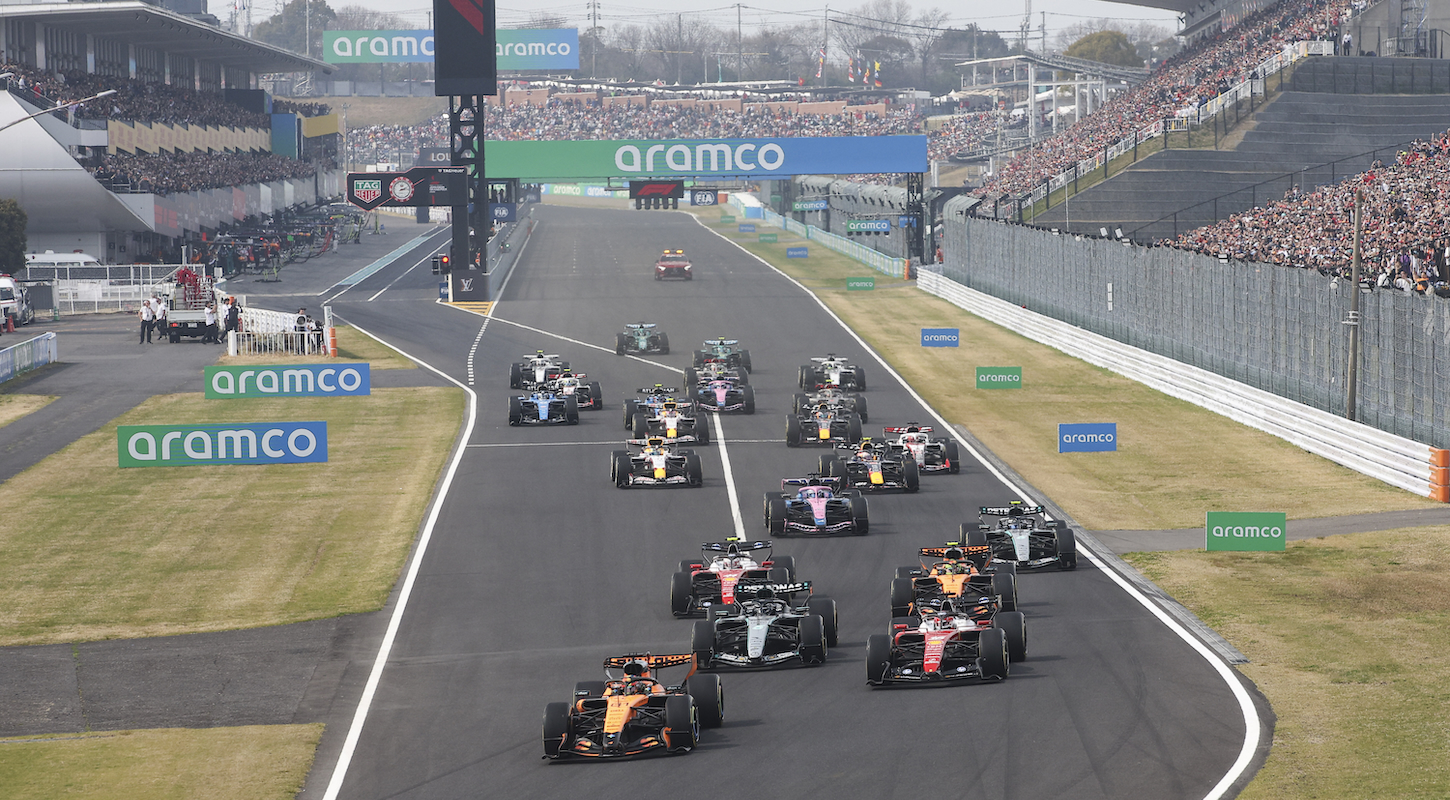
The one change that is not going into effect immediately is with race start procedure. The race start issue has a different origin from the speed deltas during races, due to turbo lag (a delay between the driver requesting and receiving power) created by the removal of the MGU-H (Motor Generator Unit–Heat, a device the cars had prior to 2026 which stored energy from exhaust gases and could deploy it to power the turbocharger on demand) which means sometimes cars just don’t get off the line. But there are similar safety concerns, demonstrated by Liam Lawson at the start of the season: Cars that fail to start just sit on the grid, and are a huge collision risk for cars coming from behind.
Ferrari, which built its engine with a smaller turbo precisely to mitigate turbo lag, has pushed back against race start procedures that would theoretically make getting off the line easier. Understandably, Ferrari would like to preserve its own competitive advantage. At the same time, it is dangerous.
The FIA’s proposed solution to this is an automatic detection system for cars with abnormally slow acceleration off the line. In that case, the MGU-K will be auto-deployed to a minimum amount of acceleration, and there will be indicator lights on the back and side of the car, so other drivers will have a visual warning that the car is slow. The refinements explicitly state that the minimum acceleration, which only kicks in during worst-case scenarios, will not introduce “any sporting advantage,” in which case Ferrari should wind up feeling happy about this solution.
All of these will be tested and analyzed at Miami, and implemented later should teams and the FIA agree.
Will all of this work?
Only time will tell, baby! I will promise you this, though: We will always have something to complain about.
Recommended