
The Athletic has live coverage of the 2026 NFL Draft.
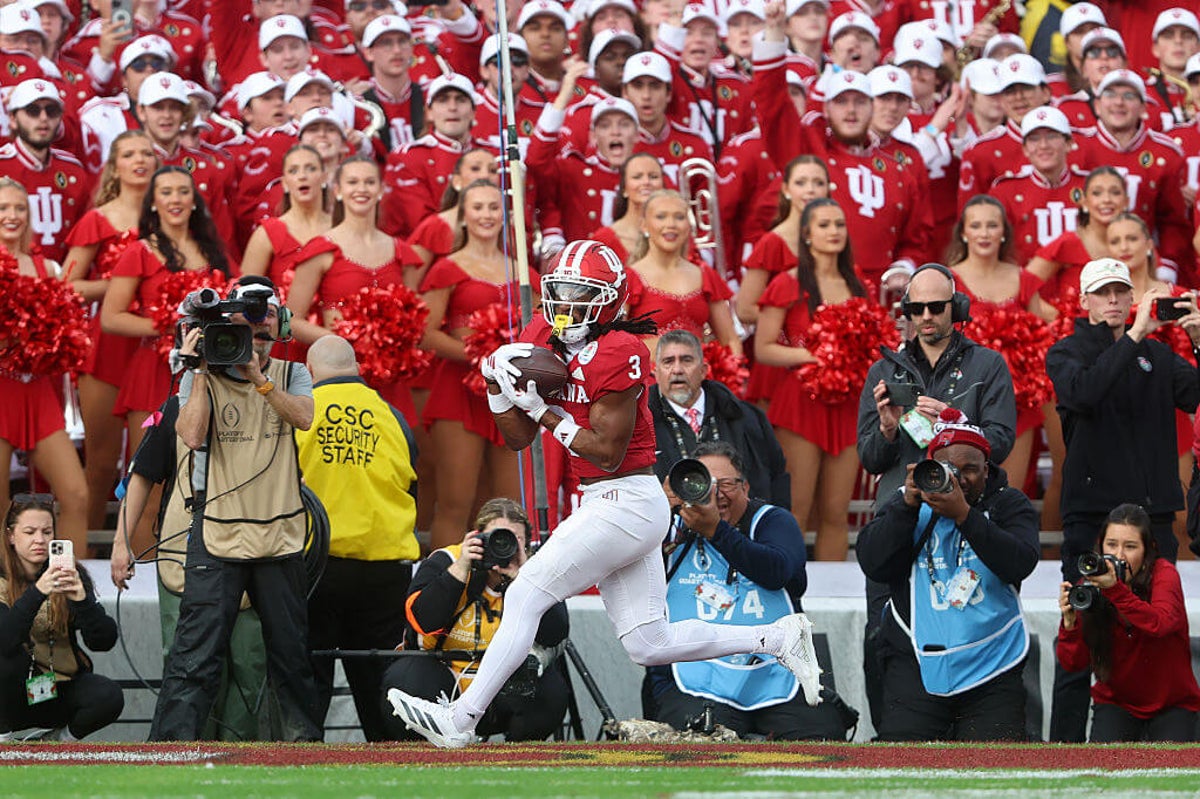
The New York Jets made Indiana wide receiver Omar Cooper Jr. the 30th pick in the first round of the 2026 NFL Draft. He was the fifth wide receiver taken.
The Jets traded with the San Francisco 49ers for the 30th pick, which dropped back to No. 33 in addition to receiving the 179th pick.
Cooper, a 1 1/2-year starter for Curt Cignetti at Indiana, worked out of the slot on 88.3 percent of his snaps in 2025 as a fourth-year junior. He caught 12 touchdowns and led the Hoosiers in targets (95), receiving yards (937) and catches. Of his 69 receptions, 44 went for first downs. He and Elijah Sarratt were the first Big Ten duo this century to each reach double-digit totals in touchdown catches during a regular season.
Memorably, Cooper made the leaping, 7-yard catch in the back of the end zone at Beaver Stadium on Nov. 8 with 36 seconds to play to produce a 27-24 win against Penn State — Indiana’s first game-winning touchdown drive in the final two minutes of regulation since 1998 — and preserve the Hoosiers’ unbeaten run. Indiana went 16-0 and won the national championship after Cooper caught five balls for 71 yards against Miami in the championship game victory.
‘The Beast’ breakdown
Cooper ranked No. 22 overall and was the No. 5 receiver on Dane Brugler’s big board. Here’s what Brugler had to say about him in his annual NFL Draft guide:
“Cooper will be an attractive draft target for the NFL teams that put high value on ball skills and run-after-catch ability. He projects as an inside-outside receiver who can be weaponized when featured.”
Coaching intel
Here’s what a head coach whose team played Indiana had to say about Cooper:
“I thought he was very underrated. There are a lot of really good receivers in the Big Ten. Nobody talks about Cooper. And he wasn’t their go-to guy. Elijah Sarratt was, and then Charlie Becker comes on later in the season and makes a bunch of big plays. Cooper plays really strong and is very slick in space. You can tell he was a good basketball (player). He’s so good with the ball in his hands after the catch, too. He’s a problem to get on the ground.”
Scott Dochterman’s analysis
Cooper would have transferred out of Indiana before Cignetti became coach, but he had a high-ankle sprain and figured there was no market for him. He stayed, then produced one of the greatest catches in college football history. That was just one of many moments for Cooper during Indiana’s historic run.
Mike Sando’s assessment
One knock on Cooper was that he plays slower than he times, which reduces the effectiveness of his otherwise very good ability to change directions.
How he fits
The Jets addressed their biggest need on defense with the No. 2 pick when they selected Texas Tech edge rusher David Bailey. They turned to their overall biggest need with their second first-round pick by adding a pass catcher in Kenyon Sadiq at No. 16. And then they double-dipped with another pass catcher after trading back into the first round to get Cooper.
It’s not the first time the Jets have traded back into the first round to get a third player. They successfully did it in 2022, too, when they added Sauce Gardner, Garrett Wilson and then traded up for Jermaine Johnson.
Cooper slots in nicely to the Jets’ offense as primarily a slot receiver. He’s an expert at making plays after the catch and his ability to line up both inside and outside at receiver should make him a fun complement for Wilson in an offense that all of a sudden is flush with intriguing, athletic pass catchers. Cooper was No. 1 pick Fernando Mendoza’s top target at Indiana last season, when they won a national championship.
The Jets considered Cooper at No. 16 but instead opted for Sadiq. When Cooper kept falling down the board, general manager Darren Mougey pounced — moving up three spots and only giving up a fifth-round pick to grab a wide receiver that should play a significant role immediately.
Depth-chart impact
The biggest weakness on the Jets’ roster was wide receiver, after Mougey opted to ignore the position in free agency. Now, the group is coming together nicely. Wilson, of course, will top the depth chart and he’ll be flanked by Cooper and big-bodied, big-play target Adonai Mitchell, who showed some flashes last season after the Jets acquired him in the Gardner trade with the Colts. They still could use another depth piece at the position since the next best wideout is another slot receiver (Isaiah Williams) and 2025 fourth-round pick Arian Smith had a rough rookie year.
They also could have picked …
Washington wide receiver Denzel Boston. Ultimately, the Jets graded Cooper as a more dynamic prospect who should help them right away. If the Jets wanted to add some more defensive talent, the top options available at positions of need at the time included Toledo safety Emmanuel McNeil-Warren, Tennessee cornerback Jermod McCoy, Tennessee cornerback Colton Hood and Ohio State defensive tackle Kayden McDonald.
Fast evaluation
The Jets simply needed to load up on playmakers on offense. That’s not only to make life easier for quarterback Geno Smith, but to build a better supporting cast for whatever quarterback the Jets aim to add in the 2027 NFL Draft. Cooper is a dynamic playmaker after the catch and now Smith will be surrounded by pass catchers at every position: wide receiver (Wilson, Cooper and Mitchell), tight end (Sadiq, Mason Taylor) and running back (Breece Hall).