
The Sixers submitted a humiliating performance in their most important game of the year, losing 128-96 to the Boston Celtics in what looks like the death knell for their season, a defeat bad enough to inspire questions about where things go from here.
Here’s what I saw.
Humiliation
There were about seven minutes on Sunday when the arena in South Philly was genuinely charged up, with Joel Embiid making his return and putting on quite a display during his first shift of the game. He drew two quick fouls on Queta, bodied Nic Vucevic on a post-up, and ran the floor hard for a dunk in transition, generating the loudest pop of the night from the home crowd. Unfortunately, that was the point at which the fun ended.
We are four games into this series, and Nick Nurse still has not figured out that Andre Drummond is in deep trouble against any of Boston’s five-out lineups. After Embiid hit the bench for the first time, a little under seven minutes of the game, Philadelphia was down just a point and holding up well defensively, hanging in despite an anemic shooting performance. It didn’t take long for the Celtics to play hunt the big bozo, with Drummond absolutely hopeless at defending in space.
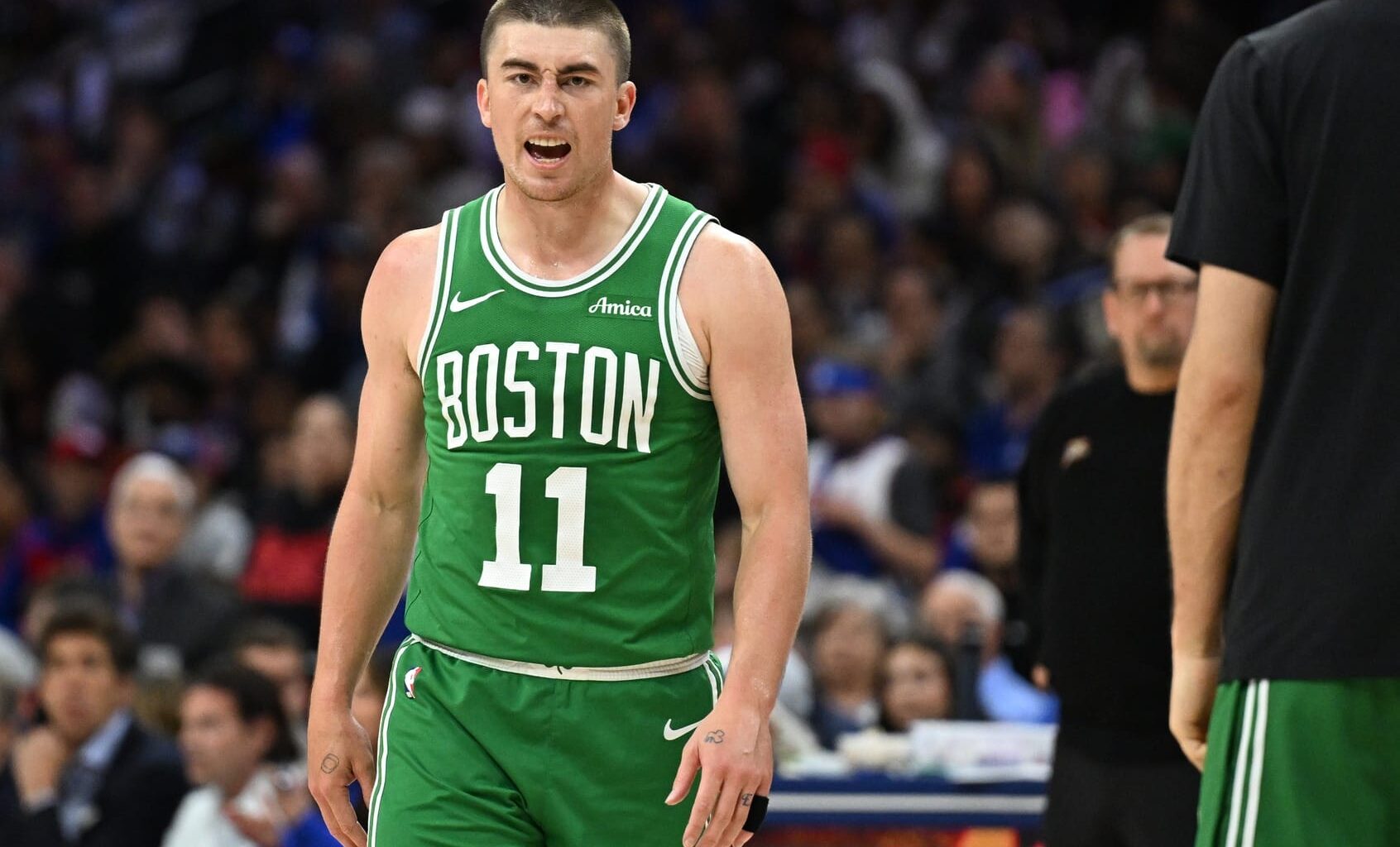
It wasn’t much more complicated than bringing the big up to screen for Payton Pritchard and letting Boston’s bench spark plug destroy Drummond in drop coverage. Drummond was apparently surprised that Pritchard, a big-time pull-up threat who won last year’s Sixth Man of the Year award. It took until the Celtics had built up a double-digit lead for Nurse to react and bring Embiid back with a quick sub, and by that point, it was too late.
The bigger problem, unfortunately, is the same issue we’ve been talking about for close to a half-decade — the Sixers simply cannot rebound the ball as a team. In that sense, Nurse’s decision to continue going back to Drummond makes sense, as he’s one of the few guys with any sort of plan to help on the glass. But no matter who was on the floor, the Sixers got humiliated by the Celtics in the rebounding battle. The Celtics extended possessions with second, third, and occasional fourth chances, stretching the Sixers out before sprinting past them from the perimeter for offensive rebound after offensive rebound.
It was a shame the Sixers couldn’t simply end possessions, because they played a ton of good possessions on initial looks in the first half that were squandered by their inability to find a body or the ball. You do the hard work for 16-20 seconds, get a good contest in on the shooter, and through bad hands, bad positioning, or just total brain melts, the Sixers allow the Celtics to get two and three guys to the ball, overwhelming whatever poor Sixers sap happens to be battling for the rebound.
Tyrese Maxey is an underrated part of this problem. He might be the poster child for the duality of Nick Nurse’s defense, which looks great when it can generate turnovers and horrific when you give up open jumpers and repeated rebounds because overhelping in the middle causes a chain reaction that kills the possession. Maxey has been an overzealous gambler all season, and his tendency to simply drift and hunt steal opportunities leaves him in an awful position at the end of most possessions, which in turn causes problems for everyone else. And of course, those guys love to gamble, too.
That wasn’t the only problem for Maxey in Philly’s abysmal first half. He attempted just three shots in the first half, contributing next to nothing as the Sixers built a house of bricks, making his defensive contributions sting that much more. Maxey was dangerously passive, even when he got to use most of the shot clock to hunt whatever look or matchup he wanted, even when Embiid was on the bench and it was his time to control the show. Mazzulla has turned to Jordan Walsh as a Maxey stopper quite a bit over the last two games, and Maxey has struggled to consistently beat his combination of length and strength, as seen on an airball he hoisted for a 24-second violation after Walsh repeatedly stonewalled him around the free-throw line. Maxey’s unwillingness to shoot pull-up threes has rewarded Boston for their choice to sit back deep, and there’s no real scheming around that when he’s on the ball.
Even though he was the halftime leader in Sixers points, I thought Embiid acquitted himself okay in the first half outside of scoring. He made repeated efforts to close from the rim to the three-point line, had some strong rim protection moments, and rebounded relatively well in the broader context of his team’s meltdown. Unfortunately, his offense was a disaster for a lot of the first half. The jumper was all the way off after a good start, and when the game was still sort of up for grabs, Embiid got the Sixers into a lot of one-and-done possessions with a quick trigger from the midrange, and as Pritchard got going in the first half, that meant the game spiraling out of control before the first half had ended.
With Embiid eventually missing so many shots that he started jabbing his way out of open shots, there was basically no pathway to good offense with Maxey effectively sitting out of scoring until the second half. The Sixers slid back into their customary “feed Embiid at all costs” approach that relegates a lot of the others to secondary roles, and they got the results that you’d expect from that. Embiid would eventually start cooking again in the third quarter, but by that point, trading buckets was only good enough to keep the deficit around 20 points, doing nothing to change the outcome.
With all of that being said, you look at the roster, and it’s unclear how the Sixers are expecting to break open a defense like Boston’s unless Embiid or Maxey are handed a crowbar and can headhunt any guy who steps in front of them. Their supporting cast is devoid of shooters, with good teams constantly loading up and daring the likes of Kelly Oubre, Dominick Barlow, Quentin Grimes, and VJ Edgecombe to beat them from deep. Edgecombe’s total inability to make shots outside of Game 2 has been a key storyline in this series, and I can’t say it was unexpected that a streaky rookie would fail to prop the team up against an elite Eastern Conference team. Justin Edwards played a single good game in this series and promptly went back to being borderline unplayable, and Philadelphia’s best bench shooter was traded to Oklahoma City at the deadline.
A win in Game 2 and a competitive loss in Game 3 are not going to change anything about how people feel about the direction of this franchise moving forward. People don’t trust this group and this plan, and have been given no real reason to do so. Their young star has not been good enough, their years-long plan to get their oft-injured star to the playoffs while devaluing the regular season resulted in a nationally televised ass kicking in his first playoff appearance in two years, and their roster is somehow both small and bad at rebounding without gaining any of the ball-handling, athleticism, or shooting benefits that you’d hope for making that trade-off. What really drives the dagger home is that they are getting beaten like this by a team that absorbed the loss of their star for most of the year and rallied to an improbably good year. The Sixers weren’t a good enough regular-season team to escape the play-in, but at least they managed to subject their fans to a few beatdowns at the hands of their most-hated rivals.
But hey, at least the owner of the team got to sit courtside at Game 1 next to Howard Lutnick! Priorities are in order!
Other notes
— I can’t say that I have ever been the biggest Nick Nurse booster during his time in Philadelphia, but I felt like I reached a breaking point in the first five minutes of Sunday’s third quarter. With his team absolutely drowning and the Celtics pushing the lead to a whopping 26 points, he opted to call a timeout around the eight-minute mark so that he could…bring the same exact lineup back on the floor. In a shocking development, the very moment that he brought in Quentin Grimes for Kelly Oubre, the Sixers started to play better.
Take Nurse out of it for a second, and I think Sunday’s Game 4 is a strong example of why I think the Sixers may need to move on from Kelly Oubre this summer. It’s not because he played poorly, which was an issue for the entire roster, but because he is treated with a level of sensitivity befitting a star, with Nick Nurse unwilling to scale down his role even as he drags down the team. Bozo foul after bozo foul, missed jumper after missed jumper, straying away from a shooter to send hopeless help toward the middle of the floor, every single piece of it screams, “Try something else.” And yet, as the Sixers rolled in after halftime, there was Oubre, in his customary spot in the starting lineup, allowed to keep negatively impacting the game for nearly half of a disastrous third quarter.
If you decide that the head coach should go, you should have a clear understanding of how he would handle Oubre before you decide to bring him back in free agency.
— Not getting an offensive rebound until the third quarter, while the opponent pulls your pants down to your ankles and spanks you on the glass, is genuinely hilarious.
— The Sixers ran not one but two different karaoke sing-alongs during the fourth quarter as the home team got run out of the building. One of the most embarrassing moments in franchise history. I would sooner get rid of arena ops altogether than subject themselves to a humiliation ritual like that ever again.
Kudos to the Celtics fans in attendance who flipped the “We want Boston!” chant from the play-in on the Sixers, by the way. Credit where it’s due, pretty funny.