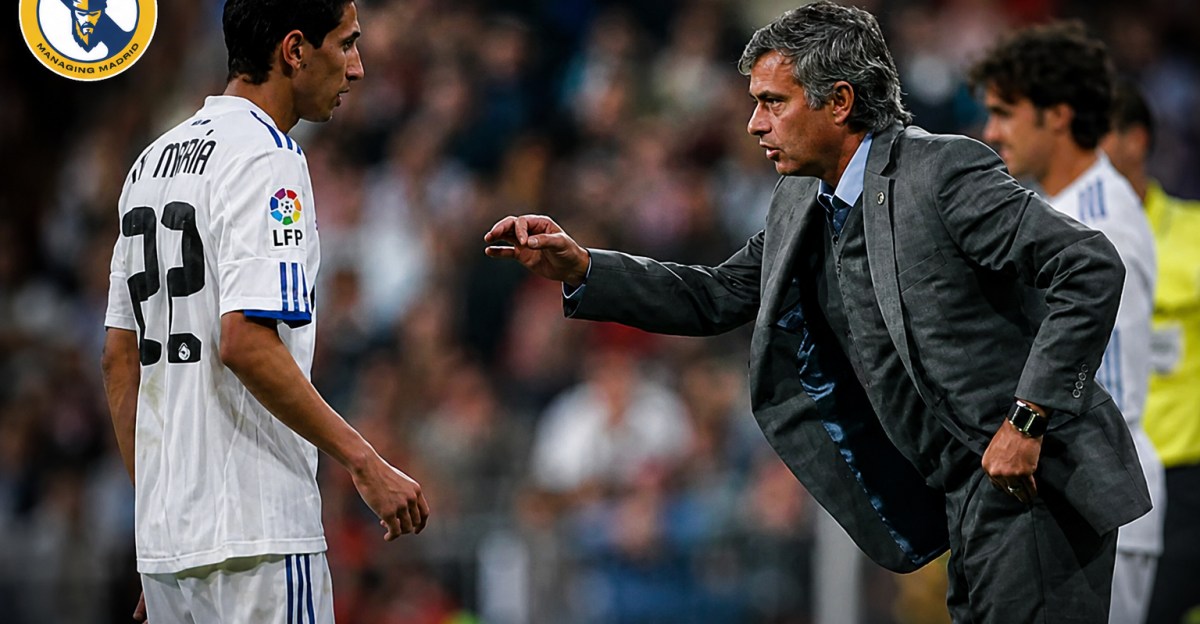
When José Mourinho arrived at Valdebebas in the summer of 2010, part of the foundation of the Real Madrid team that would go on to win four Champions Leagues in five seasons was already in place. Sergio Ramos, Pepe and Marcelo had been starters at Madrid for several seasons. Madrid’s legendary transfer window that brought Cristiano Ronaldo, Karim Benzema, Kaká, Xabi Alonso and Álvaro Arbeloa to the club preceded the Portuguese manager by one year. But that is not to minimize the work and important pieces Mourinho added to the Madrid squad. The Portuguese manager spent an aggregate €187.5 million on player signings and loans over his three years at the club — an average of €62.5 million per season. That was the seventh most in Europe over those three seasons, but considerably less than the amount spent by Manchester City (€336.6M), Chelsea (€327.7M) or PSG (€267.1M) during that period. Remember that the then €101 million record signing of Gareth Bale occurred in the summer after Mourinho left the club.
According to Transfermarkt data, no Mourinho signing at Madrid reached €40 million, with the biggest signings in the Mourinho Madrid era being Luka Modric for €35 million in 2012, Ángel Di María for €33 million in 2010 and Fábio Coentrão for €30 million in 2011 — the former two becoming two of the best signings in club history.
The Portuguese manager showed a special affinity for players from the Bundesliga and Premier League during his first stint at Madrid, signing four players from the German league (Mesut Özil, Sami Khedira, Nuri Sahin and Hamit Altintop) as well as four players from the English top division (Ricardo Carvalho, Emmanuel Adebayor, Luka Modric and Michael Essien), albeit two (Essien and Adebayor) were players received on loan. Curiously, Mourinho never signed a player from the Serie A during his 3-year tenure at the club despite having arrived from Inter Milan.
A look back at Mourinho’s first stint at Madrid reveals he used his first transfer window at the club to sign players to provide depth across all of Madrid’s lines, adding two young wingers (Di María and Pedro León), two precocious attacking midfielders (Özil and Sergio Canales) and one young defensive midfielder (Khedira). All five were under 24 years of age when they were signed. Mourinho added to that mix one veteran centre-back (Carvalho) that he had previously managed at Porto and Chelsea. Four of the six aforementioned players became frequent names in Mourinho’s 11 during his first season at the club, with Carvalho, Özil and Di María all logging over 3,500 minutes their first season and Khedira surpassing the 3,000-minute mark. The Portuguese manager also added a forward (Adebayor) on loan in the winter transfer window to compensate for Gonzalo Higuaín’s unavailability due to a back injury.
Mourinho’s second summer with Madrid saw him further strengthen the backline by bringing on Fabio Coentrão and an 18-year-old Raphaël Varane who would go on to become one of Europe’s best centre-backs. Then in his third season he closed a signing for which Madridistas will be eternally grateful, the incorporation of Modric from Tottenham days before turning 27. The Croatian maestro would go on to become the player with most trophies in club history and arguably the greatest midfielder in football history.
There are rumours circulating that the Portuguese coach would like to bring on a player from the Portuguese Liga, Danish defensive midfielder Morten Hjulmand from Sporting. The 26-year-old Hjulmand arrived in Portugal from Serie A in 2023 and has played nearly 4000 minutes at Sporting this season, including over 900 minutes in Champions League. Hjulmand typically plays in a double pivot system alongside another defensive midfielder. Hjulmand is averaging 65 passes per 90 minutes in the Portuguese liga with 91% accuracy and is a demonstrated ball winner as documented by his 165 ball recoveries in league play this season, over 6.3 per 90 minutes.
With Madrid needing to strengthen its backline due to recurring injuries to Eder Militão and the departures of David Alaba, Dani Carvajal and possibly Antonio Rüdiger, don’t be surprised to see Mourinho reach out to someone from his past as he previously did with Carvalho to incorporate a seasoned centre-back to pair with Dean Huijsen. One possibility that has been floated is signing Nicolás Otamendi, the 38-year-old whose contract with Benfica ends in June, as a short-term solution. However age may be a deterrent to signing the Argentine as Carvalho was only 32 when he joined Madrid in 2010.
Madrid fans will want to pay special attention to this summer’s World Cup standouts for possible club signings as both Özil and Khedira were signed in the summer of 2010 following stellar World Cup performances in South Africa with Germany; and James Rodríguez joined in 2014 following his sensational World Cup in Brazil. Could a spectacular performance in this summer’s World Cup by Elliot Anderson or Adam Wharton lead to Madrid opening up its coffers for either English midfielder? Time will tell, but if Mourinho’s past at Madrid tells us anything is that he is more likely to focus on players with less name recognition, but that are a more complementary fit to the current foundation. Rest assured that Mourinho is already analyzing the pieces needed to return Madrid to European glory.