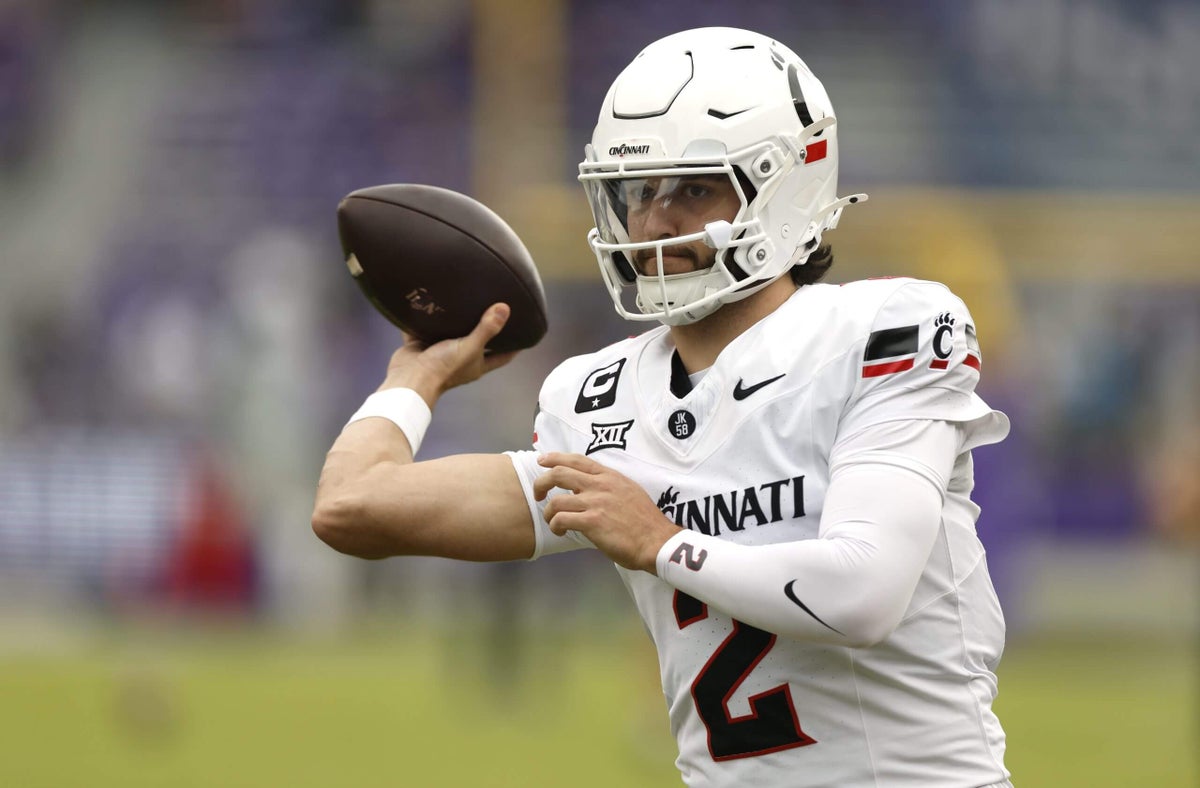
The NCAA has denied Texas Tech quarterback Brendan Sorsby’s request to have his athletic eligibility reinstated for the 2026 college football season, sources briefed on the decision confirmed to The Athletic.
The NCAA has deemed Sorsby permanently ineligible, a result of its investigation into his gambling violations, which include bets made on Indiana football in 2022 while Sorsby was a member of the Hoosiers. Texas Tech will appeal the NCAA’s decision, according to a letter from university president Lawrence Schovanec sent to Tech supporters on Tuesday.
Permanent ineligibility is the punishment for players who bet on games involving their own team, according to updated NCAA sports-betting guidelines passed in 2023.
“Recently, the NCAA issued an initial ruling that Brendan is permanently ineligible to compete,” Schovanec wrote. “Texas Tech will be appealing that decision. We believe that given the facts and the context of Brendan’s case, the NCAA’s ruling should be reversed or modified.”
Last week, Sorsby separately filed a lawsuit against the NCAA seeking a temporary injunction that would grant the fifth-year senior eligibility for the 2026 season, which would be his last year of college football. An injunction hearing has been set for June 1 in Lubbock County (Texas) district court. Texas Tech is not involved in the lawsuit.
Sorsby, 22, completed an “intensive inpatient treatment program” last week for a gambling disorder. Schovanec’s letter described it as “a meaningful step forward in what will be a long recovery.”
“This week, we will welcome Brendan back to campus,” the letter reads.
“We believe the right thing to do is to not ruin this young man’s college career for something that happened four years ago,” Texas Tech athletic director Kirby Hocutt said Tuesday from Big 12 meetings in Frisco, Texas. “There’s penalties for everything that you do, and we would accept that and expect that, but at the same time, let’s help this young man who has been very vulnerable and has admitted to some wrongdoings.”
Hocutt added that Tech was informed of the denial last week and hopes to file its appeal by this weekend.
The NCAA reiterated its statement from last week: “The Association’s sports betting rules are clear, as are the reinstatement conditions.
“When it comes to betting on one’s own team, these rules must be enforced in every case for the simple reason that the integrity of the game is at risk. Every sports league has these protections in place, and the NCAA will continue to apply them equally because every student-athlete competing deserves to know they’re playing a fair game.”
Sorsby and Texas Tech announced on April 27 that he would take an “immediate indefinite leave of absence” from the Red Raiders to enter treatment. That was the same day news broke that the NCAA was investigating Sorsby’s gambling. The quarterback transferred from Cincinnati to Texas Tech in January and signed a one-year deal with the Red Raiders that was expected to pay him more than $4 million.
Sorsby released a statement on Tuesday acknowledging the completion of his residential treatment program and his return to campus, as well as the hope that his experience can “reduce the stigma” associated with gambling addiction.
“While I accept responsibility for my behavior and know that I have a lot of work ahead of me, for the first time in many years I feel more free and no longer fully at the mercy of my addiction,” Sorsby said. “If I’m blessed and fortunate enough to have the opportunity to continue my college career at Texas Tech, I know I will get the support I need.”
In an affidavit attached to his lawsuit, Sorsby described his gambling as a “compulsion” and admitted to placing “thousands” of bets since 2022 on everything from Romanian soccer games and Nathan’s Famous Hot Dog Eating Contest to Major League Baseball games, in addition to Indiana football. The lawsuit also notes that Sorsby bet on games involving Indiana and Cincinnati men’s basketball while he was a student at each school.
The lawsuit, in which Sorsby is represented by prominent sports labor lawyer Jeffrey Kessler, argues that Sorsby has not bet on a game involving his own team since 2022 at Indiana, never bet on a game in which he played and never manipulated any game he played in or gambled on. The quarterback is seeking leniency on those grounds, along with the clinical diagnosis of a gambling and anxiety disorder. The lawsuit notes that Sorsby offered to resolve the NCAA’s investigation by accepting a two-game suspension, among other conditions, but that the NCAA declined to discuss a settlement.
“Rather than support a student-athlete’s recovery from a gambling addiction,” the lawsuit states, “the NCAA has weaponized his condition to shore up a facade of competitive integrity, while simultaneously profiting from the very gambling ecosystem it polices.”
Schovanec’s letter to Texas Tech supporters echoed points made in the lawsuit — and Sorsby’s own statement — regarding his addiction and treatment.
“Brendan himself has been open about his struggle with severe gambling addiction, and we believe his vulnerability deserves to be met with the full weight of this institution’s support,” Schovanec wrote.
The letter details an ongoing treatment plan for Sorsby as he returns to campus, including “outpatient clinical care; participation in group and individual therapy; mentor resources; treatment for his related anxiety disorder; active monitoring of his technological devices; installation of software to block betting sites from his devices; the appointment of a custodian to oversee his personal finances; and periodic compliance checks.
“This is not a symbolic commitment,” the letter states. “Each element reflects our conviction, and Brendan’s, that nothing matters more right now than his continued recovery.”
Schovanec highlighted Texas Tech’s “nationally recognized Center for Students in Addiction Recovery (CSAR)” as a resource for Sorsby and stated that the “NCAA bylaws governing Brendan’s case have not adapted to the era of widespread legalized sports betting” facing current college athletes.
“The NCAA’s own policies and procedures for reinstatement call for ‘reaching an outcome that considers the well-being of the involved student-athlete,’” Schovanec writes. “We are asking that the NCAA follow their own stated principles in this case. Ignoring these facts in this ruling puts the letter of their rules ahead of the spirit of their mission.
Schovanec added, “Brendan has shown great resilience. We’re committed to doing right by him — by giving him the support he needs to recover from addiction and finish his collegiate athletic career.”
Hocutt said that he had spoken to Sorsby’s father but not to Sorsby since he entered the rehab facility, and that head coach Joey McGuire had spoken with the quarterback. Asked how the NCAA was initially notified of Sorsby’s gambling, Hocutt said that information has been shared with him but he wouldn’t comment on it.
“We’re going to exhaust every avenue that we have through the NCAA process, and we’ll continue to move down that pathway,” Hocutt said. “Subsequently Brendan and his team have moved forward with their legal path as well, and obviously there’s common interest there, but it’s something that we’re not involved in, but obviously we’ll watch in as well with the hearing date set for next Monday.”
According to Sorsby’s lawsuit against the NCAA, the deadline for him to apply for the NFL Supplemental Draft is June 22. That’s the path Sorsby would likely pursue if he remains unable to play college football in 2026. Being selected in the supplemental draft would offer Sorsby an opportunity to make an NFL roster for the 2026 season as opposed to waiting for the 2027 NFL Draft next spring.