
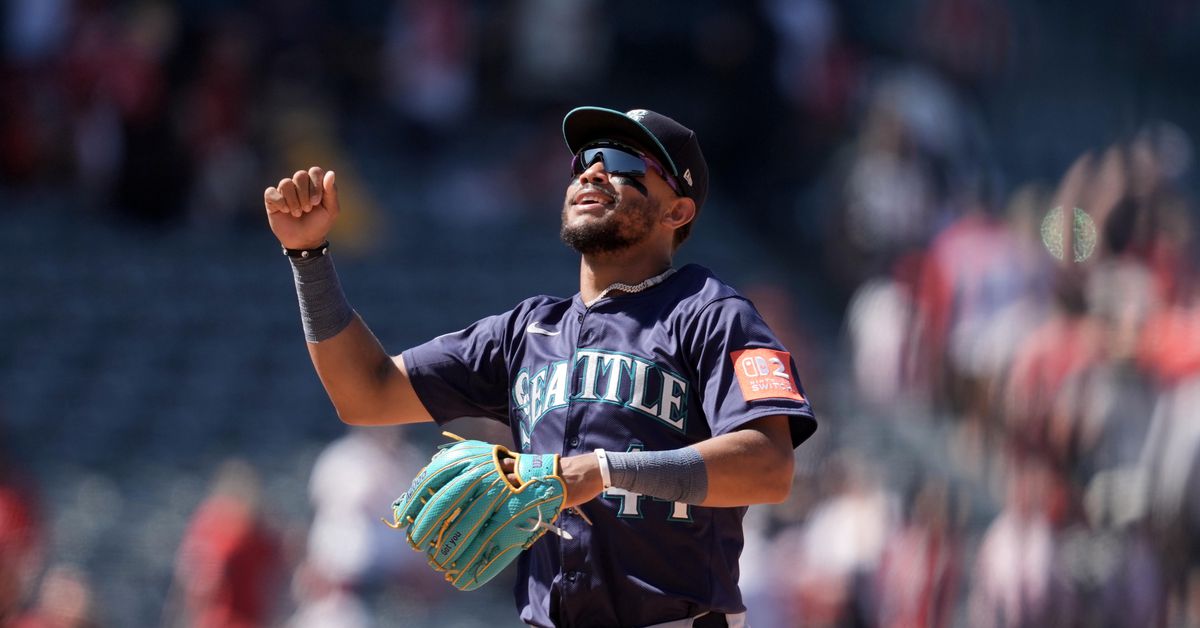
Let’s start with a quick comparison. Here is fWAR through age 24 for Julio Rodríguez and Cal Raleigh:
Raleigh: -0.1 fWAR
Julio: 18.0 fWAR (and counting)
This is not a dig at Cal, who is currently having one of the best seasons, well, ever. You can read about his excellence here and here and here and here and here and here and too many other places to list them all. I share these numbers simply to push against the sentiment, however pervasive it is, that was summarized last week by Jeff Passan on 710 ESPN.
“Cal is what we all wanted Julio to be,” Passan said. “That is rare. When you have a couple of guys, a couple of prospects who come up and one is so highly touted, and he gets the superstar contract, he gets all the attention, he gets the story that’s supposed to be written by Jeff Passan and never is, and then another guy comes in and he’s supposed to be good, you got hopes for him but he usurps them completely— and I’m not suggesting that Julio can’t be that guy for a year, too — but Cal got there first, and it tends to be the guys who get there that stick around there.”
Julio is seventh in MLB by bWAR; he’s 17th in MLB in fWAR. The only outfielder in the American League more valuable by either metric is Aaron Judge. Those specific distinctions — outfielder, American League, Aaron Judge — aren’t necessarily important, other than that All-Star voting is now open. If the game is meant to highlight the best players in MLB, then Julio should be there. It doesn’t have to be much deeper than that.
‘No Fly Zone’
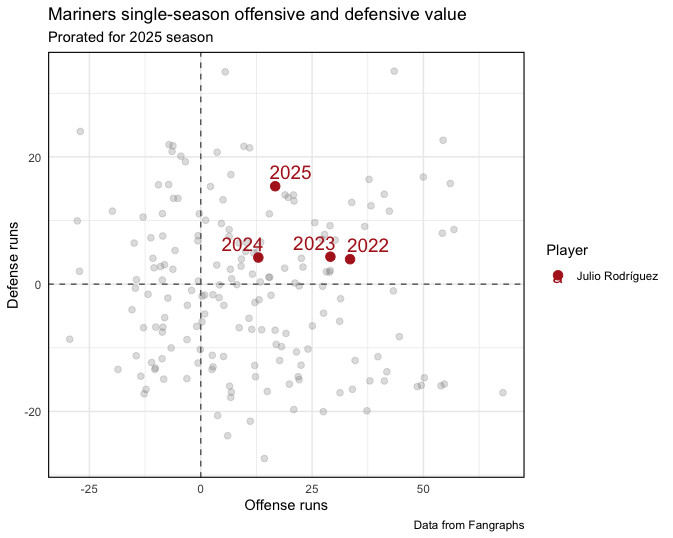
Julio is an elite defender and among the best in MLB by any metric you look at. Baseball Savant’s Fielding Run Value is the one I care about most; it tracks fielder movement and batted ball data to estimate catch probability with unique precision. Julio is already the Mariners all-time leader by the metric, which dates back to 2016, and he’s pacing to shatter the org’s single-season record of 14 (set by Leonys Martin in 2016 and Raleigh in 2024). If Julio continues at his current pace, he will finish the season at 21 fielding runs, or about two full wins above the average centerfielder.
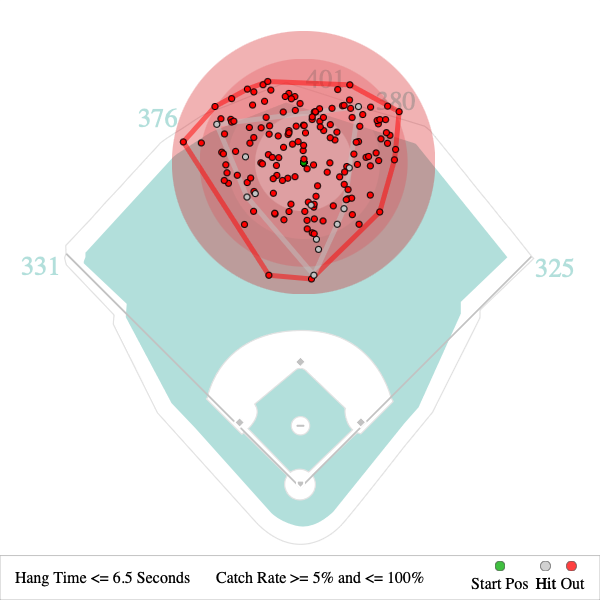
Savant gives us a few clues as to what makes Julio great in the outfield. The main reason is somewhat obvious: he is very fast. Julio ranks in the top 5% of MLB by sprint speed while running the bases, and that speed translates well to the outfield, allowing him to cover large amounts of ground in all directions. In the chart below, the red circles represent the range of Julio’s sprint speed, while the line segments show where he catches the ball (the grey shows hits). We can see that, especially at T-Mobile Park, Julio can cover the entirety of the field he’s responsble for.
Elite outfield defense isn’t simply a matter of speed. Savant breaks up a fielder’s path to the ball by initial reaction (first step), burst (next steps), and route efficiency (directness to the ball). Julio’s first step actually ranks near the bottom of MLB, but once he gets going, he moves quickly to the exact spot the ball would otherwise land. This combination of speed and precision has helped him track down a perfect 42 of 42 “routine” catches this year and allowed for a few spectacular plays as well.
The Marlins know this firsthand. On April 26, Julio made a five-star catch on a sharp liner to the left field gap, then made a four-star catch on a barrel to the right field gap. Both plays highlight what makes Julio more than just a fast guy. He runs full speed at either wall, uses a perfectly timed leaping skip to stop on a dime, and appears to know exactly where and when to extend his glove. It’s a combination of athleticism, awareness, and sheer skill that few players posses.
Range is the most crucial part of an outfielder’s value, but the arm matters, too. Julio’s is quite good. At 100.6 mph, Julio has the seventh hardest throw from the outfield this year. Teams know this and have stopped running on him, attempting to advance on just 29% of opportunities, among the lowest rates in MLB. When they have tested him, they haven’t always been successful, either, as evidenced by this game-saving throw to nab the go-ahead run in extras.
Julio, the batter
Julio isn’t simply an elite defender; he’s a good hitter as well. His approach appears entirely new in 2025, and his aggression early in counts has coincided with a five-point drop in strikeout rate, as Zach Mason detailed for the site in May. He’s given the Mariners steadily above average production, without the long stretches of non-competitive at bats we’ve seen in year’s past.
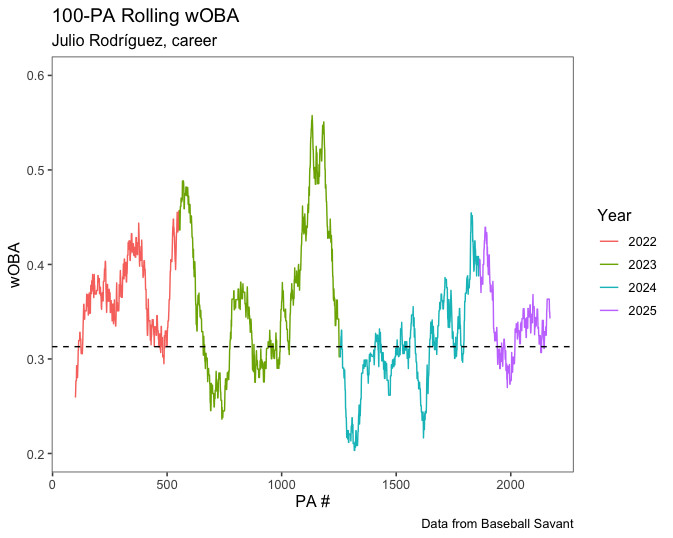
Of course, we also haven’t seen peak Julio this year. Why? I don’t know. A nuanced analysis of Julio’s swing will require more words and time than I can manage in this post. Perhaps the new approach limits his quality of contact, or perhaps it’s a matter of timing. But we seem to get a stretch of excellence every season towards the end of summer, and nothing about his peripherals in 2025 imply a similar run isn’t possible. Even if Julio simply maintains his above average production, he’s still tracking towards one of the great all-around seasons in Mariners history. Few elite defenders have ever provided more value at the plate.
I also feel compelled to point out that Julio’s streaky nature hasn’t prevented him from helping the Mariners when they need him the most. No player since 2022 has stepped to the plate in high-leverage situations more often than Julio at 248 plate appearances. For his career, he’s posted 145 wRC+ in those moments, which ranks among the top 10%. Given the total number of opportunities, Julio has been one of the four most productive batters in MLB in high leverage spots since his debut.
Generation Julio
Julio is one of the best young players ever. If he finishes the year at 6 fWAR, he will be one of the top 50 batters through age 24 in MLB history, just ahead of Barry Bonds and just behind Lou Gehrig. He’s keeping pace with his Gen Z contemporaries through his first four seasons:
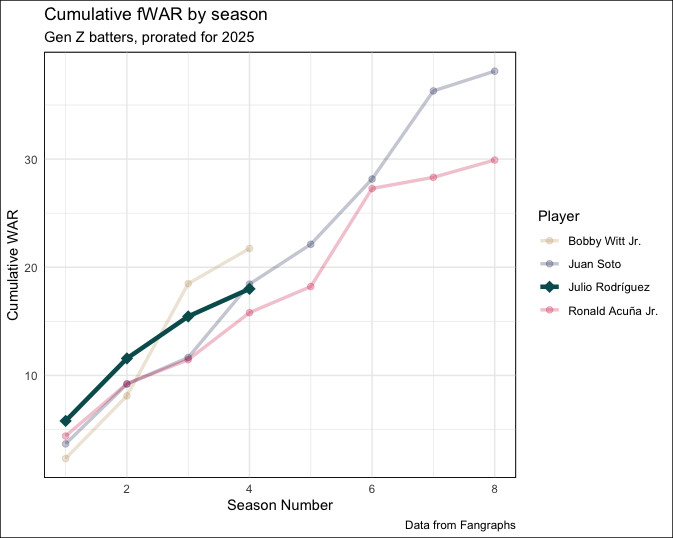
That brings me back to the point I began this post with. If you expected Julio to be the single greatest player in the history of MLB, you might be disappointed in his performance to this point in his career. But if you expected him to be great, if you expected him to be among the league’s best players, if you expected him to help the Mariners win games, that’s exactly what Julio is doing right now. He’s still a few years younger than his prime.