

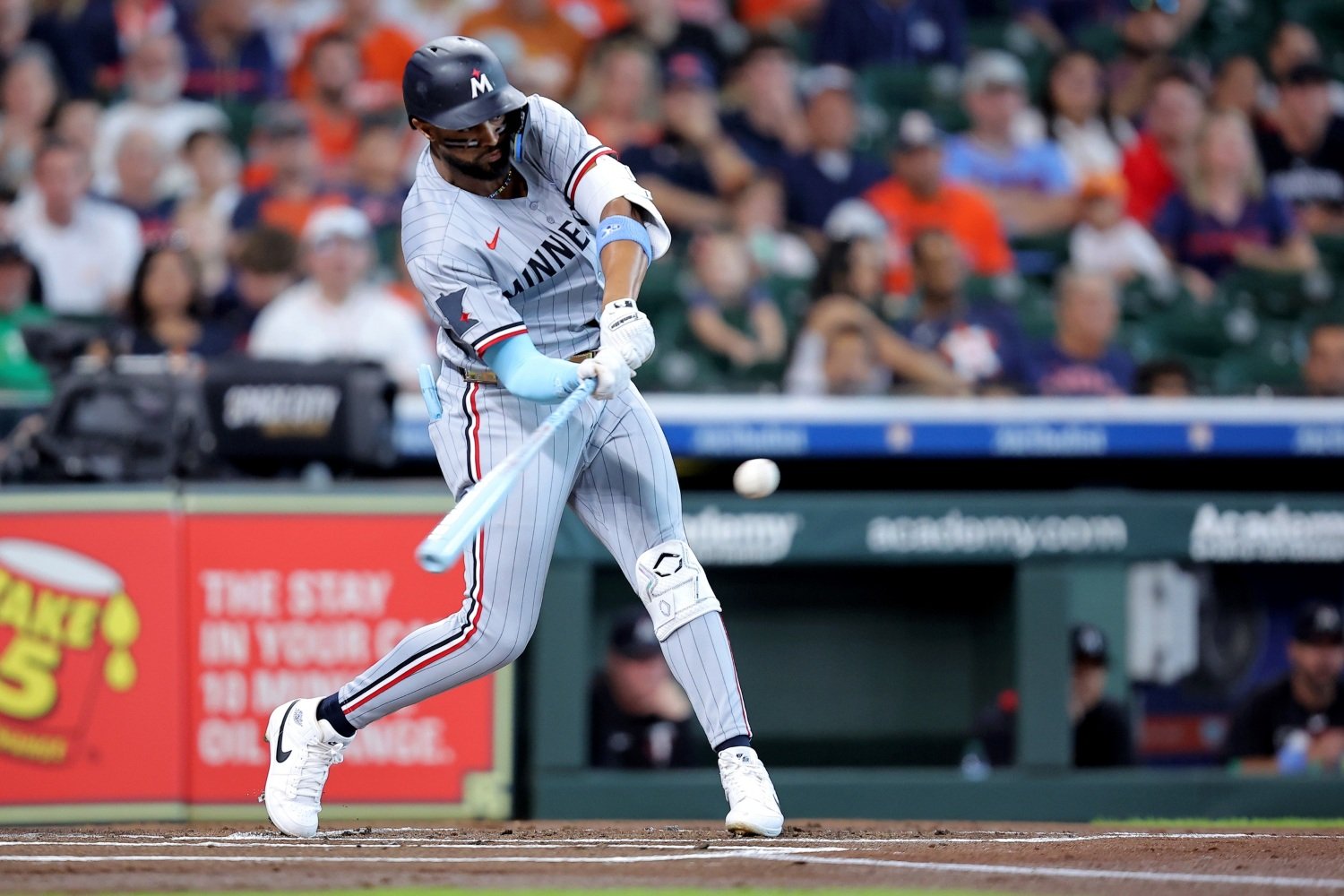
Image courtesy of © Erik Williams-Imagn Images
We’ve never seen Willi Castro quite like this. Even last year, en route to his first-ever All-Star Game, he wasn’t producing the way he’s done it this season. In 197 plate appearances, Castro is batting .290/.365/.483, with seven home runs. More impressively, perhaps, a bunch of that production has come against left-handed pitchers, while batting righty. The switch-hitting Castro had just a .242/.288/.386 line against lefties last year, but this year, that line is .327/.351/.618. Three of Castro’s homers have been off southpaws.
That’s been thanks to a big spike in average bat speed from the right side, from 71.9 miles per hour in 2024 to 74.2 mph this season. This year’s number is the kind of bat speed that generates plus power, something Castro has never shown from the right side—until now. The sudden surge gives him a greater margin for error; it’s easier for him to be on time and the ball jumps off the bat more when he makes contact.
“I think I’m more prepared on the fastball. Just be on the fastball the whole time, and I just react to the other things,” Castro said Thursday at Target Field. “When you’re on the fastball, you know you’re not gonna miss it, so you just react. You just trust your ability. When you see a curveball pop up or something, then you’ll react a bit better.”
Part of the difference is that Castro changed his stance this year, especially from the right side. By standing a bit more upright with his feet closer together, he’s effectively working from deeper in the batter’s box, giving him more time to react to the pitch. His stride length hasn’t materially changed, but he’s much better able to generate late torque in his swing, because his weight is beneath him. Here’s where Castro set up (and how his stride worked) from the right side in 2024.
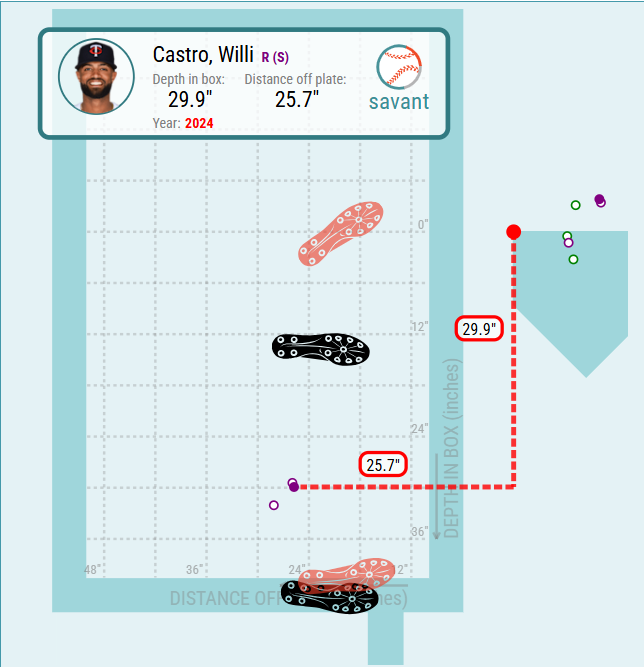
Compare that to 2025, and you can see the magnitude of his changes.
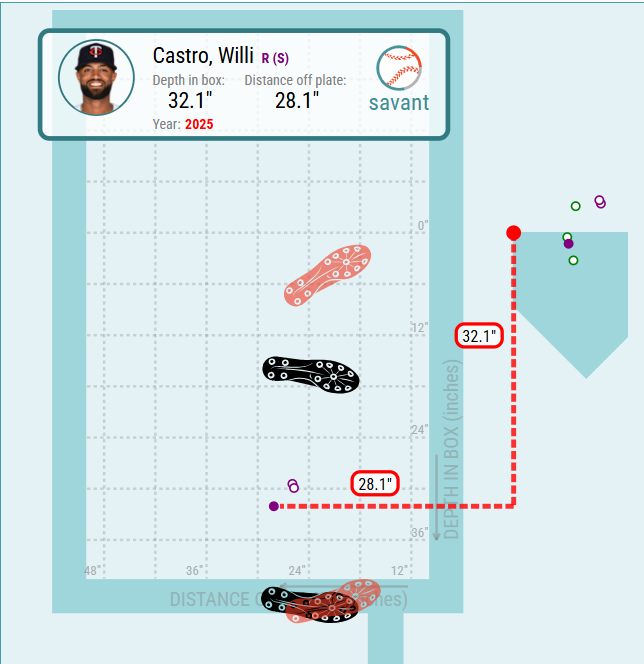
By moving off the plate slightly, he’s given himself more room to operate. Castro says much of the increase in bat speed traces to a greater sense of aggressiveness, though, rather than any major mechanical change.
“I didn’t really work on bat speed. I just worked to try to be more aggressive with the fastball, because I feel like last year, it was affecting me from the right side: not being on time, not getting the barrel where I wanted to,” he said. “I feel like I was rushing to the ball. I feel like the ball was already on me when I wanted to swing, and I wasn’t getting enough good contact, like I am right now. So I set my sight more in front. All the damage happens in the front; you want to catch the ball in front. Nothing happens when you catch the ball back here.”
In other words, in Castro’s approach, he’s gearing up to catch the ball out front more consistently. That’s where things get really interesting.