
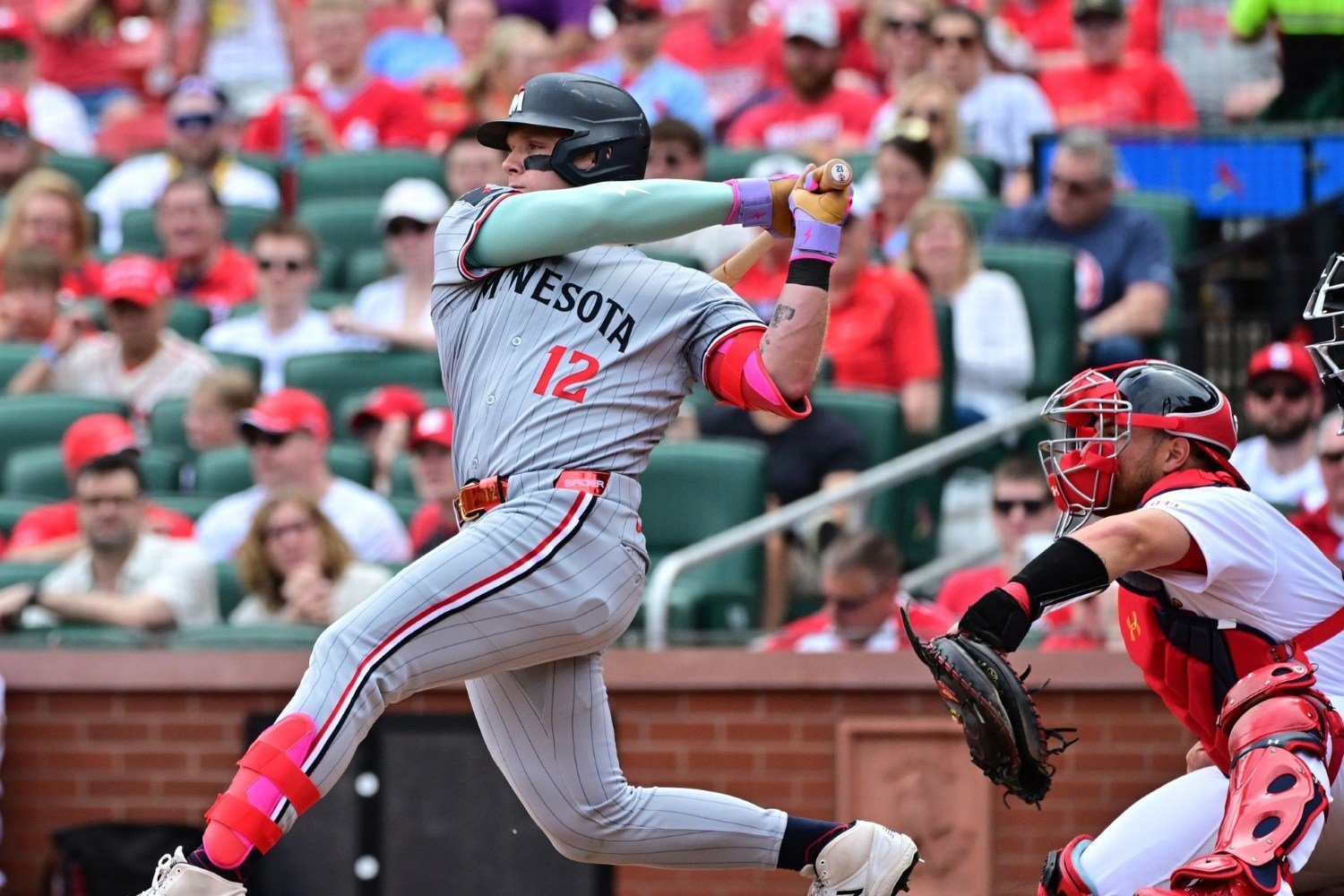
The Minnesota Twins have had a tumultuous start to the 2025 campaign, with an up-and-down performance that has made it difficult to gauge whether this team is a contender or a pretender. There have been positives, with the team’s starting pitching, Byron Buxton’s health, and various other parts of the roster. Yet, every team has some warning signs that will start to show. Five red flags are hiding in the team’s peripheral stats—figures that, if left unaddressed, could turn a competitive window into a rough slog.
1. Harrison Bader’s worrisome xBA
Bader’s impact in left field has been twofold: dazzling defense and timely hits, especially in the season’s early games. At first glance, his .280 batting average over the first few weeks suggests a renaissance. However, the underlying data raises a caution flag: Bader’s expected batting average (xBA) is in the bottom 9% of qualified hitters.
In other words, based on exit velocity and launch angle, pitchers have been getting more favorable contact than his raw average would imply. His .210 expected batting average (xBA) quantifies that regression risk. Bader’s defensive skillset will keep him in the lineup, but if those barrels dry up, the Twins will need to plug the offensive hole or risk watching their left fielder’s batting average drift back toward reality.
2. Willi Castro’s paltry exit velocity
Castro recently returned from a strained right oblique that may impact his overall numbers. More telling than his .232/.303/.362 slash line is an average exit velocity of just 84.9 mph, ranking dead last on the Twins and in the bottom 3% of hitters.
Castro’s career average is 86.0 mph, itself below MLB’s 88.5-mph benchmark, but this season’s dip compounds worries about lingering discomfort or a mechanical hitch. While Castro’s profile has never hinged on pure power, dropping further behind the league average in exit velocity shrinks his margin for error. If that velo doesn’t tick back up, Minnesota will have to weigh patience against performance, especially from a pending free agent.
3. Twins pitchers’ alarming Hard Hit % Allowed
Pitching was supposed to be Minnesota’s bedrock in 2025, but the staff’s Hard Hit % allowed ranks dead last in baseball. Many of the team’s starters struggled their first time through the order, but that has turned into improved performance since that point.
Overall, many of the troubling totals are from some of the essential bullpen pieces: Griffin Jax (62.3% Hard Hit %), Louie Varland (60.9% Hard Hit %), and Brock Stewart (59.7% Hard Hit %). Such a high frequency of well-hit balls makes success unsustainable for relievers, who work in small samples with no safety nets. Minnesota’s rotation and bullpen depth will keep games competitive, but allowing that kind of premium contact makes for a razor-thin margin. Unless the Twins can refine pitch shapes or usage patterns, especially in high-leverage relief situations, that bottom-of-the-league slugging profile will impact the team’s ability to get back into the playoff race.
4. Louis Varland’s exit velocity conundrum
Many in and around the Twins organization were excited about Varland’s transition to a full-time reliever this season. However, the early returns have been mixed. His 93.3 mph average exit velocity against ranks as the highest among Twins pitchers, placing him in the worst 2% of MLB.
Varland has always been guilty of “meatballs,” or pitches hung over the plate that hitters feast upon. His poor exit velocity numbers are similar to his time as a starter, signaling it’s a mechanical or execution issue, not just a bout of bad luck. Manager Rocco Baldelli’s decision to deploy him heavily from the bullpen underscores how badly the Twins need his strikeout prowess. Yet, Varland must expand his arsenal around the zone to avoid turning his high-leverage offerings into easy run production for opponents.
5. Simeon Woods Richardson’s inflated xSLG
Woods Richardson was the story of 2024’s first half, as he was the team’s best rookie (and arguably a rotation savior). But he has shown some cracks in his armor as big-league teams get an extended look at him.
Through early May 2025, SWR’s expected slugging percentage (xSLG) clocks in at .533, nearly 90 points above his actual .445 mark. That gap suggests that when hitters do square him up, they’re hitting the ball with authority—and often in the air. This season’s elevated projection is startling, compared to his 2024 xSLG of .373. The Twins have rewarded his 2024 performance by keeping him in the rotation, but other prospects are closing in on the big leagues. His spot isn’t in danger yet, but he’ll need to continue to refine his approach.
Early-season anomalies rarely play out to their fullest possible extent, because luck and quick adjustments can blunt the greatest effects. However, Minnesota’s front office and coaching staff must acknowledge these hidden warning lights. This could include adjustments for Bader’s approach, re-evaluating Castro’s role, bullpen retooling for those being hit hardest, or pitch changes for Woods Richardson. And right now, some of Minnesota’s most critical contributors are posting underlying numbers that could point toward regression.
Which statistic is most alarming? Leave a comment and start the discussion.