
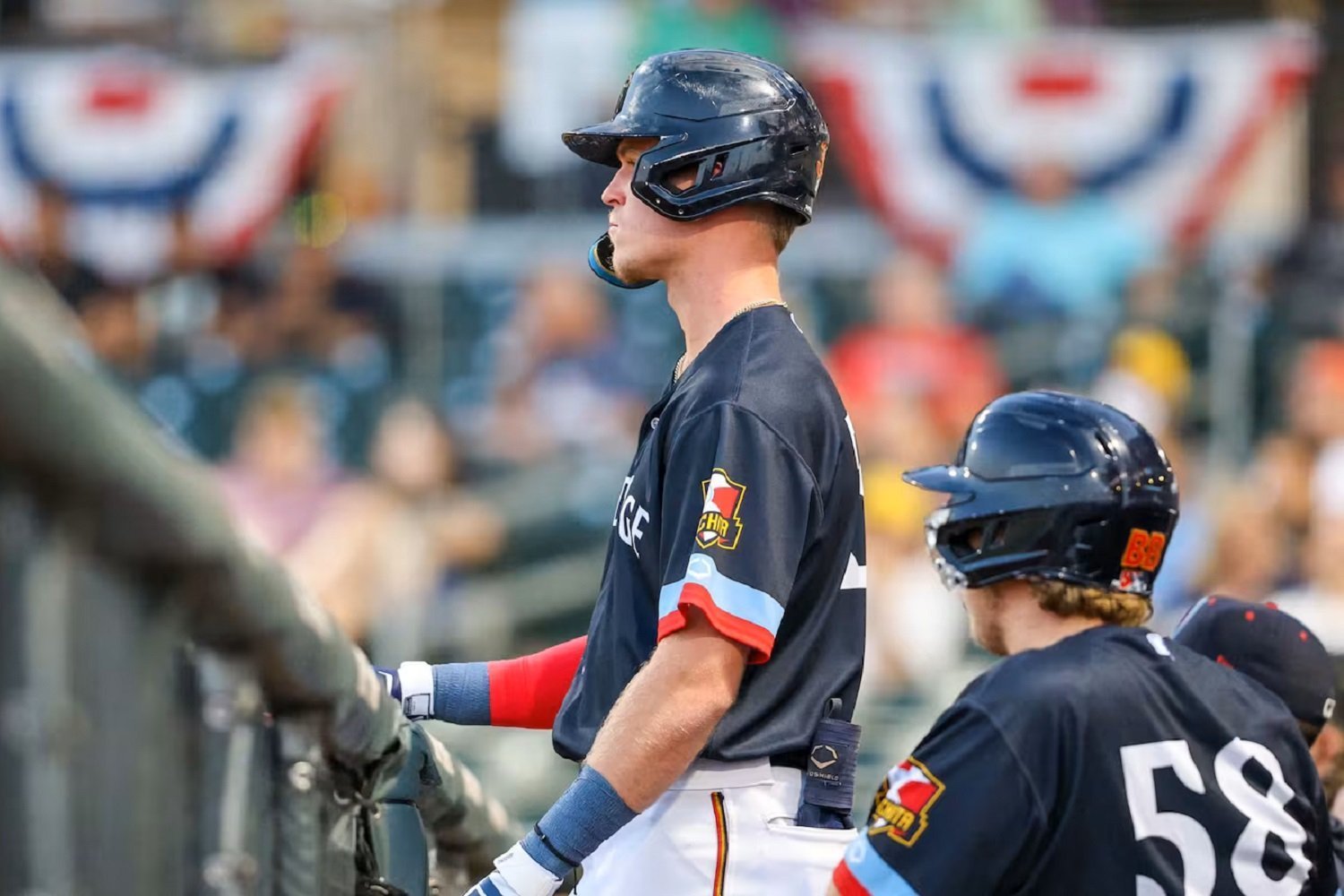
Image courtesy of Ed Bailey, Wichita Wind Surge
For top prospects, development rarely follows a straight and predictable path. In the case of Walker Jenkins, the journey to big-league stardom hit a significant speed bump this spring. Now that the 20-year-old outfielder has returned to Double-A Wichita following an extended rehab stint, it is fair to ask what exactly he needs to prove during the remainder of the 2025 season.
The answers begin with health and culminate in unlocking more of his long-anticipated offensive potential.
A Rocky Start to 2025
Jenkins entered this season as one of the crown jewels of the Twins’ minor league system. As a former first-round pick, fifth overall in 2023, he was set for a full season at Double-A during his age-20 campaign. Unfortunately, those plans quickly unraveled.
He suffered a left high ankle sprain during spring training, though he was cleared in time for Opening Day. After just two games with Wichita, however, renewed stiffness in the same ankle forced him back onto the injured list on April 9. What was initially viewed as a minor setback turned into a lengthy absence. A cortisone injection was required in late April to calm the persistent inflammation, and Jenkins didn’t return to game action until early June with a rehab assignment at Low-A Fort Myers.
In eight games for the Mighty Mussels, Jenkins produced a .280 batting average, going 7-for-25, with a .419 on-base percentage, one home run, and two stolen bases. The results were respectable, but, more importantly, he moved well and logged consistent at-bats. Now that he is back at Double-A, the real test begins.
Staying on the Field is Priority Number One
More than anything else, Jenkins must stay healthy for the remainder of the 2025 season. There is no sugarcoating the reality that durability is now a concern in Jenkins’ prospect profile. High ankle sprains can be problematic for outfielders who depend on quick first steps, sudden cuts, and explosive bursts both in the field and at the plate. The lingering nature of this injury is something to monitor moving forward.
What Jenkins needs more than any highlight-reel performances is a steady stretch of daily games. There is no need for a rushed promotion to Triple-A St. Paul or talk of a late-season call-up. The goal should be straightforward and clear: maintaining health, playing games, and achieving steady plate appearances against upper-level pitching.
If Jenkins can log 80 or more games at Double-A this summer, that alone would be a significant step forward. It would help restore confidence in the front office that he can handle a full workload when the Twins call on him in 2026 and beyond.
Finding the Power Stroke
Another essential part of Jenkins’ checklist this season is showing growth in the power department.
Some national outlets have ranked him lower on their Top 100 prospect lists, with concerns about his game power playing a significant role. Last season at Low-A Fort Myers, Jenkins posted solid overall numbers, but his underlying contact quality metrics left room for improvement. His Barrel rate, 90th percentile exit velocity, and Hard Hit percentage all ranked below the 62nd percentile. These numbers suggest that his raw power has not yet translated into consistent in-game pop.
A closer look shows part of the problem. Jenkins is not pulling the baseball with enough authority. His pull percentage last season ranked in the 21st percentile, and his rate of pulled fastballs sat at an even lower 13th percentile. This means that far too many of his batted balls are being hit softly to the opposite field or up the middle rather than turned on with intent.
For Jenkins to unlock the extra-base potential that made him such a highly regarded draft pick, this must change. Whether it requires a slight timing adjustment, a tweak to his swing path, or a more aggressive approach on fastballs he can drive, Jenkins needs to start punishing mistakes. Scouts and analysts want to see him pull fastballs into the gap with force.
Keeping Patience at the Plate
Even as Jenkins works to tap into more power, he cannot abandon his natural strength as a patient hitter. His Fort Myers rehab stint provided a reminder of this skill, as he posted a .400 on-base percentage and displayed his usual calm, disciplined approach. Jenkins has always had an excellent feel for the strike zone, rarely chasing pitches out of the zone or swinging wildly at them.
Maintaining that patience is essential as he attempts to add more aggression and pull-side damage to his game. The challenge for many young hitters at Double-A is learning when to sit back and when to attack. Jenkins has the instinct to find that balance, and Double-A offers the perfect environment for him to develop this critical skill.
What Does Success Look Like in 2025?
So, what would make this season a success for Jenkins? It is not about Triple-A St. Paul or gaudy statistics. The mission for 2025 is proving to himself, to the Twins, and to baseball evaluators that he can stay healthy and take the next steps toward unlocking his offensive ceiling.
Suppose Jenkins can play 80+ games without further incident, improve his hard contact rates, pull more fastballs with authority, and continue to show his signature plate discipline. In that case, this season will be considered a success. The prospect rankings will follow in time. The power will come. His enormous potential remains, but 2025 must be the year when the foundation for a healthy and productive career is finally established.
For now, there is no reason to talk about Triple-A or major league debuts. The goal is far simpler but just as important: health, production, and progress at Double-A Wichita. And for Jenkins and the Twins, that is enough reason to consider this season a vital step forward.
What will you look for from Jenkins this season? Leave a comment and start the discussion.