
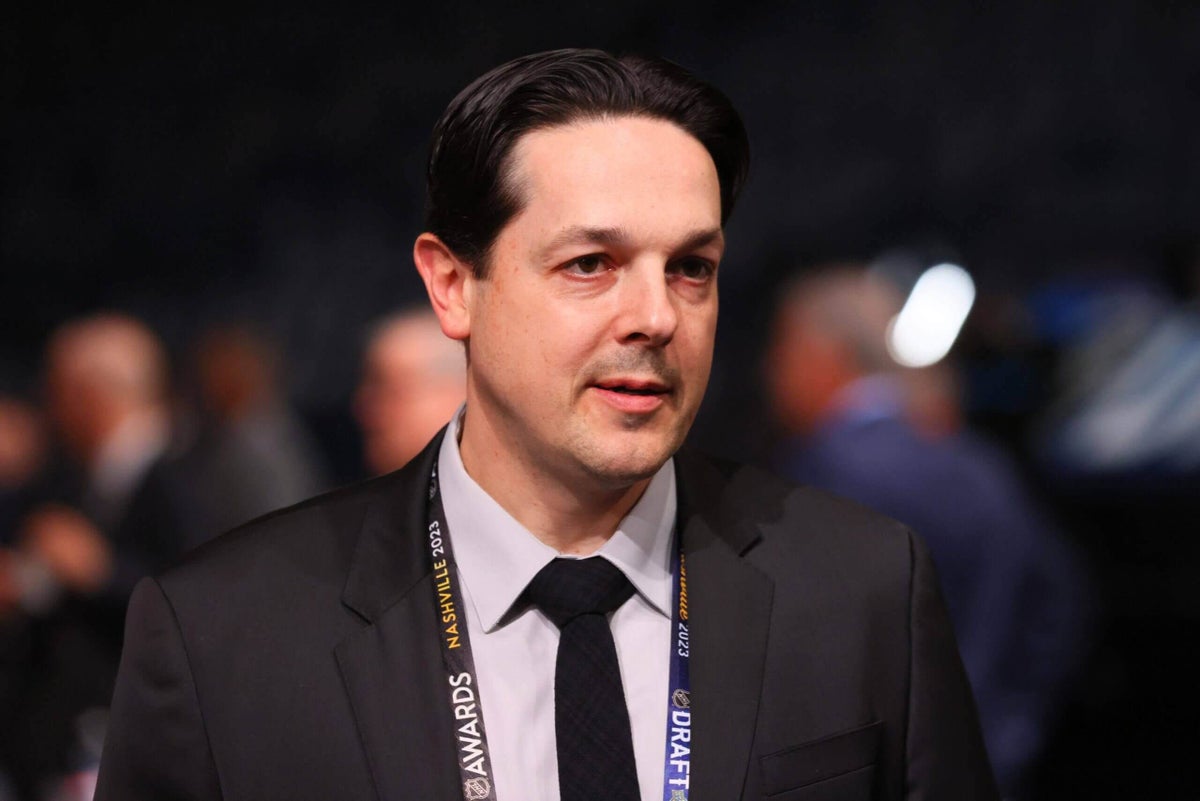
VOORHEES, N. J. — Philadelphia Flyers general manager Daniel Briere has repeated a variation of the same phrase three times in recent months: in the aftermath of John Tortorella’s firing on March 27; at the formal introduction of coach Rick Tocchet on May 16; and again this week in his annual pre-draft media conference.
“One thing I want to make sure, and let our fans know, is that our plan hasn’t changed,” Briere said on Tuesday.
Briere was responding to a query regarding how aggressive he intends to be this offseason. It’s a valid question. Briere has already expressed a desire for the club to turn the corner. He wants the Flyers to be better, perhaps more resembling the 2023-24 club, when they surprisingly stayed in the playoff mix before a confluence of events — some of which were under his control, and some not — saw them fritter it away.
There is reason to believe they could improve in 2025-26, too. Matvei Michkov may very well be on the cusp of stardom. Tyson Foerster, Noah Cates, Bobby Brink, Cam York and Jamie Drysdale are all still young and improving. Some intriguing prospects are turning pro. Travis Sanheim and Travis Konecny are two players who any team would love to have.
Further, there seems to be a strong internal culture that’s been built on hard work and sacrifice, which will be nurtured by having an experienced coach like Tocchet now overseeing the club.
But to expect the Flyers to meaningfully take steps forward without a significant addition or two by Briere — particularly after two years of roster subtraction — is, to be blunt, ludicrous. And, considering some of his comments on Tuesday, it’s fair to wonder — what exactly is the plan now, after they’ve reached what Briere has already said he hopes is rock bottom?

Briere said he doesn’t expect trade discussions to really ramp up until the start of next week. (Photo: Bruce Bennett / Getty Images)
What we do know, and that Briere has made clear both in his words and his actions, is that he’s going to remain patient. It’s perhaps his greatest virtue. There is extreme cautiousness to not jeopardize the future for any quick fixes, while ensuring that the players he signs to long-term extensions, and targets in free agency and trades, make sense from both a hockey and cultural standpoint.
In that sense, it’s difficult to argue with much of anything he’s done so far. Other than the eight-year extension for Owen Tippett, which could still go either way, Briere has brought in solid veterans and signed current players to reasonable contract extensions only after they’ve been earned.
But something else Briere has done with so many of these moves is hasten the timeline for them to try and become truly competitive again. Konecny and Noah Cates could have easily been moved for futures. Garnet Hathaway and Nick Seeler, had they not been signed to their respective extensions last year, would have brought back more draft picks and/or prospects from playoff contenders looking to bulk up. On top of that, Sanheim, 29, and Konecny, 28 — two established pillars of the rebuild who are now in the primes of their careers — aren’t getting any younger.
While that all jibes with another part of the plan that Briere has been upfront about — that the Flyers have put a premium on remaining competitive throughout their rebuild — it also reflects that they’re planning on getting back to the playoffs sooner rather than later.
And now, what is typically the most eventful part of the offseason — the approximate two-week stretch from the end of the Stanley Cup Final to the opening of free agency on July 1 — is here. It’s the most opportune time for Briere to try to improve the roster.
But, will he? Because judging from what he said on Tuesday, it sure doesn’t seem like he’s in much of a hurry.
The Flyers have three first-round picks and four second-round picks in the upcoming draft, which, you would think, might be available in the right deal for a young player or two who could help now and in the future. The Flyers could conceivably use some of those picks in trades, while also keeping enough of them to bolster what looks like a middle-of-the-road farm system.
They don’t have nearly as much to play with a year from now, with just a total of six picks — one in each round, except the fifth.
So, shouldn’t there be some urgency to finally take one of those proverbial big swings? Not in Briere’s view, if you believe his comments. He suggested that the players the Flyers could select with their bevy of 2025 picks will eventually have more value than the picks themselves. And, in theory, could net a bigger return.
“Right now, the picks are just numbers, when you look at them. But, eventually there’s a name to it,” he said. “The one thing I’ve realized is (that) when you talk to teams, is that those names become very powerful, (after) you start developing them. It’s really tough to acquire the value that teams put on names (that) become stronger and stronger.”
Flahr interjected: “You know what we’re trying to do here. … We’re not going to be throwing away (assets) for rental, older players. But if there’s a younger player that fits in our age group that helps us now, or is worth a pick or certain picks, yeah, certainly.”
Of course, there may not be any young, elite players out there to pursue. Briere strongly suggested as much when touching on the club’s well-known need for another high-end center.
“Calling around the league and finding centers is almost impossible,” he said. “And you’re not going to find a first-line or second-line center. A lot of teams will be willing to entertain moving a fourth-line guy, but they will want a second-line winger in return. They’re hard to find.”
They are hard to find. But this is the path that Briere and president of hockey operations Keith Jones chose two years ago. They must have anticipated that this moment was coming.
Briere expressed hope that some of the prospect centers already in the system (or that they could select next week) could eventually develop into high-end players, but that could be three or four years away — and the organizational plan, as he’s made clear, is to be a competitive team sooner than that. Unless they find more talent before then, the Flyers are at risk of being stuck in that so-called mushy-middle for the foreseeable future.
Perhaps it’s all a smokescreen. Briere said he doesn’t expect trade discussions to really ramp up until the start of next week. He may already have something up his sleeve that he’s trying not to give away.
But if the Flyers are going to achieve their plan of improving next season — and, therefore, making themselves a more desirable organization for free agents in the 2026 offseason, when they have tens of millions of dollars in cap space — the time to do something substantial may have arrived.
We’ll find out soon enough if the general manager agrees. For now, at least publicly, he’s tamping down that expectation.
“We’re not going to pay crazy assets just to do something crazy,” Briere said. “It has to make sense. If it doesn’t, it doesn’t, we’ll select our players (in the draft). It might be all the picks, and there might be nothing that changes, but at the same time, if we have a chance to improve the team and it makes sense for the long term, we are going to look into it. So, it’s on the table, but aggressive is probably the wrong word.”
(Top photo of Daniel Briere: Bruce Bennett / Getty Images)