
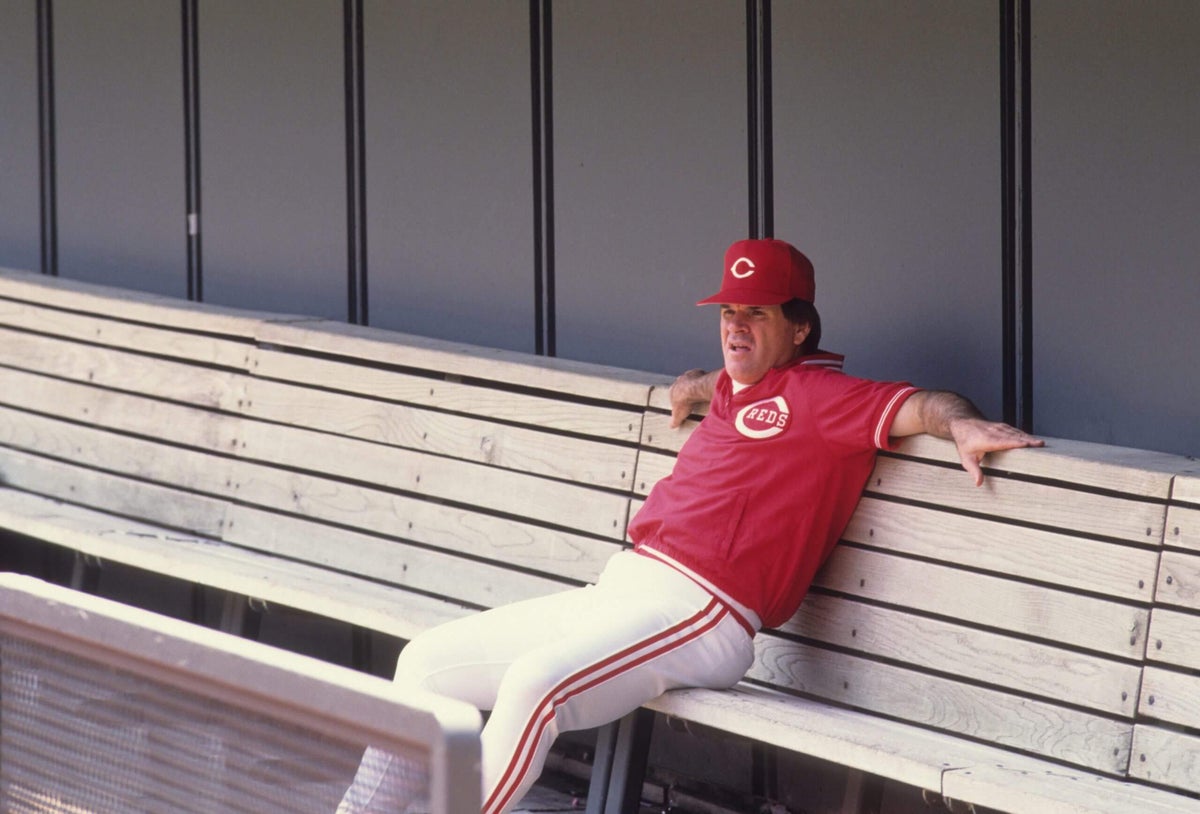
The long saga of Pete Rose’s betting on baseball goes back over 40 years, taking multiple twists and turns before finally reaching its latest end point: Rose’s reinstatement to baseball. While much of the fireworks came in 1989, the year Rose agreed to a lifetime ban, the back-and-forth persisted for decades as Rose made numerous attempts at reinstatement while also revealing details about his betting.
Aug. 15, 1984
Rose returns to Cincinnati as player/manager
Rose was 21 years into his playing career when he returned to Cincinnati, the city where he’d been born and raised and played his first 16 major-league seasons. After stints with the Philadelphia Phillies and Montreal Expos, Rose came back to the Reds with three World Series rings, 16 All-Star selections and more than 4,000 hits. He was immediately named player/manager. It was his first managerial job. Rose would retire as a player in 1986 but keep managing through the league’s gambling investigation in 1989. The league’s evidence of Rose’s betting on baseball occurs during this point in his career.
Feb. 20, 1989
Rose summoned to league office
Having retired as a player in 1986, Rose was in his fifth spring training as Reds manager when he met with Major League Baseball commissioner Peter Ueberroth in New York City. No reason for the meeting was announced. It was later revealed that on Feb. 23, the league retained lawyer John Dowd as a special counsel to lead its investigation into Rose.
March 20, 1989
MLB announces investigation
As word of Rose’s gambling allegations was beginning to leak, the league officially acknowledged that an investigation was underway. Ueberroth was in his final weeks as commissioner, and so the league issued a joint statement from both Ueberroth and his successor, National League president Bart Giamatti: ”The office of the commissioner, which was founded to preserve the integrity of the game, has for several months been conducting a full inquiry into serious allegations involving Mr. Pete Rose.”
March 21, 1989
Sports Illustrated lays out the case
Hand signals from the dugout. Bodybuilders as middlemen. A restauranteur bookie. One day after the league acknowledged its investigation, Sports Illustrated made many of the details public in a damning report of Rose’s debt, fraud, habits and lies. Rose was still denying that he’d bet on baseball, but the Sports Illustrated story told of his obsession with betting, and of his association with “undesirables” linked to drugs and gambling, some of whom said they had placed baseball bets on Rose’s behalf.
March 30, 1989
The Cincinnati Enquirer details previous investigation
Quoting Major League Baseball’s former chief of baseball security, The Cincinnati Enquirer reported that MLB previously investigated Rose’s gambling connections in the 1970s but uncovered nothing illegal. This was one of several reports coming from various outlets, uncovering bits and pieces of the investigation and Rose’s gambling.
April 1, 1989
Giamatti becomes commissioner
Elected in September to replace Ueberroth as commissioner, Giamatti’s term didn’t officially start until April, when Major League Baseball was in the thick of the Rose controversy. The issue would come to define Giamatti’s brief stint in the role.
April 18, 1989
Giamatti tells judge the key source is cooperating
Commissioner Giamatti wrote a letter to U.S. District Judge Carl Rubin, who was presiding over a drug and tax evasion trial against Ron Peters, a restaurant manager believed to be Rose’s primary bookmaker. In the letter, sent at the request of Peters’ lawyer, Giamatti made it clear that Peters was cooperating with the league’s investigation into Rose.
May 9, 1989
Dowd Report submitted to Major League Baseball
Dowd’s investigation resulted in a 225-page report with seven volumes of exhibits. The conclusion is summarized on Page 3: “The testimony and evidence gathered in the course of the investigation demonstrated that Pete Rose bet on baseball, and in particular, on games of the Cincinnati Reds Baseball Club, during the 1985, 1986 and 1987 seasons.”
Dowd’s investigation found that Peters was Rose’s bookmaker, and Rose typically placed his bets through intermediaries, primarily Tommy Gioiosa.
According to the report, “Rose’s dealings with Gioiosa, and ultimately with Peters, are corroborated by the testimony of others and by Rose’s own financial records as well.”
The report notes that “no evidence was discovered that Rose bet against the Cincinnati Reds.”
June 19, 1989
Rose sues Giamatti and Major League Baseball
Alleging that Giamatti was not an impartial judge and that the league’s investigation was improper, Rose sued the commissioner to block a hearing Giamatti had scheduled for June 26.
Aug. 24, 1989
Rose agrees to a lifetime ban from baseball
Some six months after the league’s investigation began, Rose agreed to accept a lifetime ban from baseball. Rose dropped his lawsuit against Giamatti, and Giamatti agreed not to issue an official verdict on whether Rose bet on baseball. Although the decision was an agreement between the two parties, MLB’s rules stated that any player who bet on a game involving his team should be declared “permanently ineligible.”
After the agreement was announced, both Giamatti and Rose issued statements. Giamatti’s statement was lengthy and defended his process while speaking to the ideals of fairness and integrity. He opened, though, with a blunt assessment of the result: “The banishment for life of Pete Rose from baseball is the sad end of a sorry episode. One of the game’s greatest players has engaged in a variety of acts which have stained the game, and he must now live with the consequences of those acts.”
Rose’s statement was shorter and called the settlement “fair” while still denying he had ever bet on baseball. He promised to tell his side of the story in the future. He finished by acknowledging his hope for a swift return to the game: “I’ve never looked forward to a birthday like I’m looking forward to my new daughter’s birthday, ’cause two days after that is when I can apply for reinstatement.”
Sept. 1, 1989
Giamatti dies of heart attack
Barely a week after announcing the Rose decision, Giamatti died at his home on Martha’s Vineyard. He was 51 years old and had been commissioner for five months. Despite his brief tenure in the role, Giamatti’s decision would resonate within baseball for decades as every commissioner that followed — Fay Vincent, Bud Selig and now Rob Manfred — would wrestle with whether to reverse course and reinstate Rose.
April 20, 1990
Rose pleads guilty to tax fraud
Less than a year after accepting banishment from baseball, Rose admitted to filing false federal income tax returns in 1985 and 1987. He would eventually be sentenced to five months in an Illinois federal prison. He was released from prison on Jan. 7, 1991. On the day he pleaded guilty to the two counts of tax fraud, Rose issued a statement that read in part: ‘Today, I am facing the facts of what my addiction to gambling has done.”
Feb. 4, 1991
Hall of Fame votes to keep Rose off ballot
Because he retired as a player in 1986, Rose would have been eligible for the Hall of Fame ballot in December 1991, but the Hall’s board of directors put a stop to that by ruling unanimously that players on baseball’s permanently ineligible list would not be eligible for the Hall of Fame.
“The directors felt that it would be incongruous to have a person who has been declared ineligible by baseball to be eligible for baseball’s highest honor,” then-Hall of Fame president Edward Stack said in a statement after the decision. “It follows that if such individual is reinstated by baseball, then such individual would be a candidate for election, were he to meet the other requirements for eligibility.”
Current rules dictate that a player eligible for the standard Hall of Fame ballot — the one voted on by the Baseball Writers Association of America — must have played in the major leagues no more than 15 years before election. That means that any future Hall of Fame consideration for Rose will be in the hands of the Era Committee (often called the Veterans Committee), which consists of 16 Hall of Famers, executives and veteran members of the media.
Sept. 26, 1997
Rose applies for reinstatement
Bud Selig was the fourth baseball commissioner to consider Rose’s case for eligibility. Eight years after he was banned for life, Rose sent a letter to Selig applying for reinstatement. Selig never officially ruled on the application but made clear that he saw no reason to change Giamatti’s decision, a stance Selig would hold throughout his tenure as commissioner.
“I still have the same strong feelings,” Selig said in a television interview in 2015. “That gambling rule has been on the books forever, and the job of a commissioner is to always, under all circumstances, protect the integrity of the sport.”
Oct. 24, 1999
Rose attends World Series pregame ceremony
His baseball ban effectively lifted for one night, Rose was part of a pregame ceremony honoring baseball’s All-Century Team before Game 2 of the 1999 World Series in Atlanta, and his introduction drew an ovation bigger and longer than for any of the other all-time greats on the field. The appearance became controversial when NBC reporter Jim Gray interviewed Rose on the field and repeatedly asked him about gambling and the opportunity to apologize.
“Are you willing to show contrition, admit that you bet on baseball and make some sort of an apology to that effect?” Gray asked.
Rose said he was “not going to admit to something that didn’t happen” and grew frustrated when Gray stayed on the topic.
Rose was on the field for another World Series game in 2002 and again received a massive ovation, including “Hall of Fame!” chants.
Jan. 27, 2000
Rose’s lawyers again make case for his innocence
More than a decade after he was banned from the sport, Rose was still maintaining his innocence. Two of his lawyers, S. Gary Spicer and Roger Makley, met with MLB lawyer Bob DuPuy to yet again argue that flaws in the Dowd investigation meant Rose could not be found guilty of betting on baseball. Selig was not swayed.
”Pete did accept a voluntary lifetime suspension from Dr. Giamatti,” Selig said three weeks later. ”There hasn’t been any new evidence since then. I think just from my answer, you’ll understand my depth of feeling on this subject.”
Nov. 25, 2002
Rose and Selig meet privately in Milwaukee
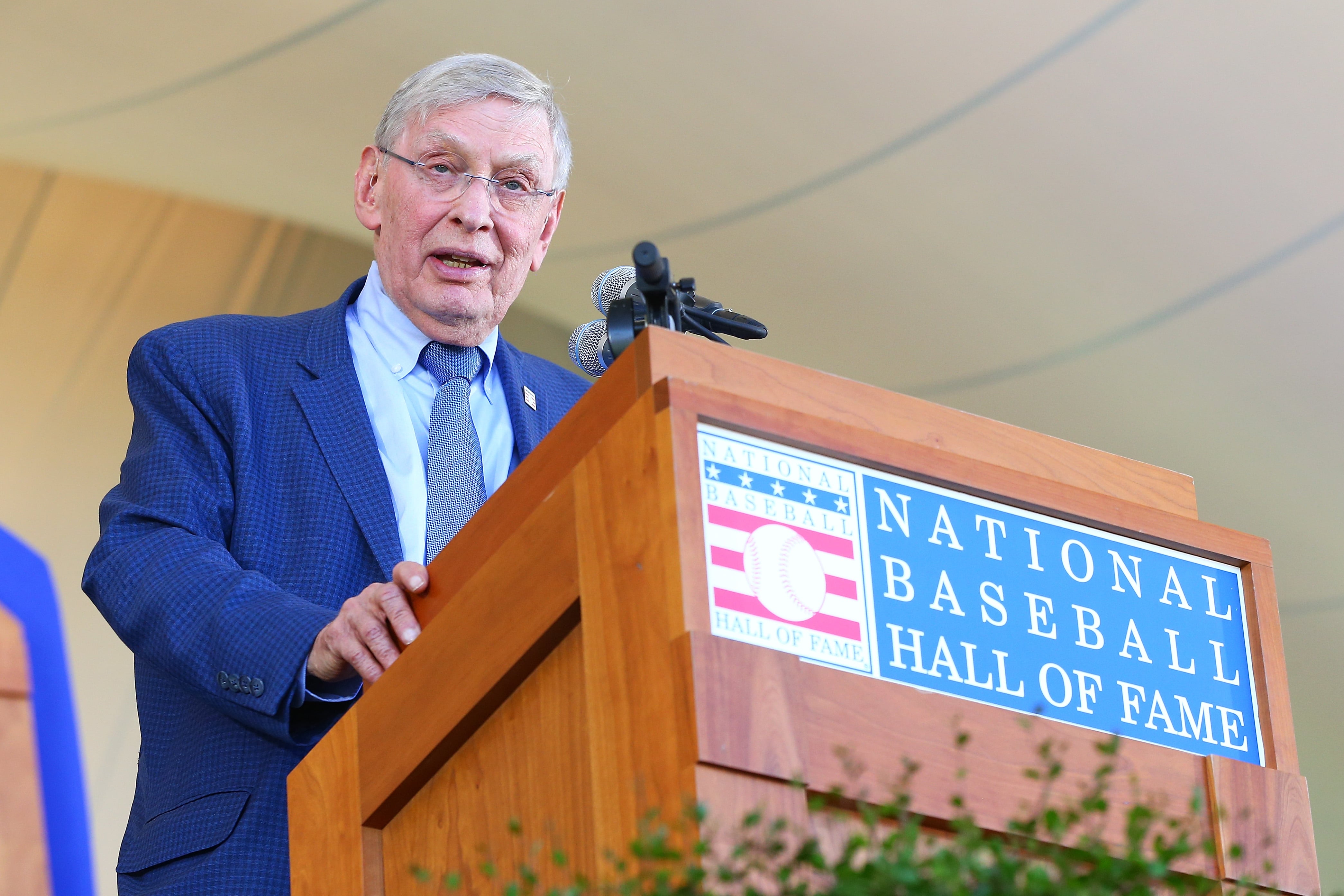
Rose told MLB commissioner Bud Selig that he bet on baseball during a private meeting. (Mike Stobe / Getty Images)
It would be weeks before this meeting was known to the public, and more than a year before its significance was fully understood. Rose and Selig met privately in Milwaukee, where Rose finally confessed to Selig that he had bet on baseball. Rose wrote about the meeting in his autobiography. Sports Illustrated reported that Selig “read him the riot act” after hearing Rose’s long-awaited confession.
Jan. 5, 2004
Rose publicly admits to betting on baseball
After 15 years of public denial, Rose admitted to betting on baseball while managing the Reds. The admission came in an autobiography, “My Prison Without Bars,” which was excerpted in various publications shortly before the book’s release.
“I didn’t realize it at the time, but I was pushing toward disaster,” Rose wrote. “A part of me was still looking for ways to recapture the high I got from winning batting titles and the World Series. If I couldn’t get the high from playing baseball, then I needed a substitute to keep from feeling depressed. I was driven, in gambling as well as in baseball. Enough was never enough.”
Rose made the same admission, around the same time, in an interview with ABC, saying specifically that he bet on his team in 1987 and 1988. He said he never bet against the Reds, and said he acknowledged his guilt in a private meeting with Selig in 2002. Although Rose acknowledged that he was wrong for betting on baseball, his book’s epilogue suggested little remorse.
”I’m sure that I’m supposed to act all sorry or sad or guilty now that I’ve accepted that I’ve done something wrong,” he wrote, “But you see, I’m just not built that way.”
June 22, 2015
ESPN reports Rose bet on baseball as a player
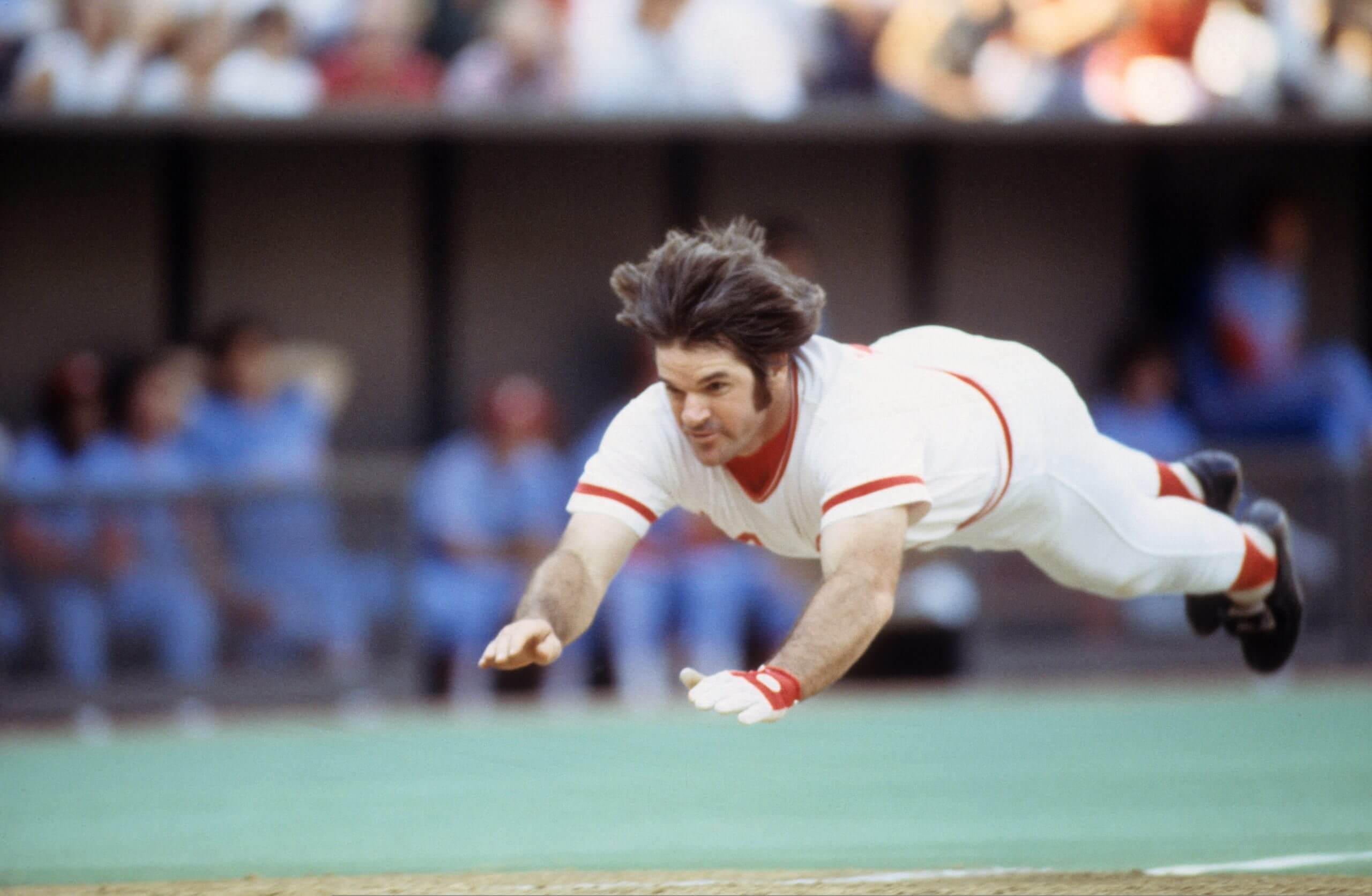
Sports Illustrated reported that Rose bet on the baseball while still an active player with the Reds. (John Iacono / Sports Illustrated via Getty Images)
The Dowd Report presented evidence that Rose bet on baseball as a manager. More than 20 years later, the ESPN investigative show “Outside The Lines” reported on evidence showing Rose was betting on the Reds as a player as well. Pages from a notebook found at the home of former Rose associate Michael Bertolini — discovered during a raid after Rose had agreed to his lifetime ban — documented bets by Rose in 1986, when he was still a player. Interviewed by ESPN, Dowd said his 1989 investigation included testimony that Rose bet on baseball as a player, but that investigation uncovered no physical evidence.
“This does it,” Dowd said. “This closes the door.”
Dec. 14, 2015
Manfred denies Rose’s appeal for reinstatement
Manfred met with Rose in the fall of 2015 and announced later in the year that he was denying Rose’s latest application for reinstatement. In a written explanation of his decision, Manfred wrote that Rose had admitted to continuing to bet on baseball. Rose also declined to admit that he bet on games as a player.
“In short,” Manfred wrote in his report, “Mr. Rose has not presented credible evidence of a reconfigured life either by an honest acceptance by him of his wrongdoing, so clearly established by the Dowd Report, or by a rigorous, self-aware and sustained program of avoidance by him of all the circumstances that led to his permanent ineligibility in 1989.”
June 16, 2017
President Trump hires John Dowd as special counsel
Under investigation related to Russian meddling in the 2016 election, President Donald Trump added Dowd — the leader of MLB’s 1989 investigation into Rose’s gambling — to his legal defense team. Dowd worked in that capacity for nine months before resigning in March 2018 after a disagreement about whether Trump should agree to be interviewed as part of the investigation. Dowd’s tenure with Trump was occasionally rocky, with various public missteps along the way.
“The president was said to be pleased with the resignation of Mr. Dowd,” The New York Times wrote, “whose prickly personality had begun to grate on him and other members of the legal team, according to a person who spoke with the president. Mr. Trump had lost confidence in his lead lawyer in recent weeks and had spoken to the outside lawyers without directly consulting Mr. Dowd about hiring them, the person said.”
Nov. 11, 2022
Rose again asks Manfred to become Hall of Fame eligible
At 81, Rose tried one last time for a chance to be enshrined in the Hall of Fame. He sent a letter to Manfred offering another apology and making clear that he wanted desperately to be in Cooperstown. “I am the Hit King,” Rose wrote, “and it is my dream to be considered for the Hall of Fame.” Manfred did not lift the ban and said the question of Rose’s Hall of Fame eligibility rested with the Hall of Fame itself.
Sept. 30, 2024
Rose dies at 83
Baseball’s all-time hits leader died at his home in Las Vegas. A coroner’s report said he died of natural causes related to “hypertensive and atherosclerotic cardiovascular disease with a significant condition of diabetes mellitus.” Neither Manfred nor head of the Players Association Tony Clark issued immediate statements about Rose’s passing, a silence that spoke volumes about the uncomfortable relationship between baseball and one of its greatest players.
“Had Shakespeare written about baseball,” Bruce Weber wrote in The New York Times obituary, “he might well have seized on the case of Rose, whose ascent to the rarefied heights of sport was accompanied by the undisguised hubris that undermined him.”
Jan. 8, 2025
Petition from Rose’s family
A month and a half after Rose’s death, his daughter, Fawn Rose, and lawyer Jeffrey Lenkov met with Manfred and MLB spokesman Pat Courtney. The meeting was in December 2024, and shortly after, the family filed a petition with the league asking that Rose be reinstated from the permanently ineligible list. Lenkov told ESPN that the goal of the petition was to ultimately get Rose inducted into the Hall of Fame.
Feb. 28, 2025
President Trump announces plan to pardon Rose
In a social media post, President Trump announced a plan to pardon Rose at some point in “the next few weeks.” It was unclear for what crime Rose would be pardoned. President Trump also wrote that Rose should be inducted into the Hall of Fame, though no legal hurdles existed that kept him from eligibility or induction. Trump previously had posted his support for Rose on social media in 2015 before his first term as president.
April 16, 2025
Manfred meets with Trump, discusses Rose
In a meeting at the White House, Manfred and President Trump discussed the status of Rose’s reinstatement request. Less than two weeks later, on April 28, Manfred announced that he would issue a formal ruling on the matter but declined to say whether he would lift the ban.
“I met with President Trump two weeks ago, I guess now, and one of the topics was Pete Rose, but I’m not going beyond that,” Manfred told the media. “He’s said what he said publicly, I’m not going beyond that in terms of what the back and forth was.”
May 13, 2025
Manfred removes Rose from permanently ineligible list
Seven months after he died, and more than three decades after he agreed to a lifelong ban from the sport, Rose and 16 other deceased former players were reinstated from baseball’s ineligible list. Commissioner Manfred announced his decision 36 years, almost to the day, after the Dowd Report was submitted to MLB. In a letter to Rose’s lawyer, Manfred announced a new league policy that “permanent ineligibility ends upon the passing of the disciplined individual.”
“Obviously, a person no longer with us cannot represent a threat to the integrity of the game,” Manfred wrote in his letter. “Moreover, it is hard to conceive of a penalty that has more deterrent effect than one that lasts a lifetime with no reprieve. Therefore, I have concluded that permanent ineligibility ends upon the passing of the disciplined individual, and Mr. Rose will be removed from the permanently ineligible list.”
The decision opens the door to Rose’s Hall of Fame candidacy, but it does not guarantee his induction. Per Hall of Fame rules, Rose has exhausted his eligibility for the annual BBWAA ballot, and so his fate will fall to a 16-person committee of Hall of Famers, executives and journalists.
December 2027
Classic Era Committee could decide Rose’s induction
The Era Committee — formerly known as the Veterans Committee — meets on a rotating basis to vote on the candidacy of players based on the timeframe in which they had their greatest impact on the sport. As a player whose heyday was in the 1960s and ’70s, Rose’s candidacy should fall to the Classic Era, which isn’t up for consideration until 2027. Players elected via that election would be inducted in the summer of 2028.
(Top photo: Tony Tomsic / Sports Illustrated via Getty Images)