
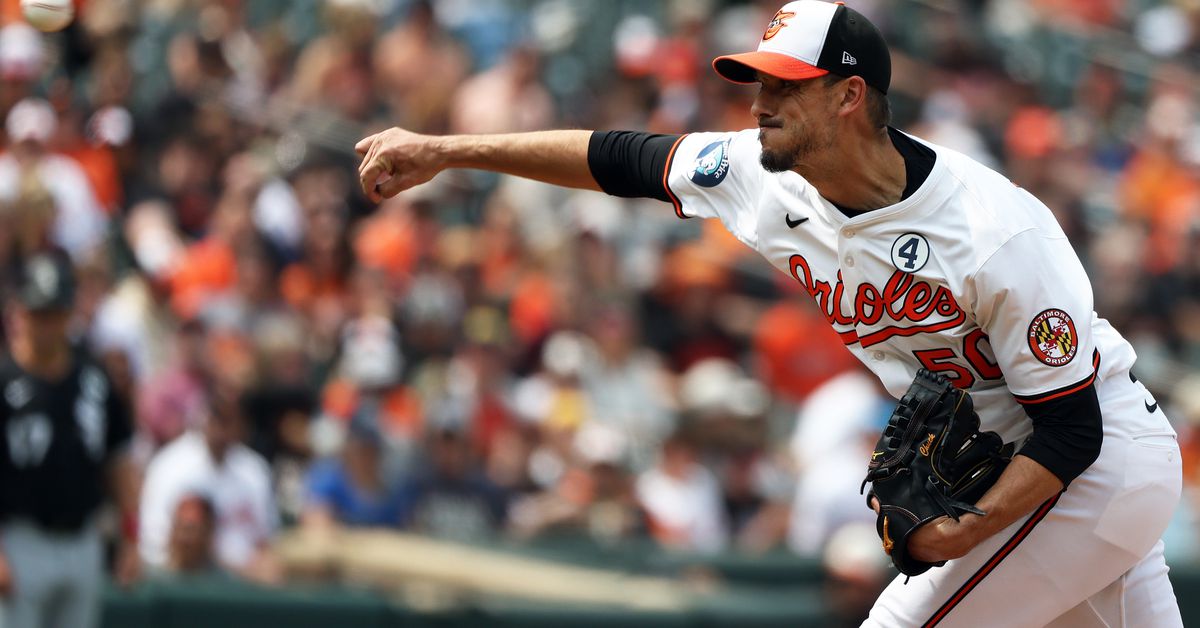
When Charlie Morton debuted in MLB, one of the Top 5 grossing movies was Hancock, Leona Lewis’s “Bleeding Love” was topping the charts, and the Phillies’ Cole Hamels was on his way to leading his team to victory in the 2008 World Series.
It’s kind of a marvel what the guy is doing out on the mound, at age 41. Maybe more so because of how dreadfully it started.
Quick refresher: the Orioles didn’t invest beyond 2025 for their rotation this offseason, showed up to camp with the second-oldest outfit in the league, no one was excited, and their 4.99 ERA is worse than all but the Athletics (bravely competing on a shoestring) and Colorado (never really competing).
But lately, the team is much more watchable. After a 9-18 May, the Orioles are 10-6 in June. It hasn’t raised them up much in the standings but it’s kept their playoff hopes alive. Pitching has been the biggest source of improvements, as the rotation has shaved off a third of a run in the last two months, and the bullpen, shockingly, is one of the Top 4 for the last three weeks. In this turnaround, no one stands out more than Charlie Morton.
It’s hard to exaggerate how bad the righthander’s debut with Baltimore was. In nine starts, he went 0-7 with a 9.38 ERA and a lousy 3.7 strikeouts per game. That included seven runs allowed in 2 1/3 innings to Cincinnati in a catastrophic 24-2 loss that had the Baltimore Sun questioning this team’s life choices. Morton looked like a sitting duck on the mound those days, confounded and confused. It was, statistically, the worst start of his 18-year career.
Reasonably, you might have thought the guy was washed, and the Orioles should cut their losses. Which is what makes his stark turnaround so fun to chart.
Over his last six starts, dating back to May 17, Morton has a 2.37 ERA, a 2.04 FIP, and is striking out 11.9 hitters per game. That includes a six-inning gem last night against the Rays, a tough opponent by any measure. The Orioles have won five of his last six outings.
In this case, it seems the villain and the hero are the same. Back in April, Morton himself blamed a lack of command for his off-key start, especially of his curveball, normally a plus pitch against which batters were slugging .818 in April. Last night, June 19, Morton noted the change: “For the better part of a month now, I’ve been locating well, I’ve been throwing strikes,” he said. “I think I made some adjustments a while back with my delivery and my timing, and since then, I’ve felt pretty good.”
Simple: command your stuff. If it were that easy, we’d all be doing it. But the results are undeniable.
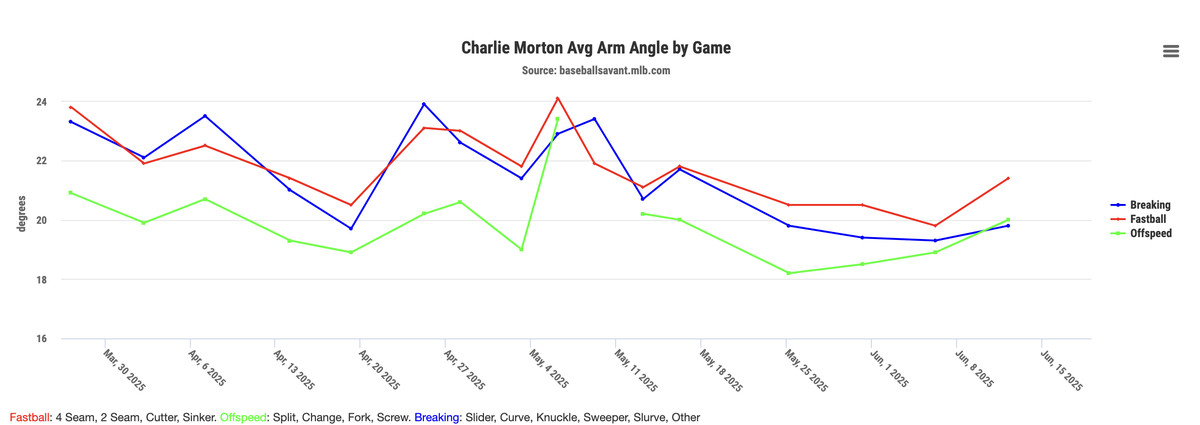
There’s definitely been a change in his delivery. A pretty drastic one, in fact. If you look at these two charts on Morton’s vertical release point and arm angle, you can see that around May 14 (the time Morton was in the bullpen, working on things) he starts to become more of a side-armer. Lo and behold, it’s a pretty big difference.

There are also changes to his offerings. For one thing, Morton’s curveball, his primary weapon over his career, is good again. Since April, hitters’ expected average on the pitch has dropped 100 points, down to .203. He’s living heavily on it now, 43% of his pitches, up ten percent from April. He’s also largely stopped throwing his cutter, against which hitters were averaging a garish .462 in the spring.
All of the above is showing in results. Morton’s groundball rate got all the way down to 24% at one point, but over his last six starts it’s back up to 44.6%, which is close to his career average.
This is consistent with the rest of what we’re seeing from Morton: more spin, more strikes, a higher chase rate, and more whiffs. That’s to say, hitters are swinging over his breaking balls, and he looks like a good pitcher now.
From a ERA over nine in his first nine starts to a 2.37 ERA in his last six, it’s been the starkest turnaround for the 41-year-old righthander. The only negative to say here is, why didn’t he work on all this earlier in the season? (The same is true, for what it’s worth, for Dean Kremer, who also had a dreadful April, though this is typical for him.) It makes me wonder about communication between the pitching staff and the players during all those months they go duck hunting, or put up drywall, or play with Legos, or whatever. All that is above my pay grade, and all of ours’, of course. So just enjoy the competent pitching, instead.