
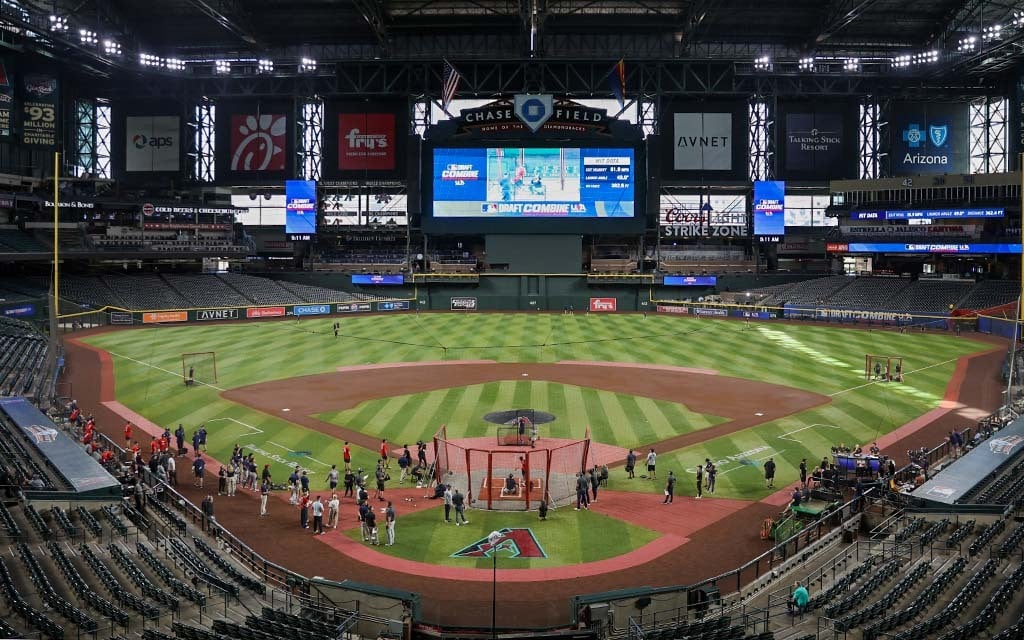
Draft prospects warm up for the 2025 MLB Draft Combine held at Chase Field on June 17, 2025. (Photo by Elizabeth Agazaryan/Cronkite News)
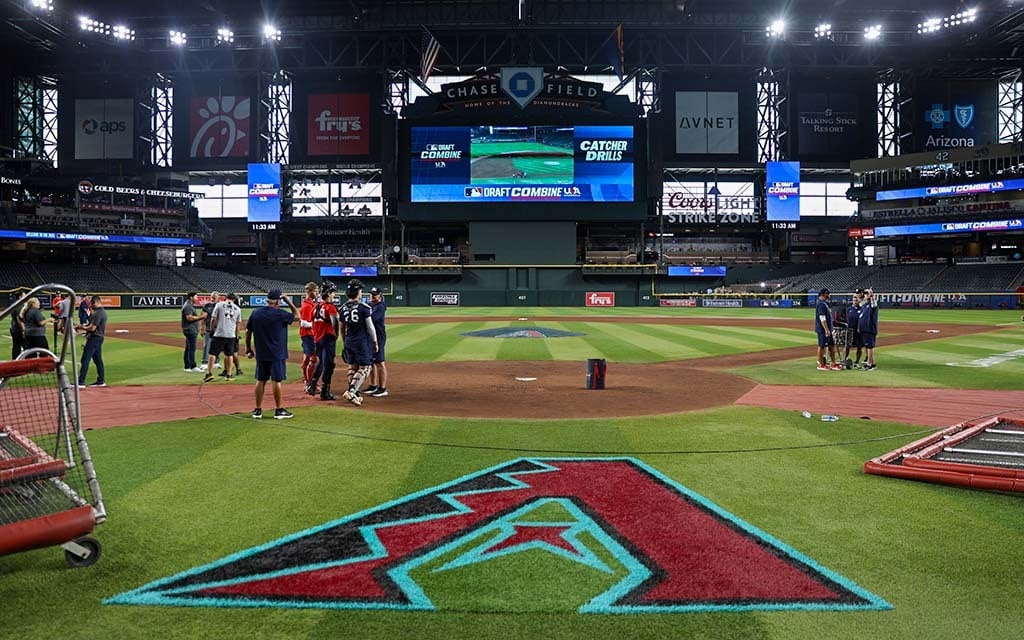
The 2025 MLB Draft Combine is held at Chase Field, home of the Arizona Diamondbacks. (Photo by Elizabeth Agazaryan/Cronkite News)
PHOENIX — The 2025 MLB Draft Combine was once again held at Chase Field, but not everybody who was invited decided to participate in on-field workouts — specifically, the players projected to have the highest draft stock.
Though the event is still very much in its infancy, top talent from across the country has begun to take a similar approach that many of the highest-ranked NFL draft prospects have followed. The pre-draft combine offered over 300 high school and collegiate baseball players the opportunity to participate in fielding drills, batting practice and strength and speed evaluations. However, numerous top players opted out, choosing to focus primarily on interviews with scouts and GMs.
Arizona State outfielder Isaiah Jackson, a high-profile draft prospect, had several factors to consider before deciding which route he would take. He chose to rely on guidance from his support system, and together they decided that the cons of participating were outweighed by the pros.
“Honestly, it’s all up to my agent,” Jackson said about the decision-making process that he went through before deciding not to participate in on-field activities at the combine. “I trust him, I have a good relationship with him, and I think his decision on what to do and what not to do is based on what he thinks is best for me.”
Jackson posted a .310 batting average at the plate this past season for the Sun Devils, and he agreed that the possibility of improving his draft stock was minimal compared to what he displayed on the diamond in 2025.

ASU baseball players Isaiah Jackson, left to right, Jack Martinez, Kien Vu and Kyle Walker, attend the 2025 MLB Draft Combine in Phoenix on June 18, 2025. (Photo by Elizabeth Agazaryan/Cronkite News)
Rather than running, throwing or batting, Jackson, along with dozens of other players, focused his efforts on “the decision-makers.”
“I think the interviews are really big,” Jackson said. “Just letting them know that the last month or so of the season wasn’t a fluke — it was what I can do and who I can be for your franchise.”
Jackson was one of several Sun Devils to make an appearance at this year’s draft combine. Alongside him last week were outfielders Kien Vu and Brandon Compton, pitchers Ben Jacobs and Jack Martinez and second baseman Kyle Walker.
Walker took an entirely different approach to the combine, choosing to take every opportunity to take the field that he could.
“Most guys just played a full season, so they might not even be mentally or physically prepared for this event,” Walker said.
Walker was one of the players who opted in for everything that he could. From his perspective, he wanted “them to see everything.”
After a tremendously successful season between the foul lines for the Sun Devils, batting .352 with an OBP of .449, Walker didn’t want to leave any room for doubt regarding his abilities.
That’s not to say that Jackson didn’t feel the same way, yet their approaches to the week were entirely different.
“(My agent) was saying that it really wouldn’t help me much, and there’s no reason to potentially get hurt,” Jackson said.
Butch Chaffin, a well-known and deeply embedded member of the USA Baseball program, pointed to a variety of reasons as to why players chose either to participate in drills or not.
Chaffin has served USA Baseball in a variety of capacities, including as a coach and on several task forces and development programs. Chaffin was most recently named assistant coach and pitching coach for the 2025 Collegiate National Team Prospects squad.
He has known many of the players who attended the pre-draft combine since they were in their early years of middle school. As a longtime supporter and staff member of USA Baseball, he knows firsthand what variables go into deciding whether or not to opt for the on-field workouts.
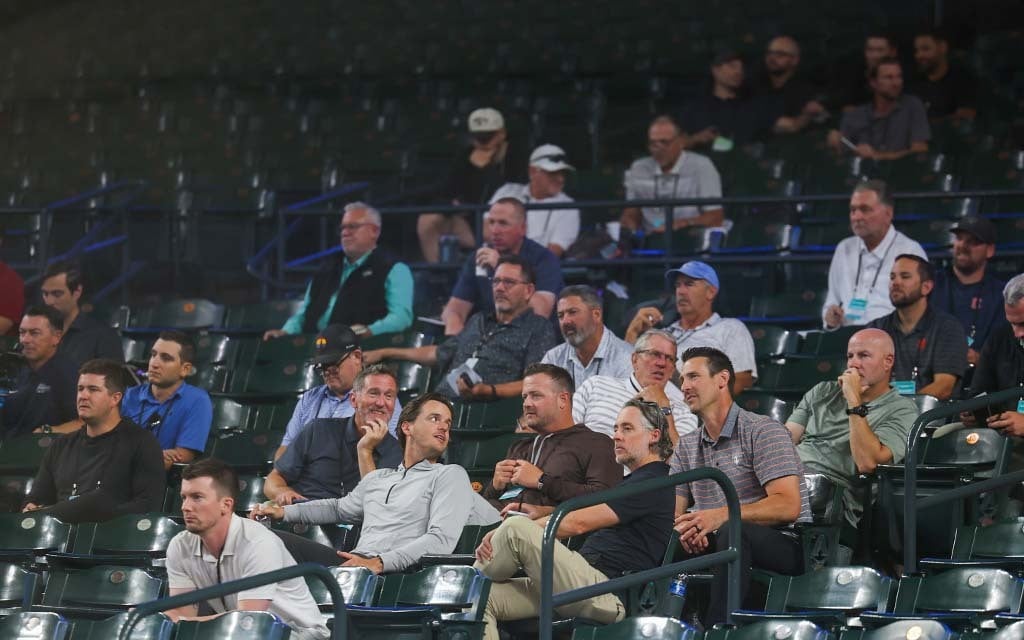
Scouts from various MLB teams watch the 2025 MLB Draft Combine from the stands at Chase Field on June 18, 2025. (Photo by Elizabeth Agazaryan/Cronkite News)
Chaffin acknowledged the role that the agents play, but he also tipped his cap to the MLB scouts.
“You’ll see that the more high-profile kids will focus on the interviews,” Chaffin said. “They’ve shown everything they can, and these scouts aren’t just guessing; they know everything about everybody.”
From Chaffin’s perspective, a lot of the players in attendance have already proved their worth statistically and through their performance. He equated the scouting process to shopping in a grocery store: “Not everybody likes the same meal.”
For players like Walker, however, who felt as though they still had something to prove, the combine provided the perfect setting to show their skills.
Regardless of whether or not a player participated in on-field activities, there is still a lot of guesswork that goes into scouting decisions. Where is this player going to be in four or five years? He might be a little undersized now, but where could he be if the organization were to provide proper nutrition and pro-level coaching?
Chaffin noted that, in a generation that’s “all about eye black and bat flips,” there are certain intangibles that MLB organizations were looking for under the bright lights of Chase Field.
From an outside perspective, it may seem like a wasted opportunity not to participate in drills, but there isn’t just one, singular strategy for selling yourself to a major league baseball team. Whether a player takes the field or doesn’t, Chaffin said the end goal is the same for all of the participants.
“We talk about it all the time, these kids are coming out here to start their careers and make money,” Chaffin said.