
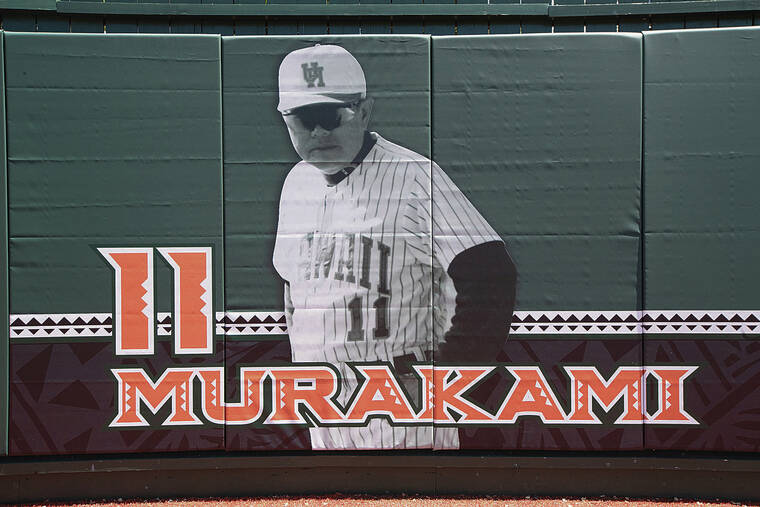
On Monday, the 89-year-old architect of the University of Hawaii baseball program was inducted into the National College Baseball Hall of Fame.
“Fantastic,” said retired UH head coach Les Murakami, whose record of 1,079-648-4 included six Western Athletic Conference titles, 10 NCAA Regional appearances, and a runner-up finish in the 1980 College World Series.
“It’s long overdue,” said Derek Tatsuno, the Rainbows’ pitching ace in the late 1970s.
Former UH pitcher Gerald Ako said: “I’m not sure what took so long. He was an outstanding coach.”
What started as a “temporary” job in 1971, UH’s first season competing in NCAA Division I, turned into a 30-year stint as the Rainbows’ head coach. For the first decade of his coaching tenure, Murakami was considered a “part-time” coach. His “day job” was with UH’s auxiliary services, where he oversaw the Manoa campus’ parking.
“He built a program from nothing to what it is today,” former UH catcher Collin Tanabe said. “Hawaii is fortunate to have had him as head coach.”
Don’t miss out on what’s happening!
Stay in touch with breaking news, as it happens, conveniently in your email inbox. It’s FREE!
After a year’s hiatus, the baseball program was resuscitated in 1971, with Murakami installed as head coach. Murakami coached Sheridan in the AJA League, borrowing their orange, green and white uniforms for his early UH teams. The color scheme stuck, with one of the hues known as “Sheridan orange.” By the mid-1970s, the UH emblems replaced Sheridan’s on the Rainbows’ caps and uniforms.
In acknowledgement of Murakami’s diligence and political pull, then-athletic director Paul Durham was surprised to notice there appeared to be a construction project underway in the quarry where the on-campus athletic facilities were located in the mid-1970s. That project became UH’s first baseball field, complete with metal bleachers and his wife Dot Murakami’s makeshift concession stand.
In 1984, the field was transformed into an $11.2-million project christened as 4,312-seat Rainbow Stadium.
“Back then, he had a lot of connections,” Tanabe said, noting former State Rep. Charles Ushijima “was the big one. (Ushijima) supported him, and he got the Legislature to support him.”
Murakami developed local talent into stars, such as Ako, Tatsuno, Greg Oniate, Randy Oyama, Billy Blanchette, Mario Monico and John Matias, while blending with mainland transplants Glenn Braggs, Rick Bass, Chuck Crim, Thad Reese and Bryan Duquette, among others. Murakami sent 74 players to pro baseball, including 10 to the major leagues. Tatsuno referred to Murakami as a “pied piper.”
“He was the perfect coach,” said Ron Nomura, a former UH catcher who then joined Murakami’s coaching staff. “He managed the team. He didn’t over-coach us. We all had different personalities. He put the pieces together.”
Bass, an outfielder, said Murakami’s strength “was knowing personnel. He pushed the right buttons. He would make little strategic changes, change a guy’s position, or insert a guy in the lineup at the right time. He knew how to handle pitching. He was a master of personnel.”
Former Wichita State head coach Gene Stephenson, who was on the Hall of Fame board that inducted Murakami, said his long-time friend is “a man of few words. But he was a great coach. I voted for him.”
Tatsuno said Murakami is a “no-nonsense guy, a straight shooter. He tells it like it is. He lays it on the line.”
“Not warm and fuzzy,” Ako added. “He knows what he’s talking about.”
Murakami once offered this advice to Nomura: “Ronnie, do you want to be a good hitting coach? Recruit good hitters. It makes the job a lot easier.”
To Tanabe, Murakami said: “Bottom line, if you produce, you’ll play.”
Murakami also had purpose in his scheduling. Bass once asked Murakami why Division II Cal Poly Pomona appeared to be an annual opponent. “He said, ‘I always pick up something from (coach John Scolinos). I always learn a play or defensive assignment,’” Bass recalled. “That’s why we always played that team every year.”
In 1978, Murakami was miffed when the 38-14-1 Rainbows did not earn an NCAA Regional berth. That year, the Rainbows went 5-0 against Oregon, 4-0 against Oklahoma, 5-1 against UCLA, and 3-1 against California. The next year, Murakami scheduled 80 regular-season games. The Rainbow won 24 of their first 25 and, at one point, were 60-3. Tatsuno won an NCAA-record 20 games. There was no snubbing the Rainbows’ 67-13 regular season. The Rainbows finished 69-15, losing to Arizona in the Regional finals.
“Thanks to Coach Les, that’s the reason I got in,” said Tatsuna, crediting his 20 victories for his 2007 induction into the College Baseball Hall of Fame. “It was because of that. If it wasn’t for that, I would never be there.”
After that, in what would be known as the “Murakami rule,” the NCAA lowered the cap on the number of regular-season games.
Murakami coached the Rainbows until he suffered a stroke on Nov. 2, 2000.
In 2001, Murakami was named to the UH Circle of Honor. He also was inducted into the American Baseball Coaches Association’s Hall of Fame.
In 2002, UH’s baseball stadium was renamed Les Murakami Stadium. “This has always been the house that Les built,” said Hugh Yoshida, who was the athletic director at the time.