
COMMENTARY: Baseball has more in common with Catholicism than one might think.
The Chicago White Sox had just come off a season in which they set a league record for most losses, an unprecedented and embarrassing 121. But this year, the club from Chicago’s South Side has redeemed itself.
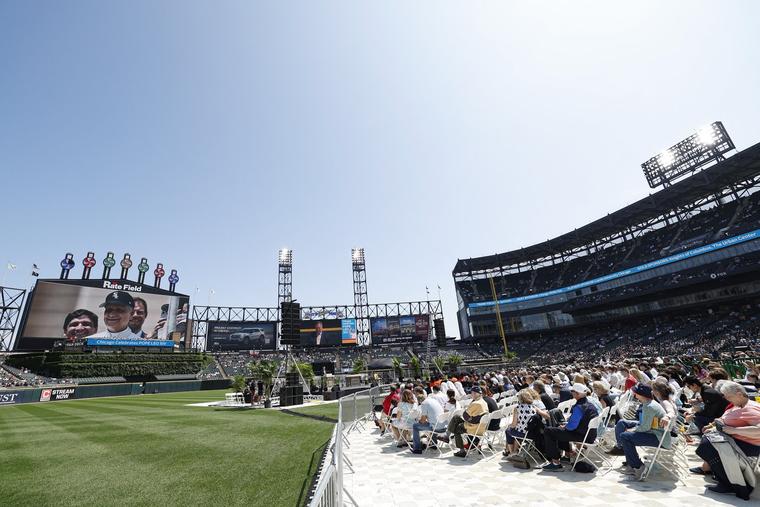
On June 14, a new arrival came to the very park where the team had been more likely to lose than win. He was not a baseball prodigy who had just joined the team after posting glowing statistics in the minors. He was a native of Chicago — but more importantly, he was the newly elected Pope Leo XIV.
A breeze blew through the park, providing relief for fans who felt the warmth of a late afternoon sun. One correspondent, perhaps caught up in the fever of the moment, likened the breeze to the action of the Holy Spirit. It was a capacity crowd, the first in four years.
A stage was set up well behind the center-field wall. The Pope’s message would be viewed on a screen 60 feet high and 134 feet wide. The crowd listened intently as Pope Leo delivered his prepared message:
“My dear friends,” he said, while seated in his office in the Vatican, “it’s a pleasure for me to greet all of you gathered together at White Sox Park on this great celebration, as a community of faith in the Archdiocese of Chicago.”
It was fitting that he eschewed the venue’s more commercial name, Rate Field.
He urged the faithful in his audience to become leaders and to have hope: “As you offer your own experience of joy and of hope, you can find out, you can discover, that you, too, are indeed beacons of hope. That light, that perhaps on the horizon is not very easy to see, and yet, as we grow in our unity, as we come together in communion, we can discover that that light will grow brighter and brighter, that light which is indeed our faith in Jesus Christ.”
As the Holy Father is an Augustinian, it was not surprising that he cited St. Augustine, who says to us that if we want the world to be a better place, we have to begin with our own lives and our own hearts.
After the Pope’s address, tens of thousands of Catholics sang Holy God, We Praise Thy Name, to organ accompaniment. The Mass that followed was celebrated by Chicago’s archbishop, Cardinal Blase Cupich.
The ballpark, at least for one day, was transformed into a cathedral of celebration. At the same time, the aggregation that attended the three-and-a-half-hour event was transformed into a community. Pope Leo, in his inaugural speech, indicated his commitment to “building bridges.” On this sunny day in June, this was exactly what he was doing.
The unprecedented event also celebrated the mixing of baseball and Catholicism. The two have more in common than many people might think.
First of all, both baseball and Catholicism venerate the past. The Church has its saints who are in heaven, while baseball has enshrined its heroes in a Hall of Fame. They accept rules that may seem odd to outsiders.
Baseball happily incorporates the infield fly rule while Catholics refrain from eating meat on Fridays of Lent. Progress in holiness is critical in Catholicism, while progress around the bases gives meaning to the game. Catholics take their consciences seriously. Baseball has its umpires. In morality, virtue is contrasted with vice. Baseball distinguishes between fair and foul. They both have their seasons and both acknowledge the importance of sacrifice. They both aspire to victory — one over the devil, the other over its opponent.
Winning and losing in baseball correspond to life and death. Home is the destiny for each — one to home plate, the other to our ultimate home in heaven. Baseball has its commissioner, and the Church has its pope. Baseball is a kind of next-door neighbor to Catholicism.
Baseball’s seventh commissioner, Bart Giamatti, was fond of pointing out that the word for “paradise” is derived from an ancient Persian word meaning an enclosed park or green place. He went so far as to suggest that ballparks exist because humanity has “a vestigial memory of an enclosed green space as a place of freedom and play.” Be that as it may, baseball does evoke a sense of timelessness as well as a test played out in an “Elysian Field,” the name of the site of the first organized baseball game.
The distinguished scholar Jacques Barzun said, “Whoever wants to know the heart and mind of America had better learn baseball, the rules and realities of the game — and do it by watching first some high school or small-town teams.” Baseball is as endemic to America as opera is to Italy.
Baseball embraces the words “pastime” and “past-time,” thereby being traditional and contemporary at the same time. The same can be said for Catholicism. They both continue to live thanks to infusions from the past that are vital to the present.
On the 14th day in June, in a place known as the “Windy City,” baseball and Catholicism shook hands. The bridge between the two was established by Pope Leo XIV. The reigning Roman Pontiff was invited to appear there because, in a certain sense, that is where he belonged, if only for slightly less than eight minutes. But he left his mark — and America may one day discover how many more bridges he built that day.