
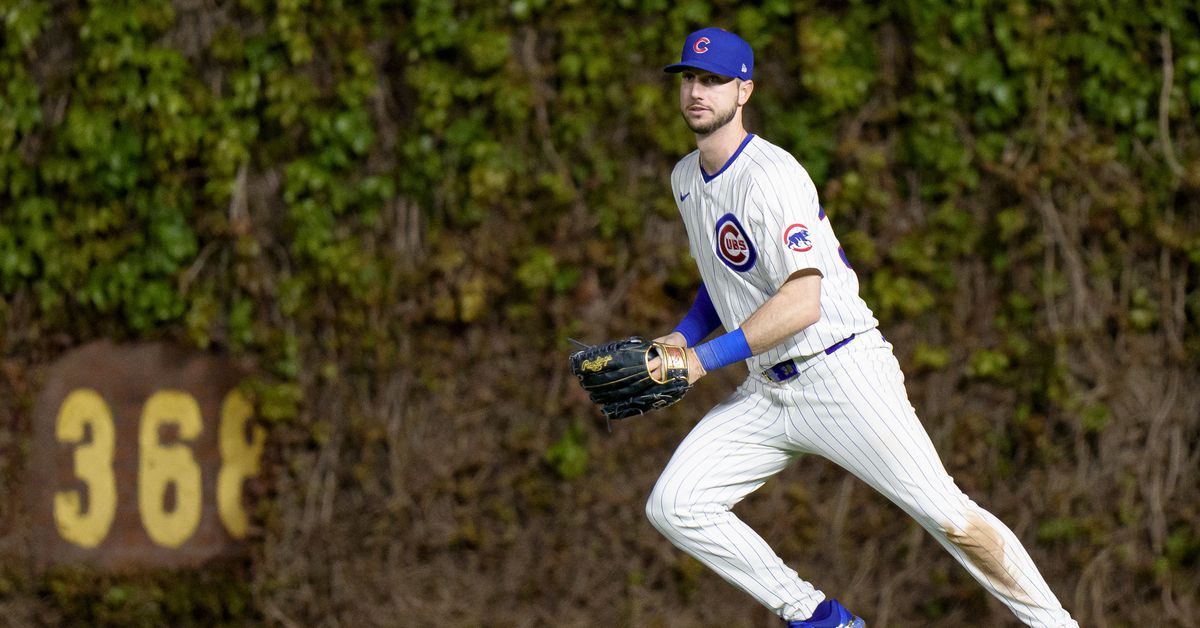
As a hitter, Kyle Tucker has been as advertised since his acquisition by the Cubs last offseason. Over the team’s first 81 games, exactly half the season, Tucker is batting .287/.395/.527 (86-for-300) with 16 home runs, 49 RBI and 57 runs scored. The .922 OPS is a bit better than his career mark of .876 and the power numbers extrapolate to a 32-homer, 98-RBI season with 114 runs scored. He has 3.4 bWAR, so a 7 bWAR season is not out of the question.
However.
Defensively, Tucker is underwater with -0.6 bWAR and he ranks ninth among MLB right fielders with -1 FRV. He also is underwater with -3 OAA and -2 DRS.
The eye test agrees with the numbers. Watching Tucker play right field, he takes odd routes to balls at times and appears to be a bit shy of the brick walls at Wrigley Field (okay, at least that makes some sense).
This is a bit surprising for someone who won a Gold Glove in 2022.
Apparently, though, his is not new for Tucker. Recently my attention was called to this Athletic article from two years ago that talked about Tucker’s defensive deficiencies. This is from that May 23, 2023 article:
Tucker is neither a speedster who can chase balls down nor the kind of agile athlete who delivers highlight-reel plays. But even without those physical tools to lean on, he has traditionally leveraged positioning and an ability to anticipate the play into a standout defensive record. Yet he awoke on Monday worth minus-7 defensive runs saved, according to both Sports Info Solutions and FanGraphs. No major league right fielder has been worse.
Tucker’s numbers as of now with the Cubs are a bit better than quoted there, but he’s still clearly a below-average right fielder both by the numbers and by the eye test.
I mention all this because, well, Tucker is a pending free agent and many here would like to see the Cubs sign him to a long-term contract. I am not opposed to that, but I would think that the Cubs, or any team, signing Tucker to a long deal would likely have to understand that the back end of that deal would see Tucker as a designated hitter.
Would that decrease the amount of money any team would be willing to spend on Tucker? Look at, for example, the $765 million deal the Mets gave Juan Soto, who ranks even worse defensively than Tucker this year (14th of 15 on this Fangraphs leaderboard). There’s no question that Soto will have to DH through at least half of that Mets contract. Tucker might have to do the same over the last half of, say, a 10-year deal.
So is Tucker a $400 million (or more) player if half of that contract means having him as a DH only? I’m not saying “don’t sign him,” I’m just saying that Tucker might be just a DH for quite a bit of his future MLB time.