
Erwin Higueros was just one of the surely many Bay Area baseball fans searching “Rafael Devers” on YouTube.
But when the San Francisco Giants introduced the former Boston Red Sox slugger after a landmark trade last month, Higueros wasn’t hoping to find highlights of Devers’ 215-and-counting career home runs.
Higueros, the Giants’ longtime Spanish language radio broadcaster and team translator, was more interested in clips of the Dominican-born Devers talking, not playing.
“I kind of got an idea of how much English he spoke or how little he did,” Higueros told The Examiner. “I wanted to kind of hear his tone, his accent. Even though Spanish is Spanish — even though for me, I am a native Spanish speaker, I can understand anybody — each player speaks different.”
Born in Guatemala but living in the United States since he was 12 years old, Higueros doesn’t just serve as the Giants’ translator for Spanish-speaking players. He also leads a crew that is broadcasting all 162 Giants games in Spanish this season for the first time.
On the day Devers was introduced to Giants fans, that meant sitting in front of cameras as he answered reporters’ questions, through Higueros’ translation, about the tumultuous final months the third-baseman-turned-designated-hitter spent with the Red Sox.
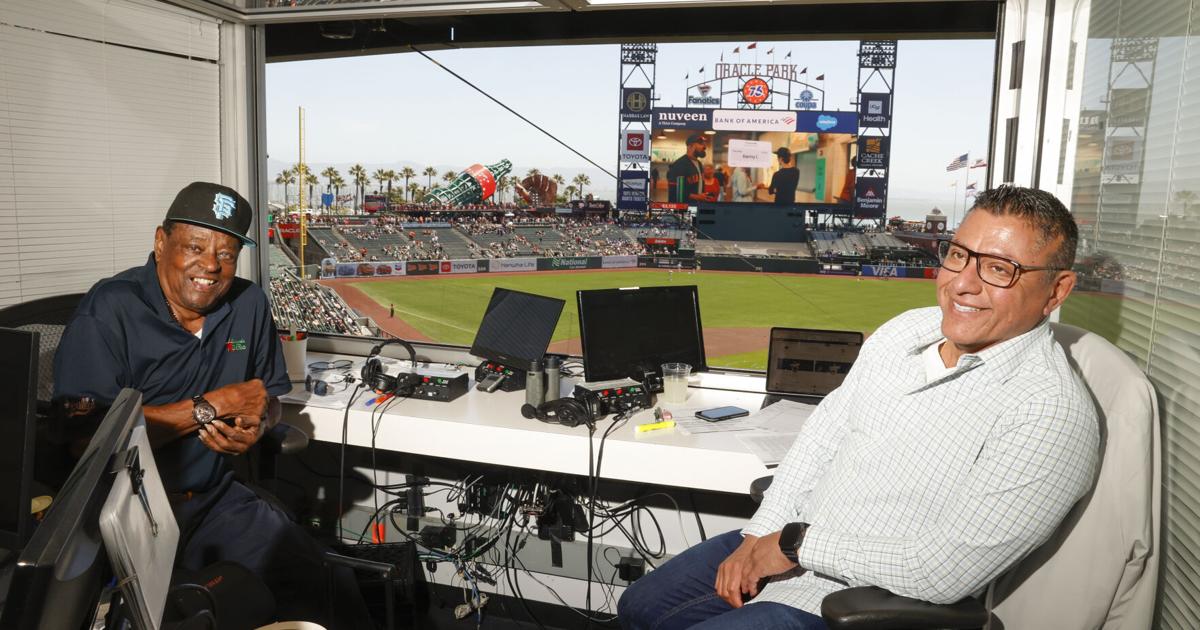
Just hours later, Higueros was in the broadcast booth calling the game with longtime partners Tito Fuentes and Carlos Orellana. Higueros made the call when Devers got his first hit as a Giant into Oracle Park’s iconic Triples Alley.
🚨 RAFAEL DEVERS CON SU PRIMER HIT COMO GIGANTE 🚨 pic.twitter.com/hWIVdaHZ6W
— SF Gigantes (@SFGigantes) June 18, 2025
It’s all in a day’s work for Higueros. And when it comes to work, there’s more of it now than ever before.
“We have had Spanish for years, but going to 162 [games] is a commitment to the Hispanic community,” Higueros said. “It’s a commitment that says ‘we are here for you.’”
For the Giants, it’s an expansion of the team’s concerted outreach to Spanish-speaking fans in the Bay Area and beyond.
“It’s so important for so many reasons, not the least of which is the number of Spanish-speaking guys we have on the team, but the multicultural Spanish-speaking communities throughout the Bay Area,” Giants Chief Revenue Officer Jason Pearl told The Examiner.
But as technology evolves, it’s not just local fans that broadcasts can reach.
The MLB.TV app allows viewers from around the world to tune into Giants games and select Spanish audio. In fact, when Higueros met Dominican-born Giants pitcher Randy Rodriguez’s parents during a recent road trip to Florida, they told him that’s how they watch the games.
Higueros and the Spanish broadcast are at the anchor of the Giants’ continually evolving interactions with and marketing to Spanish-speaking fans.
In 2023, the team played its first-ever games in Mexico. In addition to broadcasts in Spanish, the Giants also hold an annual Fiesta Gigantes — this year’s is scheduled for a Sept. 14 game against the Los Angeles Dodgers — in which they wear jerseys that read “Gigantes” (“Giants” in Spanish), a brand the team has carefully developed and trademarked over the last 20 years.
“His work in the media-relations department and his work as sort of our face for Gigantes in Spanish-speaking communities in general, has been outstanding,” Pearl said of Higueros.
With so many eyes and ears on them, it’s a good thing Higueros is surrounded by experienced partners in the broadcast booth.


Tito Fuentes delivers play-by-play commentary from the KSFN radio broadcast booth during a Giants-Marlins game at Oracle Park.
Craig Lee/The Examiner
Fuentes, a legendary former player, provides color analysis and a sprinkling of play-by-play for the Giants’ home games. Born in Cuba, Fuentes played nine seasons for the Giants from 1965 to 1974. He’s been broadcasting games professionally for more than 40 years, and he takes on both play-by-play and color-analysis duties.
Carlos Orellana grew up in Daly City in an El Salvadoran family that mostly spoke Spanish at home. Following in the footsteps of his father, who worked in radio, was never plan A for Orellana. As a Giants fan, playing professional baseball was the priority.
Orellana recalled earning a few bucks as a kid by helping his father and other hosts track down soccer scores or manage broadcast gear. He would save the money he sporadically earned to buy the latest baseball equipment, not realizing that he was developing a different professional skill set all the while.

The mayor’s proposal to add more than 80 beds to the site had sparked fierce pushback from Supervisor Shamann Walton, who represents the area

Juanita MORE! is hosting her annual Pride party on Sunday, and the proceeds will go towards supporting the work of the Transgender Law Center

More than 100 artists, 20 vendors descend on Fort Mason Center one Friday a month
“I didn’t get to the major leagues playing baseball, but I got to the major leagues broadcasting,” Orellana said.
He jumped at an opportunity to work for one of the team’s former media partners, helping edit highlights for the Giants’ Spanish-language broadcasts — a job he started the day after graduating high school. Orellana has now spent 17 seasons working on the team’s broadcasts.
“I’ve gone from broadcasting 50 to now doing 162 [games per season], which is unbelievable to think about,” Orellana said.

Giants Spanish-language broadcaster Carlos Orellana: “I didn’t get to the major leagues playing baseball, but I got to the major leagues broadcasting.”
Craig Lee/The Examiner
Like Higueros, Orellana balances several responsibilities. For both home and away games, he’s the broadcast engineer and the producer, cutting up highlights and making sure everything sounds OK on the air. For road games — to which Fuentes doesn’t travel — Orellana covers three innings of play-by-play duty as well.
“Erwin and I — especially Erwin — we’ve rolled up our sleeves. We understand we’ve got to wear multiple hats,” Orellana said. “The end goal for us is to actually provide a good broadcast for our Spanish-speaking community.”
It’s not enough to just say, “‘Hey, we’re on the air and this is what we do’ — we take our craft seriously,” he said.
Higueros has worked in local sports broadcasting for 37 years, the last 27 of which have been with the Giants, who made him a full-time employee in 2007. When he’s not in the booth, Higueros is often developing his relationship with the players for whom he’s tasked with translating.
Higueros was not formally a translator for the Giants until the MLB Players Association successfully advocated in 2016 for the league to require each team to designate a translator, which is a particular skill.
Players naturally have varying English-language capabilities. Devers, for example, didn’t need Higueros’ help translating media questions, only articulating his answers. “Spanish is Spanish,” as Higueros said, but the ways people speak it can vary widely. Former Giants player Donovan Solano spoke very properly, for example, while other players can use different slang depending where they’re from.
“We just don’t translate,” Higueros said. “We try to adapt it to the culture.”
Translating requires trust, and that’s something Higueros has been able to build with players now that he travels with them to spring training in Arizona, which he has done since 2007.
“Every year, they come to the big-league camp, I’m there,” Higueros said. “I go to the minor leagues, I’m there, they see me. So, eventually, I guess they figure out, ‘Well, Erwin’s been here for years, so yeah, we can trust him.’”
Thus, the Giants’ Spanish-language broadcast consists of a multigenerational team that has a wealth of experience in baseball, with the Giants, and in broadcasting.
“We see the game with a different set of eyes,” Orellana said. “But at the end of the day, we can all agree that baseball is baseball, no matter how you try to play it.”
“Our goal is to break even with the program,” Pearl said. “We do that. We do better than that, frankly, which is why we’ve been able to grow the number of broadcasts.”

The KSFN radio broadcast booth at Oracle Park offers a typically spectacular view during the Giants-Marlins game on June 26.
Craig Lee/The Examiner
Not content to call it a job well done now that they’ve reached 162 games, Orellana said the objective “is now kind of keep building off of that, to expand — and at the end of the day, improve the broadcast that we’re doing.”
And while Spanish is Spanish and baseball is baseball, the way fans interact with it — and even with the broadcasters who call it — is continually evolving. Social media has allowed the relationship between fan and broadcaster to grow even closer, even from great distances.
Higueros recalled one fan who messaged during the COVID-19 pandemic to say he was listening from home in Mexico. Higueros replied, but the man didn’t answer, leaving Higueros to wonder what happened.
It turned out the man was busy helping a cow deliver a calf on his farm.
“He actually sent me a video of it,” Higueros said.