
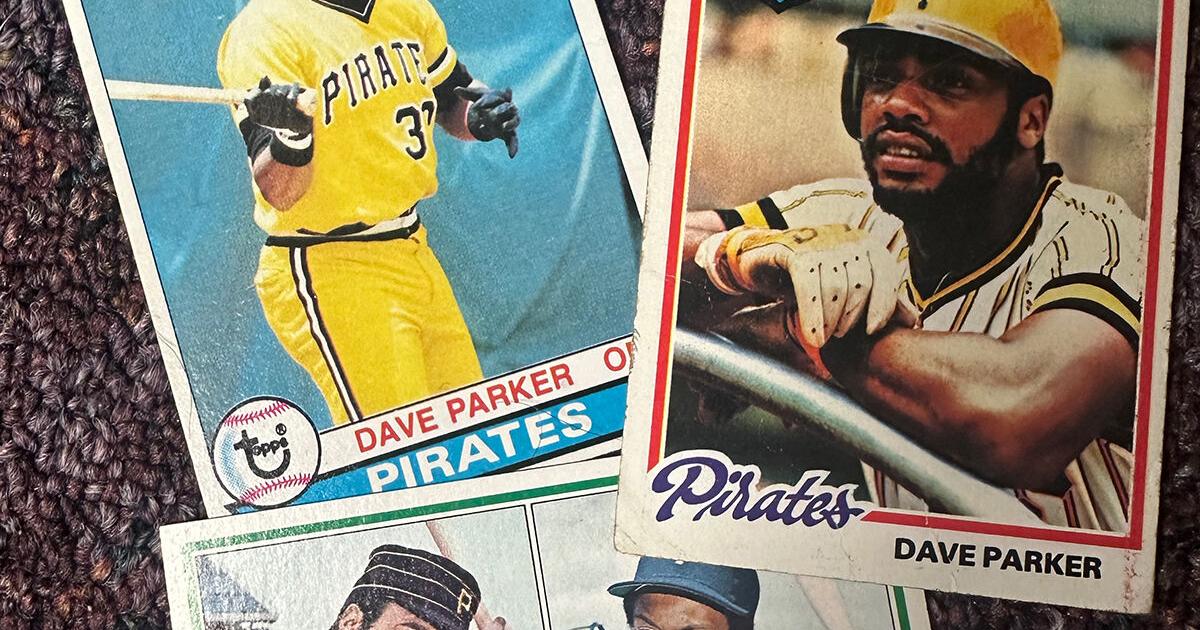
Back in the day, all-star games just meant something different.
You couldn’t wait for the pre-game introductions. If you were a baseball nut like me, you knew all the players, but it was still a great time to see all these guys you have in baseball cards alive and all in one place.
Remember, you couldn’t watch a baseball game every night.
On July 17, 1979, at the three-year-old Seattle Kingdome — it was knocked down in 2000 — I couldn’t wait to see Dave Parker, the only Pittsburgh Pirate on the National League All-Star team. He was starting and batting second, and playing right field of course.
The player introductions back then at least were huge. That’s “my” guy for “my” team and he’s an all-star. We did see that pride show at the All-Star game in 1994 at Three Rivers when Pirates manager Jim Leyland got a rousing ovation.
Parker was the only Pirate on the team in 1979, interesting considering they won the World Series in October. But, at the time, the Pirates were in fourth place in the NL East at 46-39, four games behind the Montreal Expos in what was still a very wide-open playoff race.
The Pirates were actually in the midst of a hot streak, a stretch of winning 13 of 14 games through July 23. That got them to second place and they wouldn’t drop lower than that the rest of the way.
The Pirates nearly came out of nowhere to catch the Philadelphia Phillies at the end of 1978, so for sure there was an expectation that they could pull off a playoff run this time around.
Parker was at the peak of his powers. In 1978, he won the National League MVP after winning his second straight batting crown. From 1975 through 78, he finished in the top three of MVP voting three times.
As I glance to my 45-plus year-old scorebook’s account of that All-Star game, Parker played the whole game and was the only National Leaguer to do that while Boston Red Sox outfielder Jim Rice did it for the American League.
Parker went 1-for-3 with a single and sacrifice fly. Nolan Ryan struck out Davey Lopes and Parker to start the first inning, but his NL teammates scored two runs off Ryan as Mike Schmidt tripled in Steve Garvey after Garvey walked and scored on George Foster’s double.
Parker’s sacrifice fly in the second off Ryan again scored Bob Boone to tie the game at 3-3.
In the fifth with the AL leading 5-3, Parker led off and flew out to center against Mark Clear. With the NL down 6-5 in the seventh, Parker singled with one out and was stranded at second. Now with the score tied at 6-6 in the ninth, Parker helped spark a rally against AL closer Jim Kern. After one out, Kern walked Joe Morgan and then Parker intentionally after Kern balked Morgan to second.
Kern got Craig Reynolds to pop out in foul territory before walking Ron Cey to load the bases.
The Yankees’ 1978 Cy Young Award winner Ron Guidry replaced Kern and promptly walked Lee Mazzilli to force in the run. Then in the bottom of the ninth, Bruce Sutter held the AL scoreless for the save and the NL continued an amazing stretch that had them win 18 of 19 matchups through 1982. Its 1979 win was its eighth straight.
So up to this point, Lee Mazzilli seemed like the logical MVP considering he tied the game with a pinch-hit home run to lead off the top of the eighth. Dave Parker’s arm said otherwise.
In the bottom of the seventh and the AL up 6-5, Rice popped a fly ball down the right field line. Parker lost the ball in the lights, but located the high-bouncing ball and gunned a throw to third baseman Ron Cey to nail Rice trying to stretch his lead-off double into a triple.
Then in the bottom of the eighth with the score tied with Brian Downing on second and Reggie Jackson at first and two outs against Sutter, Craig Nettles reaches out and lines a single to right. NBC announcers Joe Garagiola and Tony Kubek take it from there, with the help of youtube.com of course.
Garagiola: Line drive right field, we may have a play at the plate. Big hop. Here comes Downing. Here’s the throw. It is … he knocked him off the plate. What a tag by (Gary) Carter! A tremendous play by Carter. Oh baby, what a play.
Kubek: And what a throw by Dave Parker, who continues to show why some people consider him the greatest player in the game. (During a replay), one big hop. Watch it. A great play by Carter, as you said Joe. A strong throw, Downing tries to slide inside away from the ball and Carter blocks him off.
Garagiola: Carter knocked him off and never did let him in. How Carter was able to catch that ball …
Carter’s ability to catch the incredible throw is right there with how hard and accurate the throw was indeed amazing. It definitely takes two to make that play.
Parker threw it the plate over the head of Pete Rose at first base. It had to go directly to the plate to get Downing, who was tagged by Carter with Downing’s right hand within 4 inches of touching the plate. Rose pumped his fist in celebration and both Carter and Parker were mobbed by teammates as they walked to the dugout.
Parker won the All-Star MVP award with his arm, basically, and the help of Carter’s brilliant play at the plate. It was the first time in All-Star history an outfielder had more than one assist in a game.
Parker became the 16th Hall of Famer from that game. At the time, anyone would’ve agreed that he wouldn’t be the 16th to make it, but Parker’s career got complicated. He exited Pittsburgh in less than great terms.
Parker signed a five-year, $5 million deal with the Pirates at the beginning of the 1979 season and it was almost immediately a focus of scorn from Pirates fans, who had a hard time dealing with a brash, rich and very talented African American. Then in 1985, the infamous drug trials held in Pittsburgh connected Parker.
To his immense credit, Parker got through his drug use and his post-Pirates career — eight years with his hometown Cincinnati Reds, Oakland A’s, Milwaukee Brewers, California Angels and a short stint with the Toronto Blue Jays at the end of the 1991 season — didn’t diminish his Hall of Fame career.
In 1985 and 1986 with the Reds, Parker finished second and fifth in NL MVP voting. He won the first All-Star Game Home Run Derby in 1985 at age 34. He rarely missed a game with the Reds in four years, then moved on to Oakland for two seasons and won a World Series ring again in 1989.
But Hall of Fame talk really wasn’t intense, likely due to his drug use during the 1980s and his presence in the ugly Drug Trials. But he did finish with over 2,700 hits, 339 home runs and three Gold Gloves. And, as Tony Kubek said after Parker hosed Downing at the plate, he was considered by many to be the best in the game at that time.
Time heals. Hard views of players soften and frankly, the numbers eventually win out. It doesn’t click right for all players in the age-old debate on who should be in, who shouldn’t and why is that guy in and not this guy. It finally did for Parker.
I wasn’t all that sold on Parker after his years in Pittsburgh as well, either. In 2013, Parker announced that he had Parkinson’s Disease and his fight against Parkinson’s was well chronicled. He helped bring attention and awareness to the Parkinson’s and he fought until his death last Saturday.
Parker was elected to the Hall over the winter by the Classic Era Committee with now fellow posthumous inductee Dick Allen along with C.C. Sabathia, Ichiro Suzuki and Billy Wagner.
My later-in-life appreciation of Parker was bolstered by his “Cobra: A life of baseball and brotherhood” book with Dave Jordan. The title should tell you how much he cared about the clubhouse culture. Combine this book with David Maraniss’ work “Clemente” and you’ll live the Pirates from inside-out of the clubhouse from the mid-1950s through Parker’s years with the Buccos.
“The Buccos in the seventies won five division crowns, two playoffs, and two rings — nine in all, man. And we were last in the Majors in walks during the 1960s and 1970s. We didn’t win with elite pitching and defense — tell you that much. It was our situational hitting that won those crowns. The Bucco way. And let me say this — if me and my boys were playing today, with all the advancements in nutrition, date and technology, with our elite ability? We would f-in destroy everyone in our path. And have a time doin’ it,” Parker wrote at the end of “Cobra.”
And he finished with this:
“Pittsburgh was my baseball birthplace. Cincinnati, my adult life. Oakland, an extended vacation. Milwaukee, a consultation gig. California, a hard lesson. And Torono, my division-winning curtain call. I could hit dingers and crucial singles, I threw the ball with the greatest outfielders of all time, I could run, I could field, but if I’m remembered for anything, I sincerely hope it’s my relationships with the fellas. The Buccos instilled a sense of love for teammate more than any club I’ve ever been a part of, and I tried to take that with me the rest of my journey. … I remember driving to Three Rivers some mornings thinking of ways to be a better brother to young Doe Boyland. Always having Garner on my mind. All the family time I spent with Madlock. That moment in the eighties when me and Pete rebuilt the Big Red Machine … If you take anything away from this story, this game ain’t tennis, and it ain’t golf. Relationships matter. I cannot stress this enough. Friendships matter the most, and oftentimes they’re what keep cats coming to the clubhouse long past their playing ability’s expiration date.”
Sure, it’s a shame that Parker didn’t make it to the Hall of Fame Induction stage with all the living legends. But he knew he was an official Hall of Famer before he passed.
He also knew well before he was elected.
Rich Rhoades is the Sports Editor of the Leader-Vindicator and Jeffersonian Democrat in Brookville. E-mail: rrhoades@thecourierexpress.com. Follow on X @TheSkinny1969 or on Facebook