
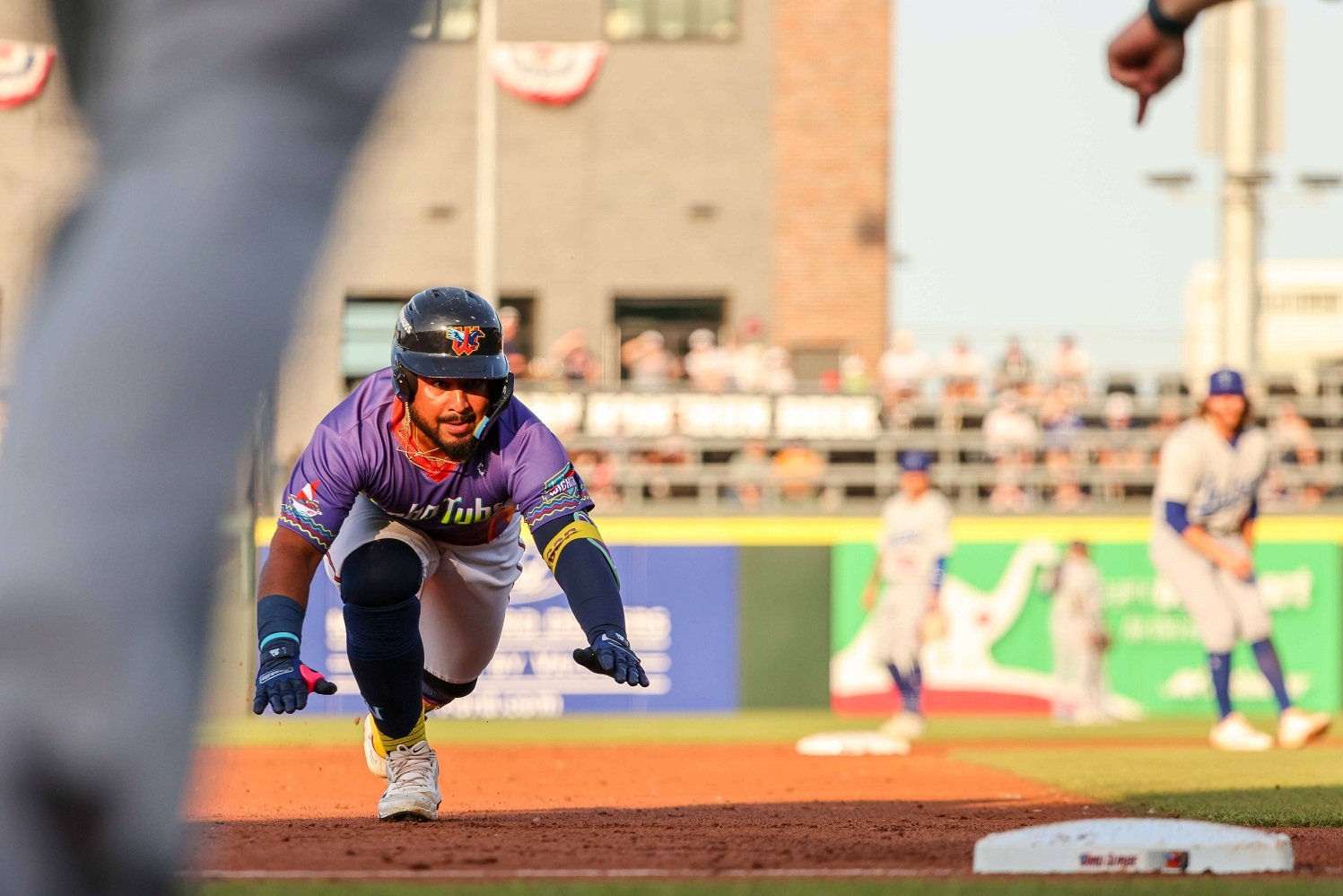
Gabriel Gonzalez is raking. The 21-year-old is slashing .341/.407/.515 across 301 plate appearances split between A+ Cedar Rapids and AA Wichita. He’s not even using the lower level to inflate those numbers; Gonzalez’s OPS is above .900 for both teams. He already has more hits in 2025 than he had over 81 games in 2024.
You’d be forgiven if you forgot about Gonzalez, given that he was a part of the four-player return the Twins netted for Jorge Polanco before the 2024 season. Justin Topa and Anthony DeSclafani were the big-leaguers, and therefore claimed attention; Gonzalez—and Darren Bowen—were unproven, even if the outfielder was a notable prospect.
Some consternation for Gonzalez stems from his “swing often and crack line drives” approach atypical for a player these days. “He’s chase prone but has the bat-to-ball skills to make up for this to some degree,” wrote Eric Longenhagen in 2024. “He can absolutely punish fastballs, but it’s a very aggressive approach that can lead to too much chase, especially against softer stuff,” explains his MLB.com writeup. That can be a strange profile to understand. Maybe he’s Nick Castellanos. Maybe he’s Ernie Clement. Maybe he’s somewhere in the middle.
Aiding his profile is an encouraging walk-to-strikeout rate: the righty has just one more free pass than punchout at AA, and he’s at 27 walks to 37 strikeouts overall in 2025. He’s already walked more than he did in 2024. His 12.3% strikeout rate is the lowest of his career.
Though considerations for a major league spot are still a ways away, a path for Gonzalez does exist. He’s perhaps the slightest step further ahead than Walker Jenkins, his teammate on the Wind Surge. Emmanuel Rodriguez is ahead of him in prospect status and level, yet his constant injuries have blurred a vision of him in a daily big league role. Minnesota’s current cadre of outfielders? Byron Buxton and his whelming group of merry men. Harrison Bader might not be a Twin by August, and neither Trevor Larnach nor Matt Wallner have played well enough to demand a lineup spot written in pen. It’s a bit strained—squinting and minor mental gymnastics are required—but Gonzalez could at least get a shot by 2026. In any case, the Twins will need to add him to the 40-man roster after this season to avoid Rule-5 draft eligibility.
Gonzalez may also be a lesson for amateur prospect evaluators: always consider a player’s age relative to their level. One year is long enough for a player to improve drastically; just ask Pablo López, who had a 5.04 in A+ ball as a 21-year-old, then zoomed to the majors the next year after dominating AA. It’s sometimes lost that these are young men still developing mentally and physically. Life strengthens all of us differently. Sometimes the 21-year-old we see today is utterly unlike the 20-year-old we met just last year.
Gonzalez is a fascinating player. He harkens back to a young Luis Arraez, in that he might not be one of the best prospects in baseball, but his profile and performance demand a look at the major-league level. For a franchise stuck in a quagmire of redundant, lifeless hitters, Gonzalez’s line drives could be a reprieve, a legitimate unique skill set to set apart and push forward an organization looking for answers.
Interested in learning more about the Minnesota Twins’ top prospects? Check out our comprehensive top prospects list that includes up-to-date stats, articles and videos about every prospect, scouting reports, and more!