
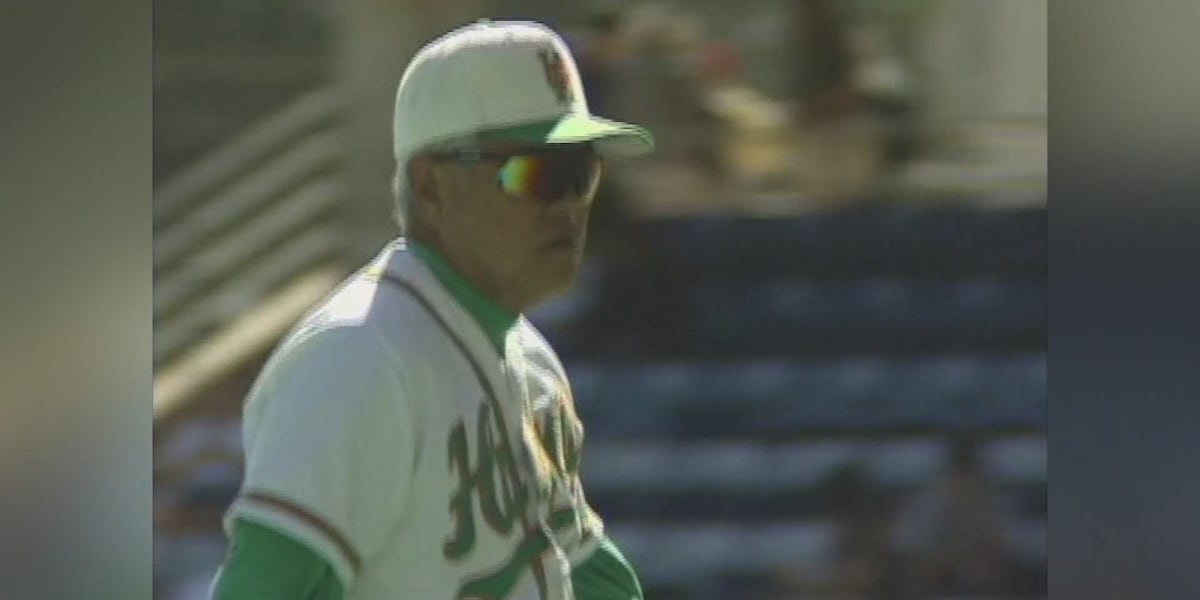
HONOLULU (HawaiiNewsNow) – In an honor that many consider long overdue, longtime University of Hawaii baseball coach Les Murakami is being inducted into the College Baseball Hall of Fame.
At 89-years-old, he rarely does interviews, but this week, Hawaii News Now had a chance to sit down with the man himself to look back at his legendary career.
“I’m proud of winning so many games and getting paid so little bit,” Murakami said in an hour-long interview at his East Honolulu home. “When I started at UH, (I got paid) $500 dollars for the season you know. Unbelievable, yeah?”
Even 55 years after Murakami first took over the University of Hawaii baseball program, that kind of salary remains astounding.
It’s also part of the reason why he turned down the job three times before finally saying yes for the 1971 season and it was a gig, far from glamorous.
“My mother, she always said you work the players so hard, you gotta feed them after the game, but $500, how far that going?,” Murakami said. “So my mother, my father, and my wife, they would make sandwich(es) and then feed the ball players after the game.”
On top of player meals, Murakami, without admin approval, created his own practice field, which sat at the current site of the tennis and softball complex, a surface he had fertilized with chicken manure.
“All of a sudden I get a call from the athletic director,” Murakami said. “He tells me what the hell you doing on the field? I say, ‘why?’ I getting so much calls because the fricken thing stink.”
But the lack of resources never discouraged Murakami from having high expectations.
“The reporters asked me, ‘What’s your goal? What you gonna do?,’” Murakami said. “I told them, my goal is to goal to the World Series. They all laugh and they tell me, you never even play one game yet and you talking World Series. I told them, wait a minute now, you asked me what’s my goal, I said I don’t know if I can reach it, but I told them that’s my goal.”
Murakami’s Rainbows won only eight games through his first four seasons, hard luck that started to shift in the late 1970s.
Murakami, who was born on Kauai and grew up on Oahu’s youth baseball circuit, prided himself on keeping local talent home.
Among his biggest recruiting wins, Aiea High all-star pitcher and future College Baseball Hall of Fame inductee Derek Tatsuno.
“I was so lucky to get someone like Derek Tatsuno,” Murakami said. “That’s why I called him the Pied Piper. Before I had Derek, we would draw 100, 200 guys, maybe 300 at the most. The day I got Derek and threw him the first day, was standing room only, unbelievable.”
The kind of fanfare that laid the groundwork for the team’s first and only College World Series appearance in 1980, one of Murakami’s favorite moments.
Yet, the team didn’t have a stadium to be proud of, so Coach Murakami took matters into his own hands and lobbied state lawmakers to help get it done.
“I said I’m embarrassed because I told them look, we (are) the only school that I know of at this caliber, we don’t even have our own stadium,” Murakami said.
Murakami eventually made it happen, and Rainbow Stadium opened in time for the 1984 season, just nine months after construction started.
The student of the game designed it to his liking with deep fences to neutralize power hitters and help his defense-oriented squads.
“I said I’m worried about the guys I’m bringing in, you know, Arizona State, USC, UCLA,” Murakami said. “I said I’m trying to keep the ball in the field. If I can do that, we get chance.”
Years later, the stadium, now named after him, is considered one of the best college venues in the nation.
A place that saw him become the winningest coach in program history with 1,079 victories over 30 years.
Murakami recently turned 89 this past June, and is a survivor of the highest order, recovering from a stroke suffered in the year 2000 and a rectal cancer diagnosis five years ago.
Right there every step of the way, his wife of 61 years, Dot Murakami.
“You have to have positive thinking, you cannot be negative,” Dot said. “It’s not woe is me, woe is me. Every day is what’s the next adventure, and you have to be like that in order to be 89.”
The induction ceremony is scheduled for February 2026 at the College Baseball Hall of Fame in Overland Park, Kansas.
Copyright 2025 Hawaii News Now. All rights reserved.