
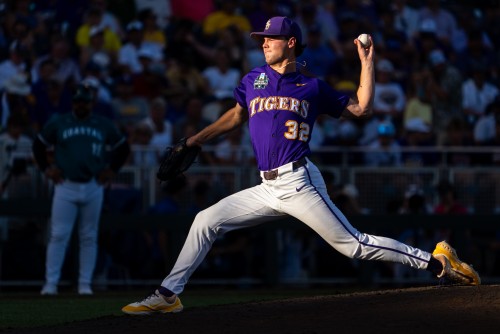
The MLB Draft, also known as the Rule 4 Draft, will take place July 13th & 14th in Atlanta as part of the All-Star Week. The 20 round event is the primary way for high school and college players to latch onto professional organizations. Day 1 will see the first 74 picks (the first two rounds plus two competitive balance rounds), with the remaining picks slated for Day 2.
RELATED: 2025 MLB Draft Tracker
Player Eligibility
Players eligible for the draft must be a resident of the United States, Canada, or a US Territory.
High School players are eligible for the draft if they’ve graduated, but haven’t yet enrolled to a college.
4-Year College players are eligible after completing their Junior or Senior year – or once they turn 21 years old. Players selected here have the option to return to school or sign with their drafted team.
Junior College players are eligible after their 1st completed year.
Lottery System
Beginning in 2023, MLB adopted a lottery system for the Top 6 picks in the draft. All 18 non-playoff teams are considered lottery teams for the draft. Teams are given a number of 4-digit combinations based on their standings (so the worst overall record in baseball carries a much better chance of winning the #1 overall pick than the 18th worst record).
There are exceptions to being eligible for this lottery pool.
The Chicago White Sox, despite holding the worst record in MLB last season, aren’t eligible for the 2025 lottery because they were a Revenue Paying Team who was awarded a lottery pick in 2024 (#5 overall). Revenue Payors cannot hold lottery picks in consecutive drafts.
The Athletics are also ineligible this year, as they’ve secured a lottery pick two years in a row. Revenue Receiving Teams cannot hold lottery picks in three consecutive drafts.
Ineligible teams automatically slot in to the 10th overall odds, but cannot receive a Top 9 pick due to their status.
2025 Lottery Odds
Colorado Rockies, 22.5%
Miami Marlins, 22.5%
Los Angeles Angeles, 18%
Washington Nationals, 10.2%
Toronto Blue Jays, 7.5%
Pittsburgh Pirates, 5.3%
Cincinnati Reds, 3.7%
Texas Rangers, 2.5%
San Francisco Giants, 1.9%
Chicago White Sox (ineligible)
Athletics (ineligible)
Tampa Bay Rays, 1.5%
Boston Red Sox, 1.2%
Minnesota Twins, 1.1%
St. Louis Cardinals, 0.8%
Chicago Cubs, 0.7%
Seattle Mariners, 0.5%
Arizona Diamondbacks, 0.3%
2025 MLB Draft Order
December’s Lottery unearthed the following Top 18 picks:
#1: Washington Nationals (lottery)
#2: Los Angeles Angels (lottery)
#3: Seattle Mariners (lottery)
#4: Colorado Rockies (lottery)
#5: St. Louis Cardinals (lottery)
#6: Pittsburgh Pirates (lottery)
#7: Miami Marlins
#8: Toronto Blue Jays
#9: Cincinnati Reds
#10: Chicago White Sox
#11: Athletics
#12: Texas Rangers
#13: San Francisco Giants
#14: Tampa Bay Rays
#15: Boston Red Sox
#16: Minnesota Twins
#17: Chicago Cubs
#18: Arizona Diamondbacks
Based on current MLB standings, the Rockies, Nationals, and Angels all stand to be Lottery-ineligible for the 2026 draft, while the White Sox and Athletics find themselves right back up at the #1/#2 odds.
Luxury Tax Penalties
MLB Teams who spend $40M or more over the CBT threshold will see their highest draft pick dropped 10 spots. If their first round pick is a Top 6 lottery selection, the team will see their second highest pick lowered. For 2025, the Dodgers, Mets, & Yankees all fall into this category.
Draft Bonus Slots/Pools
Each pick in the first 10 rounds has an assigned slot value, which are determined by league revenue growth. 2025 slot values were announced a few weeks later than usual; Baseball America reported that was because of a dispute between the league and MLB Players Association regarding the revenue growth.
3-Year Slot Value Increase / Total Bonus Pool
2025: 4.8% ($350,357,700 total)
2024: 8.7% ($334,375,000 total)
2023: 9.9% ($307,335,300 total)
A team’s Signing Bonus Pool is the total amount a team can spend on signing bonuses for players they select in the first 10 rounds. The bonus slot numbers are just the “suggested” figure for that pick in a given year. Teams are able to sign a player at more or less based on a variety of factors. Picks in rounds 11-20 are slotted at $150,000, often come in at a much lower cost, and are not factored into a team’s bonus pool.
Can teams go over their bonus pool? Yes. But there’s an up-to 5% overage tax in doing so. Teams that exceed their pool by more than 5% are subject to stricter penalties, including loss of future draft picks. While teams often exceed within the 5% range, no team has gone over this threshold as of yet.
2025 Slot Bonuses
For 2025, slot bonuses vary from $11.075M (#1 overall) down to $187,300 (#315 overall). The first 15 picks are all slotted to earn a bonus north of $5M, while the first 50 could see a number near or above $2M. Pick #81 is where the bonus slots fall below a million for the upcoming season. The Top 11 picks carry combined bonuses that equal just north of 25% of the $350M+ total pool. Full slot numbers are available on the Spotrac MLB Draft Tracker
Team Bonus Pools
Bonus pools are the collective total of each draft pick slot bonus in the first 10 rounds. 21 MLB teams will carry a pool north of $10M this year, with the Mariners (who hold 11 picks in the first 10 rounds) leading the way. The Yankees (one of the teams who saw their top pick lowered 10 spots due to luxury tax overage), bring up the rear with a $5.3M pool.
Rank
2025 Bonus Pool
1
Mariners: $17,074,400
2
Rays: $16,699,400
3
Angels: $16,656,400
4
Nationals: $16,597,800
5
Orioles: $16,513,100
6
Rockies: $15,723,400
7
Marlins: $15,187,400
8
Cardinals: $14,238,300
9
Pirates: $14,088,400
10
Brewers: $13,138,100
11
Royals: $12,794,700
12
Twins: $12,653,000
13
Red Sox: $12,409,300
14
White Sox: $12,169,100
15
Reds: $11,836,800
16
Rangers: $10,991,300
17
Tigers: $10,990,800
18
Diamondbacks: $10,917,800
19
Athletics: $10,563,500
20
Blue Jays: $10,314,600
21
Guardians: $10,198,100
22
Cubs: $9,636,800
23
Braves: $9,081,100
24
Dodgers: $9,031,300
25
Giants: $8,403,300
26
Phillies: $7,849,400
27
Astros: $7,181,500
28
Padres: $6,569,100
29
Mets: $5,465,900
30
Yankees: $5,383,600
The Prospect Promotion Incentive Pick
Beginning in 2022, MLB implemented this PPI system to help reduce keeping star young players in the minor leagues in order to push their service time clock into an extra season of control. If a player garners a full season of service time, and factors into a major season award (Rookie of the Year, MVP, Cy Young), their respective team will secure an extra draft pick in the following year.
This means that a player must be called up in time to be active for 172 days of service within a season, then either win the Rookie of the Year award OR finish Top 3 in MVP or Cy Young voting. If a player has garnered the necessary service time, but doesn’t finish in any of the top award results, they can meet the PPI credit any time before they reach arbitration.
To date, four teams have earned PPI draft picks
Seattle in 2023 for Julio Rodriguez’ 2022 ROTY
Arizona in 2024 for Corbin Carroll’s 2023 ROTY
Baltimore in 2024 for Gunnar Henderson’s 2023 ROTY
Kansas City in 2025 for Bobby Witt Jr’s Top 3 2024 MVP result
The Royals were awarded the #28 overall pick for the upcoming draft which added $3,282,200 to their Bonus Pool.
Compensation Draft Picks
These picks are tied to pending free agents who are given a Qualifying Offer from their previous team, reject that 1-year salary, and sign elsewhere in the open market. These picks are slotted based on the revenue-sharing status of the team, and the dollar value of the contract the losing player signs.
First Round
These picks are awarded to revenue-sharing teams who lose a qualifying offered player to a contract north of $50M. These picks fall right after the 1st round, before the Competitive Balance A round.
#29 | ARI for Christian Walker ($3,191,100 slot)
#30 | BAL for Corbin Burnes ($3,113,300 slot)
#31 | BAL for Anthony Santander ($3,042,800 slot)
#32 | MIL for Willy Adames ($2,970,900 slot)
Second Round
These picks are awarded to revenue-paying teams who did not exceed the luxury tax threshold in the season prior. They fall right after the Competitive Balance B round.
#75 | BOS for Nick Pivetta ($1,093,800 slot)
Third Round
The Angels are receiving a special Third Round compensation pick this year because they were unable to sign their 3rd round draft pick last season.
#105 | LAA for Ryan Pranger ($729,600 slot)
Fourth Round
These picks are awarded to revenue-paying teams who did exceed the luxury tax threshold in the season prior. They fall right after the fourth round.
#136 | ATL for Max Fried ($431,100 slot)
Competitive Balance Draft Picks
MLB offers two rounds where teams can secure additional draft picks based on players they’ve lost in last offseason’s free agency
Competitive Balance Round A falls in between the 1st and 2nd rounds.
Competitive Balance Round B falls in between the 2nd and 3rd rounds.
In essence, when a player of consequence signs a free agent contract elsewhere, the relinquishing team is compensated back through this draft pick system. What constitutes an A versus B pick? Simply put, teams that have the biggest “need” in that particular year based on a combination of winning percentage, market score, and revenue generation will be awarded the better draft picks. The formula scores each team every year, so it’s not as simple as claiming that these 10-12 teams will always benefit more or less based on previous year results. Based on this grading system, the 6 teams with the lowest “score” that offseason will be awarded Competitive Balance A picks. All other scenarios will fall into the B round.
In 2025, 11 picks were awarded for the A round (#33-#43), while 9 were slotted into the B round (#66-#74).
Maybe the most important caveat attached to these Comp. picks is that they’re the only draft picks currently allowed to be traded per the MLB CBA. The picks cannot be traded for cash considerations alone, and cannot be “flipped” by an acquiring team (only traded once).
The #1 Pick
As noted above, the Washington Nationals secured the #1 pick for the upcoming draft, despite entering the lottery with the 4th-best odds, adding about $2.3M to their overall signing bonus pool.
This is the third time in franchise history that the Nationals have secured the top pick, with the previous two instances working out pretty favorably…
2009: SP Stephen Strasburg
2020: OF Bryce Harper
2025: TBD
History of #1 Overall Pick Bonuses
(Slot/Actual Signing)
2025: $11,075,900 (slot)
2024: $10,570,600 / $8,950,000
2023: $9,721,000 / $9,200,000
2022: $8,846,900 / $8,190,000
2021: $8,415,300 / $6,500,000
2020: $8,415,300 / $8,416,300
Various factors come into play when pinning down why a #1 pick goes under/over slot, but most of it comes down to position, and a player’s MLB timeline. When looking at the list of potential #1 picks below, it seems extremely likely that any player selected should be able to secure a full-slot bonus from Washington next week.
Expected Lottery Prospects
Ethan Holliday (3B/SS)
The brother of 2022 #1 overall pick Jackson, early reports claim that Ethan could be a more powerful hitter, and a stopgap third baseman in the league for years to come. It’s widely expected that he’ll be the Nationals’ pick next week. It would be the first sibling duo to go #1 overall if so.
Seth Hernandez (RHP)
The high schooler out of California might be the most talented overall player in the draft (including his abilities at the plate), but right-handed pitchers coming out of high school simply don’t get drafted #1 overall in this league. Will Washington break this mold?
Jamie Arnold (LHP)
The Florida State junior fits the mold for highly drafted pitchers, and teams are always attracted to reliable left-handers, but it seems highly likely that Washington would be more apt to take the risk on Hernandez (above), who might have the highest ceiling of anyone in the draft.
Kade Anderson (LHP)
The Most Outstanding Player at this year’s College World Series saw his draft stock soar over the past few months, compiling a D1 high 180 strikeouts on the way. He might not have the ceiling or pedigree that Hernandez/Arnold possess, but nobody enters the week with more momentum.
Notable Notes
Deadline to Sign Rookies
Teams must sign their draft class to respective bonuses by August 1st, 5PM ET. Any unsigned players can report back to college if eligibility remains, or can latch on with an international league. They can re-enter the following year draft if their eligibility remains in good standing. The team that was unable to sign the draft pick will receive a compensation pick in that same round in the following year draft.
Trading Drafted Rookies
Any player selected in the 2025 MLB Draft and subsequently signed to a corresponding bonus cannot be included in a trade until after the current league year finishes (after the upcoming World Series). The rule used to be a full calendar year restriction (July->July), but the Padres & Nationals uncovered a loophole at the 2014 trade deadline that forced a change. The Padres sent a package of players to Washington that included a “player to be named”. That player was named in December of 2014 to be Trea Turner, the #13 overall pick in that year’s draft. MLB forced the Padres to keep Turner on their roster until June 2015, after which the trade could be completed – but they also agreed to change the rule to the one that exists today in the process.
Rookies Signing MLB Contracts
The 2012 CBA eliminated the possibility for MLB teams to sign drafted rookies to multi-year MLB contracts, as the deals were being used to spread out signing bonuses and lower payroll hits. All drafted rookies now effectively sign minor league contracts in accordance with their signing bonus, and must have their contract purchased at the MLB level in order to be eligible for an extension.
These early extensions have become much more popular in recent years, including a recent deal for Red Sox 2B Kristian Campbell, who was handed an 8 year, $60M extension just 21 months after being drafted.
RELATED: 2025 MLB Draft Tracker