
In about two weeks at MLB All-Star, Major League Baseball could finally announce the resolution of a media rights negotiation few expected at the start of the year.
ESPN’s February decision to opt-out of its contract — followed by MLB commissioner Rob Manfred’s decision to publicly announce the end of the sides’ relationship — immediately put a package of marquee rights on the open market. Between Sunday Night Baseball, the Home Run Derby, the MLB Wild Card Series and even Opening Day, the current ESPN package is stacked with enough high profile programming to split between multiple partners. But while there is no question the properties are attractive, MLB seems likely to come away from negotiations making less off of the package than the reported $550 million/year ESPN currently pays.
Heading into what appears to be the home stretch of negotiations, here is a refresher on the contenders.
#1: Comcast (NBC)
Comcast has consistently been mentioned as a contender for the rights, specifically the Sunday Night Baseball component, but it remains to be seen how much the cable giant would pay.
Comcast owned MLB rights fairly recently, acquiring a Sunday morning package of games — carved out from weeknight rights ESPN ceded in the 2021 negotiations — for its streaming service Peacock in 2022. The $30 million annual price tag was barely anything for a major sports package, and yet Comcast was still unwilling to renew, instead seeking a cut to $10 million/year. MLB met that price, but went with the streaming service Roku instead, a deal that by all accounts motivated ESPN to opt out earlier this year.
So in Comcast, one has a contender that was barely paying anything for exclusive MLB rights two years ago and still wanted to cut that rate by more than half. Why should anyone assume they are looking to pay even the $200 million/year that ESPN, per The Wall Street Journal, is said to have offered?
To begin with, as Manfred noted in his initial announcement of ESPN’s opt-out in February, the Sunday morning package that previously belonged to Peacock is not the equivalent of Sunday Night Baseball, which is a fully exclusive window in which no other games take place. The Sunday morning window is only partially exclusive, with start times that precede the day’s other games by no more than two hours (Sunday’s Orioles-Braves game on Roku began at 11:35 AM ET, two hours before the day’s other games).
That is not nearly enough of a difference to justify the wild gap in price between the two packages, even acknowledging that Sunday Night Baseball is only one component of a larger deal. Nonetheless, it is one way the primetime window is more attractive. As goes without saying, so too is the fact that it is a primetime window, and the fact that it lasts the full season — the Sunday morning schedule begins a month in and ends a month early.
But the biggest difference between now and 2023 may be Peacock. When it last aired its exclusive Sunday morning MLB window two years ago, the streamer had yet to have aired Big Ten football and baseball, had yet to carry an exclusive NFL game, and had yet to acquire an extensive slate of NBA rights. Peacock has gone full bore into live sports, and MLB rights would help close the only gap on its calendar, the non-Olympic summer months.
A year-round schedule would also be useful to NBC, which between Sunday Night Football and the NBA has sports scheduled for every Sunday night from August to presumably late May. A Sunday Night Baseball schedule that includes exclusive Peacock games in April, May and September, with NBC simulcasts the rest of the year, would strengthen both the broadcast network and the streamer — and give MLB a second over-the-air primetime window for much of the season.
Assuming, of course, that Comcast is willing to spend the money.
#2: ESPN
 Queens, NY – October 7, 2022 – Citi Field: Buster Olney prior to game one of the 2022 National League Wild Card.
(Photo by Joe Faraoni / ESPN Images)
Rob Manfred was publicly insistent that MLB and ESPN were done after this season, but it never made sense that MLB would freeze out the incumbent — much less one with whom it has had a continuous relationship for nearly four decades.
Besides, ESPN and MLB have been down this road before. MLB went as far as to terminate ESPN’s contract three years early in 1999, setting off a legal fight that ultimately ended with the sides agreeing to a new six-year deal. Bad blood is never permanent in this business, and if staying with ESPN is ultimately the best deal for MLB, holding a grudge would be counterproductive.
With that in mind, the report last week that ESPN and MLB had resumed negotiations was not a surprise — and while those talks were said to be in the early stages, the fact that there are any talks at all is a strong signal that Manfred’s tough talk has given way to reality. Staying with ESPN is not the most exciting move, but the time for exciting moves is not now, but three years from now, when all of the MLB national rights will be up for bid. Manfred is well aware, as he said last month: “[D]o I wish I wasn’t in a position to sell three years, so we can line our rights up to 2028? The answer to that is yes.”
It has been overlooked, but John Ourand of Puck reported soon after the opt-out that ESPN entered negotiations willing to pay MLB in line with current levels in the event that it was awarded more rights. ESPN has long coveted local MLB rights, and in his report last week that the sides had resumed talks, Andrew Marchand of The Athletic said local rights were a part of those discussions. Marchand also reported in April that MLB has floated including exclusive rights to MLB.tv as part of negotiations, though it is not clear whether those plans went anywhere — or whether they are playing any role in the resumed ESPN talks.
In the event that ESPN and MLB reach a deal that includes any local rights, much less exclusive rights to MLB.tv, one would have to think MLB has a good chance of maintaining most of the current ESPN rights fee. Whatever complaints MLB has about the way ESPN covers the sport will be largely immaterial if the network is outbidding the competition.
#3: Apple TV
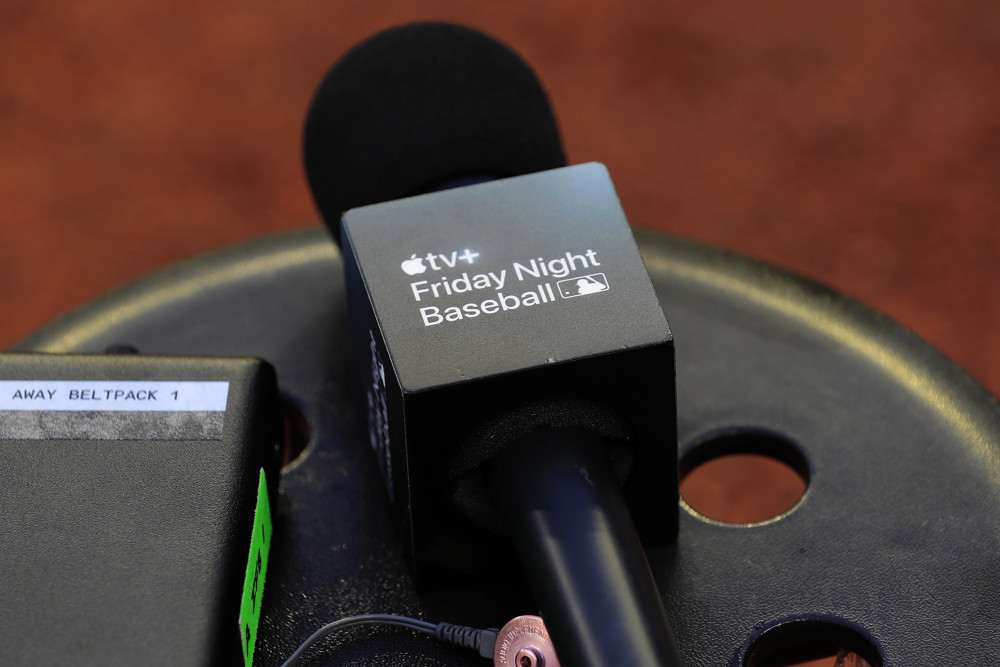 ATLANTA, GA – JULY 05: An Apple TV+ microphone on the sidelines before the Friday evening MLB game between the Atlanta Braves and the Philadelphia Phillies on July 5, 2024 at Truist Park in Atlanta, Georgia. (Photo by David J. Griffin/Icon Sportswire)
When ESPN scaled back its MLB coverage as part of the 2021 media rights negotiations — which allowed the network to cut down its rights fee from nearly $800 million — that meant ceding the weeknight rights that had sustained the network’s spring and summer lineup for generations. No more Monday Night Baseball, no more Wednesday Night Baseball.
In seeking a new home for those rights, MLB did not have many takers and ended up looking at some unconventional outlets — including Barstool — before splitting the rights between the aforementioned Comcast on Sunday mornings and Apple TV+ on Friday nights.
It is impossible to know whether the Apple TV+ deal has succeeded in attracting an audience, as no data has been reported in the four seasons the streamer has carried games. But it would seem like the deal is at least working out for Apple, which has been widely reported as a contender for at least part of the ESPN package. Beyond game inventory itself, the ESPN package includes highlight and international rights that could be valuable to Apple, which has prioritized global reach.
With all of that said, an Apple deal does not make much sense. One, Apple would have to outbid Comcast and ESPN for such a deal to make sense, and that is not how Apple has done business in this industry. (The Pac-12 essentially died waiting for Apple to back up the Brinks truck.) Two, Apple would have no real need for Sunday Night Baseball given its Friday night doubleheaders. Three, Manfred has said that he is prioritizing reach, and perhaps more than any other of the major streamers, Apple is lacking on that front.
The May report by Ourand noting Apple’s interest in the ESPN package characterized talks between the sides as “the most extensive among the streamers,” which is a very different terminology than the “the most extensive.”
#4: Fox Sports
Fox is the MLB “A” partner with an annual rights fee north of $700 million, so there is not much more the network can add without approaching the billion mark — quite the expense given that MLB is getting barely $100 million per year from Apple and Roku combined.
Fox has thus far been mentioned as a realistic contender for the Home Run Derby, but that is pretty much the extent of the speculation. While it’s true that the network’s non-sports schedule has faded to the point that it is willing to feature pretty much any sporting event in primetime — even rugby — the idea of it carrying primetime MLB on both Saturday and Sunday nights seems like a little much, between the cost and the commitment.
#5: Anyone else?
Versant, the spinoff company consisting of NBCUniversal cable networks, threw its hat into the ring — but nobody believes it is a serious option. Manfred made his feelings about cable clear when he described ESPN as a “shrinking platform,” a description that surely applies to cable networks like USA, which will not even have a corresponding streaming platform once the spinoff is complete.
TNT Sports reached out as well, per Ourand of Puck, but “talks never got serious.” With TNT set to be spun off as well, and separated from both HBO and Max in the process, simply hanging onto its existing MLB package will be enough of a challenge — much less acquiring more rights.
Little has been said about Amazon’s Prime Video, a bit surprising given that Amazon already has a toehold in MLB by way of its deal with the Yankees and its link-up with FanDuel Sports Network. Of all the streamers, Prime Video is the most established in sports, and the only one for which viewership estimates are regularly available.
All other bidders are just speculative thought experiments at this point. Netflix for the Home Run Derby? Nexstar’s CW making its biggest splash yet on Sunday nights? Paramount somehow resolving the SkyDance merger in time to get CBS involved? If any of these were realistic options, one imagines there would be a hint of smoke by now.
Who should it be?
The most interesting option is a Comcast deal for NBC and Peacock. While that would include a fair number of Sunday Night Baseball streaming exclusives, the full summer of Sunday night games would presumably air on NBC. Being part of a year-round package of Sunday night sports would be a benefit to the league, particularly the association with the venerable Sunday Night Football.
Could a Comcast deal potentially involve playoff games on Peacock? If so, MLB would be simply joining the NFL and NBA on that front.
But the simplest solution is usually the best one. ESPN’s decision to opt out was clearly intended to spark a negotiation, either for additional rights or a lower rights fee. It seems fairly evident that MLB has a better chance at a good deal from a party that wants to negotiate than from parties who are essentially just doing their due diligence.
The “shrinking platform” of ESPN has delivered some of baseball’s largest audiences this year, including 2.0 million for Detroit-Minnesota last week. MLB may have legitimate complaints about ESPN’s coverage, but those can be addressed in the next set of negotiations in 2028, when presumably the competing bids will be a bit more compelling.
If ESPN is willing to stay in the neighborhood of its current $550 million payout for an extension, plus local rights, it is hard to argue for MLB making any other decision. If splitting the rights multiple ways somehow adds up to the same or greater figure — unlikely, based on any of the reporting thus far — then that could change the calculus. But remember, what got MLB into this mess in the first place were tiny deals for small amounts of money. It might be good for MLB to avoid setting another low price tag for these properties ahead of ’28.