
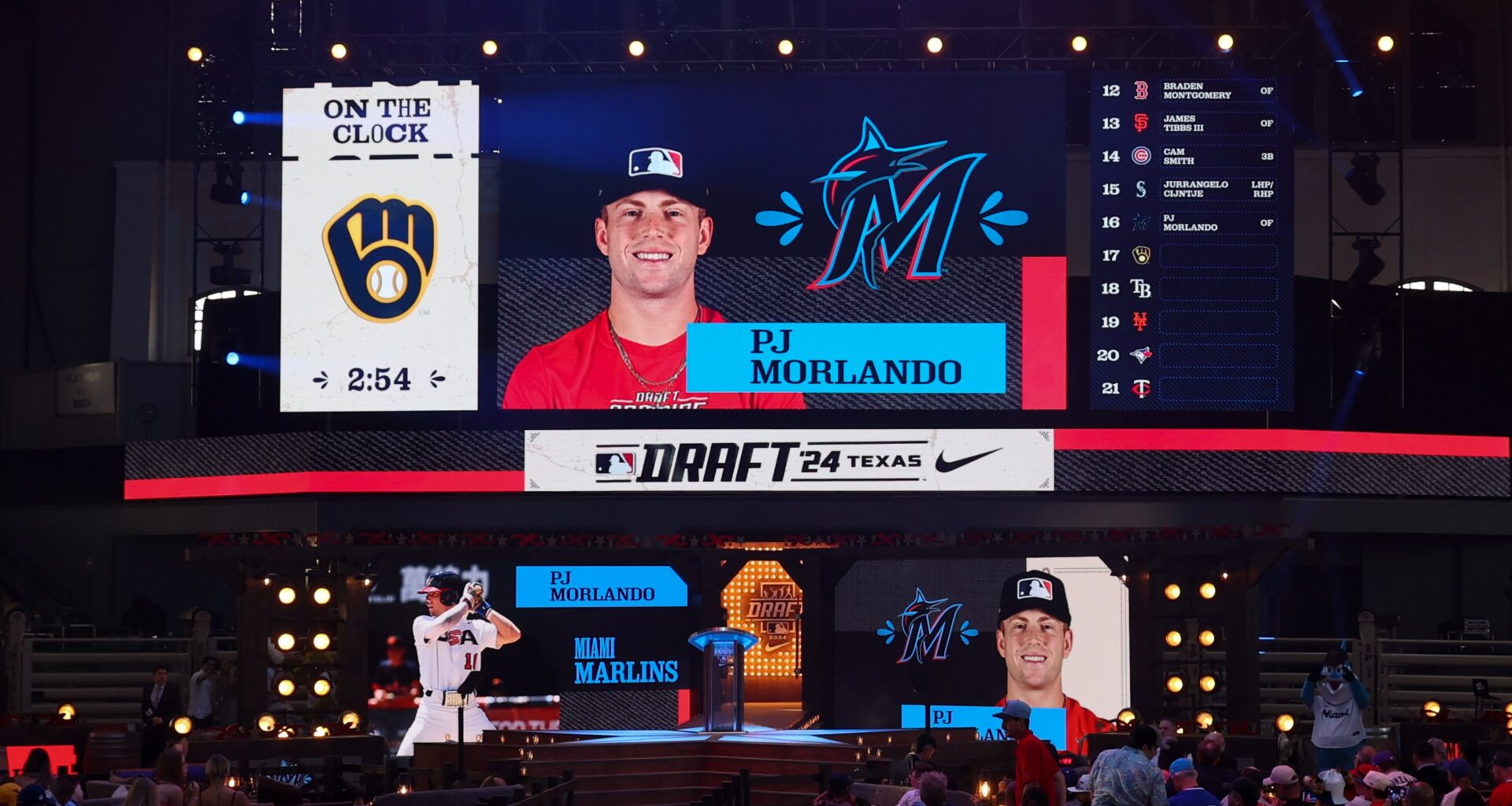
To start off, this is not an article degrading the talent and ability of 2024 Marlins first-rounder PJ Morlando. In the limited time that Morlando has been available to play, he has been one of the better hitters for the Low-A Jupiter Hammerheads. In 20 games this season, he has posted a .231/.427/.385 slash line with a .812 OPS, splitting time between center field and left field. It’s too soon to close the door on him eventually becoming a productive big leaguer.
The question is, how did the Marlins reach the conclusion that Morlando was the best available player on the board for them? The third-oldest high school player selected in the first round last year, it was clear in the moment that his ability to reach the majors relied heavily on his bat and he was lacking the flashy tools of other outfielders taken after him.
Part of the reasoning was financial—Morlando signed for $3.4 million, which was $1.3 million below slot value. Those savings gave the Marlins flexibility to go overslot on their second-rounder, Carter Johnson. However, fellow outfielders who were selected later in that round, such as Braylon Payne, Carson Benge, and Slade Caldwell, also signed for $4 million or less. Why take Morlando over them?
Payne went to the Milwaukee Brewers immediately after Morlando and for a near-identical bonus ($3.44M). He was one of the youngest high school bats in the whole class. The power is lacking as Payne has a small frame, but he graded out to be a future center fielder, with great speed and an above-average hit tool. As it turns out, Payne is easily out-slugging Morlando as a pro thus far while having a clearer path to providing value to a MLB team even if he does not hit at the highest level.
Zoning in on Benge, he had a great college career and has continued that success in the minors, already reaching Double-A. Passing on Benge is also a head-scratcher. He had shown the ability to play center field and posted elite numbers versus more advanced pitching prior to the draft. According to both Baseball America and MLB Pipeline, Benge now ranks among the top 100 prospects in the entire sport.
Slade Caldwell fell to the Diamondbacks at pick No. 29. He has played strictly center field in the lower minors and has shown an elite ability to get on base and generate contact, which was expected out of him pre-draft. Caldwell signed for $3.09 million—significantly less than Morlando—and had just turned 18 at the time of the draft. This is another example of a player who has several avenues to succeed as he develops, rather than being a literal hit-or-miss prospect.
The Marlins must look to optimize value in every draft selection, especially in the first round. Morlando lacked the experience of Carson Benge, and the all-around tools and youth of Braylon Payne and Slade Caldwell. Time will tell whether or not they ultimately suffer for that particular decision, but repeatedly making similar errors in the 2025 draft and beyond will eventually come back to bite them.