
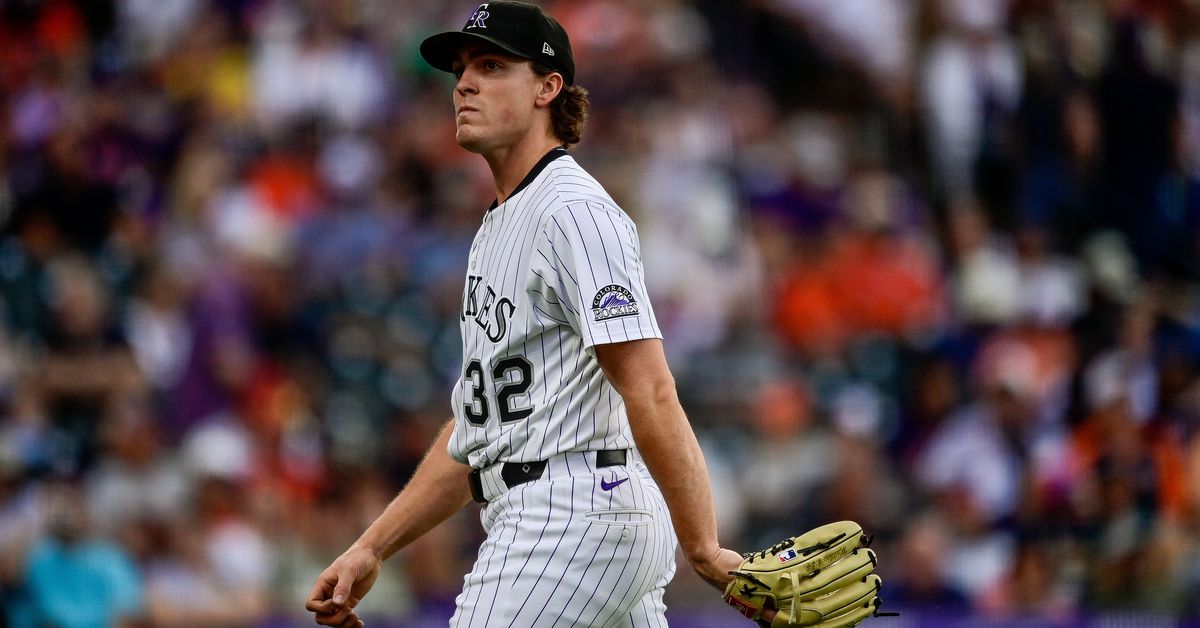
When the Colorado Rockies were entertaining the idea of starting the 2025 season with top prospect Chase Dollander in the starting rotation, it was an exciting notion for the fan base.
The 2023 first-round pick has been heralded as someone who could become the true ace that this team has desperately needed. When he was called up on April 6, after a single start in Triple-A, the hope was that the future had started for both him and the Rockies.
Unfortunately, that future has hit a bit of a snag and has been put on hold for now.
The Rockies optioned Dollander back to Triple-A Albuquerque on Monday following another rough start last Sunday when he labored through 3 2⁄3 innings against the Chicago White Sox. Over 15 starts with the Rockies, the 23-year-old posted an inflated 6.68 ERA in 68 1⁄3 innings. There were flashes of the brilliance that lies within him, but the struggles became too glaring to ignore.
So what went wrong for the rookie?
A look under the hood via Statcast points to some of the answers. While his electric fastball velocity and breaking pitch run value are fairly strong, the rest of his numbers rank among the bottom of the league.
Dollander’s fastball run value is in the bottom 1% among MLB pitchers. Opposing batters ended up .294 AVG while slugging .588 against it. He owns one of the highest barrel rates in the league, which resulted in a lot of damage and a hard hit rate of 41%.
Alongside his fastball is pitch variations didn’t yield good results either. His sinker, cutter, and changeup all have batting averages against over .300, with the latter two both with opposing slugging percentages over .500. With so much hard contact, it’s easy to understand why he has given up 7.21 runs per nine innings.
The correlation is that Dollander had a low chase and whiff rate compared to other pitchers. With an overall chase rate of 23.8% (eighth percentile) and a whiff rate of 22.1% (26th percentile), he just couldn’t seem to miss major league bats like he did in the minors last season.
Dollander’s most effective pitch has been his curveball. With a higher than average 14.1 inches of glove-side break and a lower than average 51.5 inches of vertical drop, opposing hitters are just .152 against the curveball. The pitch carries a 30.7% whiff rate, despite being his slowest pitch with an average velocity of 78.9 mph.
The curveball ended up being his put-away pitch 18% of the time, but it didn’t help improve his subpar 16.8% strikeout rate this season. He posted a 12.89 K/9 between High-A and Double-A last season while posting a 6.8 K/9 this season in the big leagues.
Being unable to miss bats has also compounded his lack of command in finding the zone. Efficiency and consistency have been an issue for Dollander, even dating back to his excellent minor league season last year, and it’s something that manager Warren Schaeffer wants him to work on during the reassignment to Albuquerque.
“He absolutely has things he needs to work on,” Schaeffer said on Monday at Fenway Park. “He needs to work on his efficiency and getting deeper into games and throwing more strikes early in counts. And he knows all this, and it’s a good time for him to go down there and work on it.”
Dollander throws plenty of strikes, coming in 61%, but that hasn’t stopped him from posting a 10.7% walk rate. In fact, he had a 9.4% walk rate last year, but it was counteracted by his 33.9% strikeout rate. You can typically get away with some command issues in the lower levels by sheer firepower, but it won’t fly in the majors as hitters are more selective and aren’t as likely to miss mistakes.
He averaged 18 pitches per inning, which would rank second among all qualified pitchers (if he actually qualified). The excess of pitches has been apparent for Dollander, who has struggled to work deeper into games. Of Dollander’s 15 big league starts, just seven have been five innings or more. He has had five games in which he’s thrown over 90 pitches; only in two of them has he gone at least five innings.
Dollander has not found the zone consistently enough, and the pitch sequencing has left him trying to play catch-up in most at-bats where he has not found success.
So what needs to be done?
First and foremost, he has to improve his command and efficiency. A high walk rate is playing with fire, especially when you pitch for Colorado. He also needs to find that balance of being able to overpower hitters when needed to keep the walks in check.
A big part of that is getting a feel for his pitches again. A noticeable absence during his time with the Rockies was that he hardly used his slider, which was such a crucial pitch for him in college and last season. He threw a total of four sliders in 68 innings. Rather than trying to mix in cutters and sinkers alongside his fastball, I’d like to see Dollander rediscover his slider and make that a vital weapon in his arsenal to help set up his fastball, curveball, and changeup.
He also needs to figure out pitching in higher altitude, which is a reason the Rockies call Albuquerque their Triple-A home. Dollander has a 4.25 ERA on the road but a massive 9.37 mark in the mountains. His 20.3% strikeout rate on the road is much better than his 13.7% clip at Coors.
There is no doubt that Dollander has the tools to be a great big league pitcher; we’ve seen instances of it this season already. But he is still unrefined and needs a reset, and the demotion to Triple-A is likely a good move for him at this time. This is a crucial moment in a young, highly-touted pitcher’s career that can set the stage for his career trajectory.
It’s time for Dollander to show what he’s truly made of.
★ ★ ★
On the Farm
Triple-A: Albuquerque Isotopes 6, Round Rock Express 5
Zac Veen’s hot streak continued with a three-hit performance, but it was the bottom of the order that proved the difference. The 5-9 hitters drove in all six of the Isotopes’ runs, including Sean Bouchard’s two-run home run in the sixth. Anthony Molina started the hill and allowed two runs over five innings of work. However, Mason Albright gave up three runs in the sixth, but the rest of the pen locked it down, and the offense did its job later on.
Double-A: Hartford Yard Goats 6, Portland Sea Dogs 1
Nic Kent delivered a four-hit day as the Yard Goats put up four runs in the top of the ninth to secure the victory. Charlie Condon drove in a pair of runs in the game while Dyan Jorge and Kyle Karros each delivered doubles on the day. Sean Sullivan was the standout on the mound, going seven innings and allowing just one run on four hits with seven strikeouts and no walks.
High-A: Eugene Emeralds 5, Spokane Indians 4
A four-run rally in the ninth came just shy of a miracle for the Indians in their loss. Alberto Pacheco allowed three runs over five innings, taking the loss after the offense couldn’t overcome the deficit. Jesus Bugarin delivered a two-run double in the ninth, while Jean Perez had an RBI sacrifice bunt and Braylen Wimmer had an RBI triple.
Low-A: Fresno Grizzlies 6, San Jose Giants 4
Jimmy Obertop delivered a three-run home run in the fifth inning that pushed the Grizzlies ahead in their win over San Jose. Nolan Clifford had three hits on the day while Kelvin Hidalgo and Robert Calaz each had two hits. Angel Jimenez allowed four runs on four hits in five innings of work, earning the win after the bullpen locked things down with four shutout innings.
★ ★ ★
Ken Rosenthal gives his take on the potential shakeup of the Rockies’ front office. He points to the Nationals shake-up recently and points to some former Rockies employees who could step in as an “outside hire.” Essentially, he believes the Rockies need to bring in an outside person to gut the organization, and the team should be open-minded to trading anyone and everyone, including pieces like Dollander.
Affected by Altitude Episode 170: The All-Star Game could use a Good Man | Rocky Mountain Rooftop
This week, Evan Lang and I celebrate the All-Star news of Hunter Goodman and what it means for his future with the team behind the dish. We also talk about the outfield situation surprises, and then round out with how the Rockies could learn from the Nationals front office changes.
★ ★ ★
Please keep in mind our Purple Row Community Guidelines when you’re commenting. Thanks!