
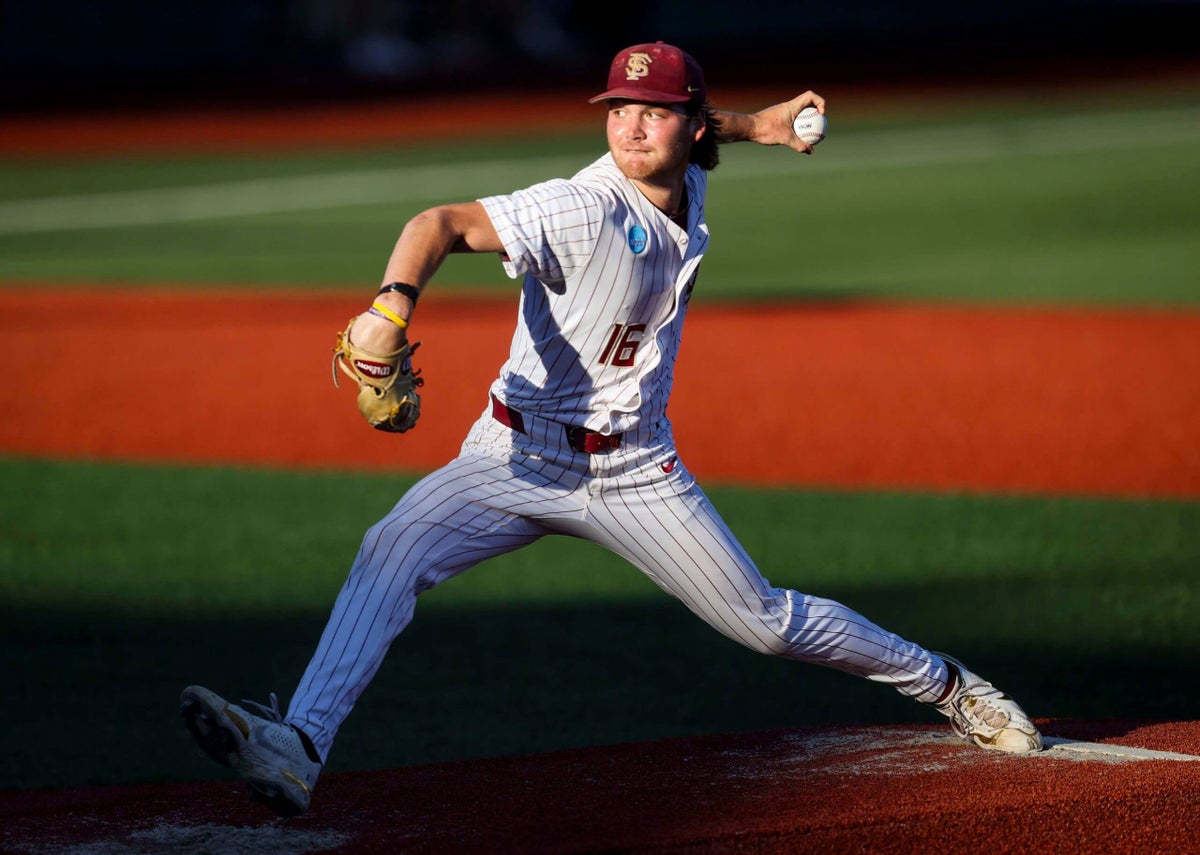
For the past two years, few Division I pitchers have been better than Florida State left-hander Jamie Arnold, who became the No. 11 pick in the 2025 MLB Draft when the Athletics selected him on Sunday. With a near sidearm delivery and lots of swing-and-miss in his arsenal, Arnold has drawn comparisons to Chris Sale. He’s hoping to follow in Sale’s footsteps with a quick journey to the major leagues.
Coming out of Jesuit High in Tampa, Fla., Arnold was a well-regarded pitching prospect, though few could’ve projected that the scrawny left-hander with a fastball that barely broke 90 mph would go on to strikeout 327 batters in 234 1/3 innings over three seasons at FSU.
“Everyone dreams of it, but I didn’t expect it for myself because I didn’t have the size, or anything like that. But as I got older, I got better and put in the work and it’s paid off,” Arnold said at the MLB Draft Combine last month.
Arnold had a fairly nondescript freshman season, posting a 6.34 ERA in 44 innings. He starred that summer in the Cape Cod League (2.95 ERA with 21 strikeouts in 18 1/3 innings) and carried over that success into his sophomore season, when he helped lead the Seminoles to an appearance in the College World Series. He finished third in Division 1 with 159 strikeouts in 105 2/3 innings, along with a 2.98 ERA and 11 wins. Arnold followed that up with a strong showing for Team USA last summer.
After his standout sophomore season, Arnold, 21, came into this year as an early candidate to go 1-1 in the draft. That meant that every start he made was heavily scrutinized and scouts were always in attendance. He missed one start with a stomach bug midseason and knew it would immediately raise red flags that perhaps he was injured. Arnold admitted when he returned the following week, he was out to prove that there was nothing wrong with him physically (beyond being down a few pounds from the illness).
“I hit my PR that week (in terms of velocity), so I think I showed pretty good stuff,” he said.
There was pressure on Arnold all season, given everything that was riding on his performance in terms of draft position, but he learned to block out the distraction and focus only on what he could control. He finished the year ranked No. 6 on Keith Law’s top 100 draft prospects.
“It’s baseball. You’re gonna have bad outings,” he said. “You just gotta say screw it sometimes and go out there and just focus on the next pitch and not really think about what’s going on in the stands or what’s going on online and stuff like that.”
Legendary Florida State head coach Link Jarrett has plenty of experience with players who are dealing with high draft expectations throughout their junior seasons. Jarrett said Arnold handled that pressure well, focusing more on having fun and winning with his teammates than the draft noise. Arnold served as a co-captain along with shortstop Alex Lodise and was a leader in the program.
In general, Arnold appeared to gain strength as the season progressed. He pitched at least six innings in six of his final eight starts and struck out at least nine in five of them. His final outing came against Oregon State in the Super Regionals, a 3-1 win in which he allowed a run on six hits in 6 2/3 innings, striking out nine and walking one. The week before, he struck out a season-high 13 in an NCAA Regional win over Mississippi State. Though he didn’t quite match his overall stats from his sophomore season, he did finish the year with the same ERA (2.98) while posting a 119:27 K:BB in 84 2/3 innings.
Normally a laid-back personality, Arnold takes on a more intense persona when it’s a high-pressure situation, like a postseason game, Jarrett says.
“He’s the happiest, most humble guy, but you see the look in his eyes when it’s time to go in those games, and he turns it up,” Jarrett said. “There’s another gear there.
“You see the velocity jumps a little bit all of a sudden. It might be the fifth, sixth inning, right? But the look in the eye changes, and it’s a very quiet intensity, and he lets it out.”
Florida State’s season ended earlier than Arnold had hoped, as the Seminoles fell short of a return to Omaha, ultimately losing in the Super Regionals. The silver lining was that he got a chance to spend some time at home, fishing on the lake and decompressing from a long two-plus years in the spotlight. By the time the combine rolled around in mid-June, Arnold was ready to be back on the field.
“This is where I love to be,” he said at Chase Field last month.
Arnold says the fastball was always a strength for him, but the pitch jumped to another level of effectiveness when his slider improved to the point that it was a plus pitch.
“Once the slider got going, that’s when things kind of took off for me,” Arnold said.
Because of his low release point from the left side, Arnold has drawn comparisons to Sale. The release point has been very effective for Arnold, and it arrived almost by accident. He used a three-quarters delivery in high school but says he put on 30 pounds of muscle the summer before his freshman year of college, and his arm slot dropped down even further with the added strength.
“It felt comfortable, so I didn’t change anything,” he said.
Not surprisingly, Arnold takes pride in being compared to Sale.
“It’s awesome. I mean, he’s going to be in the Hall of Fame,” he said, noting that while there are plenty of differences between him and the Atlanta Braves left-hander, he watches a lot of Sale’s starts to see how Sale attacks hitters so he can think through how he’d handle similar situations.
One thing that separates Arnold from many other pitchers who use a lower release point is that he has an effective four-seam fastball that plays up in the zone that hitters have had a very tough time making contact on. He also has a two-seamer that gets more run than the four-seamer.
“I didn’t really understand the metrics behind (the four-seamer) until I started seeing everyone whiff at it,” he said with a laugh. “Nowadays, VAA (Vertical Approach Angle) is a huge thing. Once I understood that, I kind of understood why it worked. But the two-seam still plays, obviously, from that slot, easy to get run on it. So having both has been great.”
Perhaps not surprisingly, Arnold’s VAA compares favorably to Sale’s. His IVB (Induced Vertical Break) is relatively flat compared to many elite fastballs, but, like Sale, Arnold gets so much deception with his arm angle that hitters can’t square it up. When they do hit it, they often don’t get good results.
“For the metrics on his fastball, it surprised me at times that he got so many weak, chopped ground balls, because it has that unique vertical approach where it’s climbing up in the zone,” Jarrett said.
Arnold pairs the fastball with a slider that, as Law wrote in his top-100 ranking, “gets huge horizontal break.”
“The sweep on the slider is as unique as I’ve ever seen,” Jarrett said. “That arm slot and the angle and the action on the pitch, it almost looks like when you’re out there that he’s throwing a wiffle ball at times. It’s got that much movement.”
Arnold notes that the higher he releases his slider, the more depth the pitch gets, but he tries to keep a consistent arm slot that allows his slider to get good break and lets his fastball play up in the strike zone. He also has a changeup that Law rated as above-average. That pitch was new to Arnold this season, according to Jarrett, and the FSU head coach believes that as Arnold gets even more comfortable with the pitch, it will become a significant weapon for him, especially against right-handed hitters.
“Don’t be surprised if that pitch becomes something that people talk about,” Jarrett said.
Lodise, the NCAA Dick Howser award winner, played behind Arnold at shortstop for the past two seasons. He says the left-hander is a defender’s dream because he doesn’t waste time on the mound.
“He is the quickest pitcher that I’ve ever had to play defense for,” Lodise said at the combine. “He works so fast, you’re not standing out there for long, so even when he gets hit around — because it happens, everybody gets hit — it doesn’t feel like you’re out there for 30 minutes.”
Jarrett said at times he and FSU pitching coach Micah Posey had to slow Arnold down a little bit, delaying a pitch call to give him a little more time in between pitches. Although Arnold was a strikeout pitcher at FSU, Jarrett said that the lefty’s ability to induce groundballs to get quick outs allowed him to work deeper into games and get out of jams.
“It’s a great combination of pace, stuff, deception and intensity,” Jarrett said.
After a dream career at Florida State, Arnold is ready for the next step. Like so many in the industry, Arnold has taken notice of how quickly some college prospects are getting to the big leagues. His 2024 FSU teammate, Cam Smith, is an AL Rookie of the Year candidate in his first full professional season. Smith is one of seven 2024 draft picks who have already debuted in the majors.
Arnold takes a little extra motivation from seeing so many players he recently played with or against already in the big leagues.
“It’s exciting to see. I think it’s something that should have happened a while ago with prospects,” he said. “I think sometimes some teams might have taken too long, and I like how it’s going nowadays.”
(Photo: Abigail Dollins / Statesman Journal / USA Today Network via Imagn Images)