
An adjusted MLB draft schedule forced a quick turnaround for the Chicago Cubs and amateur scouting director Dan Kantrovitz.
The league changed the format this year. Rather than spreading the 20 rounds over three days, it was reduced to a two-day process with Rounds 1-3 on Sunday night and Rounds 4-20 starting Monday morning. The Cubs’ draft room staffers left Wrigley Field around 1 a.m. Monday and were back at 5 a.m.
“Whenever there’s a break in the rhythm, I feel like it could be a little disruptive sometimes and in years past, when I felt like maybe it stretched a little bit further and you want certain days to keep going, and this year, we kind of got our wish. Today was a long day,” Kantrovitz said Monday. “The best I could sort of summarize it is, it was exhausting for all of us, but that’s how a draft should be. And looking back, it was pretty fun.”
Through at least the sixth round — “because it’s tough to have too much visibility beyond that,” Kantrovitz explained — he believes the Cubs executed the plan they laid out over the last two weeks.
“Pretty much to a T,” Kantrovitz said. “Now it’s just time to see how the players go out and perform. But in terms of coming in with certain expectations, I think we nailed those.”
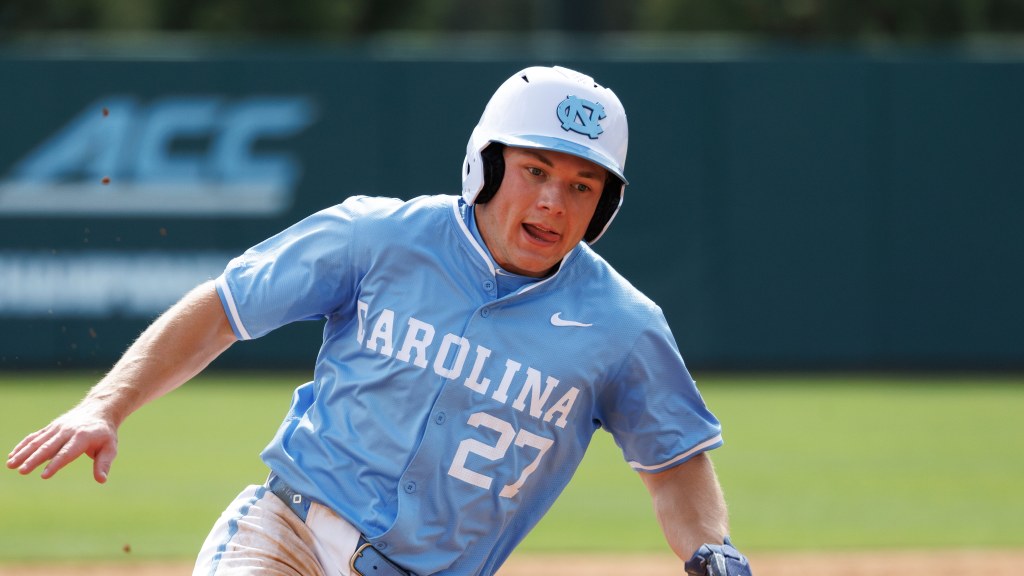
The Cubs opted for left-handed hitting outfielders Ethan Conrad from Wake Forest and Kane Kepley from North Carolina with their first two picks.
Part of the Cubs’ strategy was to come out of the draft with pitching volume, wanting to exhaust that talent pool as much as possible. Drafting seven college pitchers with their final 10 picks and identifying starters was by design.
Kantrovitz anticipates the Cubs signing 18 or 19 of their picks. Whether third baseman Caleb Barnett, an Alabama commit drafted with their 19th-round pick, is among the signees, Kantrovitz wouldn’t characterize it as optimism that Barnett will forgo college.
When dissecting the Cubs’ 20 picks, there are four initial takeaways on the draft class.
1. Their picks heavily skew to college
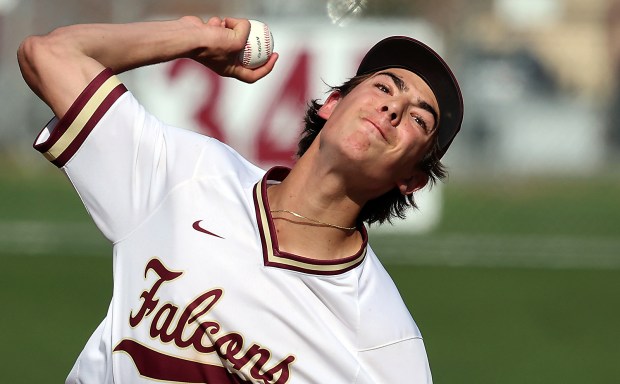 Scotts Valley High’s Kaleb Wing pitches in the first inning against Santa Teresa on Tuesday, March 18, 2025. (Shmuel Thaler/Santa Cruz Sentinel)
The Cubs have shown a willingness under Kantrovitz to skew more toward college players in the top rounds.
Some of that strategy can be attributed to how a team wants to allocate its bonus pool money. College players, particularly seniors, cost less, which would allow those funds to be put toward another player(s) for over slot value. Eight of the Cubs’ first 10 picks came from college, including four who were seniors or in graduate-level programs. Ultimately, the Cubs selected only four prep players in 20 rounds:
No. 121, 4th round: Kaleb Wing, RHP, Scotts Valley HS (Calif.)
No. 181, 6th round: outfielder Josiah Hartshorn, OF, Orange Lutheran HS (Calif.)
No. 421, 14th round: Kaemyn Franklin, RHP, Victory Christian HS (Okla.), the brother of Cubs minor-league pitcher Kohl Franklin
No. 571, 19th round: Caleb Barnett, 3B, Mountain Brook HS (Ala.)
Asked after Day 1 of the draft, which featured the first three rounds, whether the Cubs were able to save bonus pool money to be more aggressive in the final 17 rounds, Kantrovitz agreed with that assessment of their situation.
“We’re going to go into (Monday) with some flexibility, and at this juncture, it’s difficult to forecast how we’re going to deploy that flexibility,” Kantrovitz said. “But suffice it to say, we’re going into (Monday) with, I think, a good amount of financial flexibility.”
2. Cubs value experience and success in major conferences
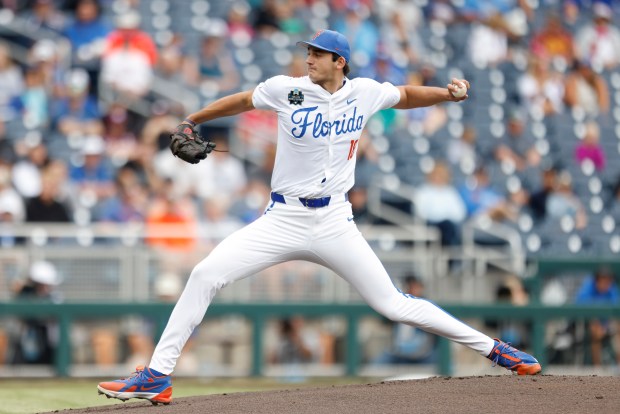 Florida pitcher Pierce Coppola throws during an NCAA College World Series baseball elimination game against Kentucky on Wednesday, June 19, 2024, in Omaha, Neb. (AP Photo/Mike Buscher)
In a college-heavy draft for the Cubs, their selections from the collegiate ranks tended to skew toward two of the top NCAA Division I conferences.
Among the Cubs’ first 13 picks, eight players came from the Atlantic Coast Conference (ACC) or Southeastern Conference (SEC).
“I never know if it’s like a chicken and egg thing, right? Like if we value it or if there are better players from those conferences,” Kantrovitz said. “I think on one hand, if that’s where the best players are, it’s natural for us to probably draft more players from those conferences, or maybe the best players go to those conferences because we tend to draft more of them, or a combination of both.
“But I don’t think it’s unusual to have a high concentration of your draft picks from some of those major conferences. Anytime you can see a player against really good competition, it just helps us formulate a more crisp evaluation of them.”
3. Strong performances in summer leagues help
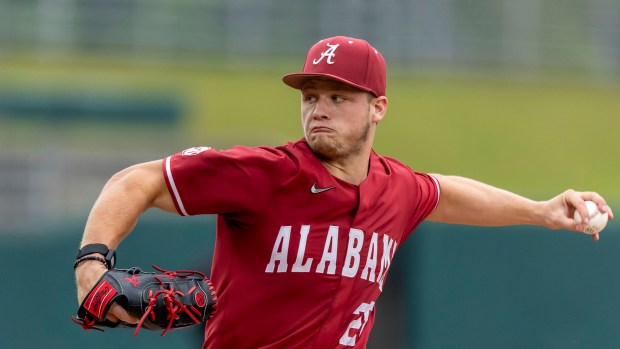 Alabama’s Kade Snell during an NCAA baseball game on Tuesday, April 9, 2024, in Tuscaloosa, Ala. (AP Photo/Vasha Hunt)
A background that features a strong showing in summer leagues, like the Cape Cod League or the MLB Development League, has helped hone scouting reports for players during the Cubs’ evaluation process.
Multiple picks had notably great showings in summer leagues in previous years, including Conrad, Kepley, outfielder Kade Snell (fifth round), catcher Justin Stransky (10th), right-hander Noah Edders (15th), right-hander Connor Knox (18th) and right-hander Freddy Rodriguez (20th).
The Cubs pretty aggressively scout leagues that play in the summer, like the Cape Cod League, an approach they believe proves valuable on multiple levels.
“From both a scouting standpoint, in terms of we blanket the summer leagues so we get some high-quality looks out there and and then also just from an analysis standpoint, you get to see the hitters hit against some of the best pitching in the country on a daily basis, and vice versa for the pitchers,” Kantrovitz said. “They’re using wood bats, so there are just parts of that that allow us to probably have a little bit of a cleaner translation when we’re making our analytical projections.
“That definitely helps us to complete a picture and sometimes in rare cases, it’s the only picture in terms of an evaluation of some of these players.”
4. Cubs continue not to be scared away by players’ injury history
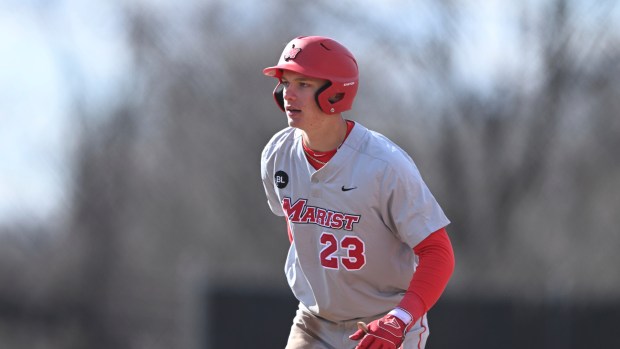 Ethan Conrad during an NCAA baseball game on Tuesday, March 14, 2023, in Towson, Md. Conrad played for Marist before transferring to Wake Forest. (AP Photo/Gail Burton)
The Cubs have shown a willingness to draft players whose medical history might not be the cleanest.
Of course, there are layers to that and how the Cubs evaluate a player’s upside. It didn’t prohibit them from taking Conrad with their first pick despite missing most of the 2025 college season following shoulder surgery.
“It’s something that we’re open to, and you don’t want to close the door on a player based on his health if the forecast is that he’s going to recover,” Kantrovitz said. “In the case of Ethan, we expect a full recovery. So, I’m not sure if it’s a trend, but it’s definitely something that we’re not going to dismiss players that we think are hurt and are going to get back to full strength and full speed at some point soon.”
Conrad wasn’t the only player whose past injuries might have impacted where they were selected in the draft. A trio of pitchers saw their collegiate careers limited due to injuries.
Right-hander Eli Jerzembeck, taken in the 11th round out of South Carolina, showed great stuff his freshman year with the Gamecocks in 2023, striking out 36 and walking only six in 31 2/3 innings to complement a 2.84 ERA in 16 games (three starts). But Tommy John surgery and a stress fracture in his right elbow prevented Jerzembeck from pitching the last two seasons, creating some risk with the pick.
Left-hander Pierce Coppola (seventh round) dealt with back and shoulder injuries during his three seasons at Florida, limiting him to 16 total starts and 49 1/3 innings in his Gators career. He was a strikeout machine this year while posting a 0.984 WHIP and 2.53 ERA. Coppola struck out 43 of the 92 batters he faced (46.7%) in 21 1/3 innings.
Kantrovitz noted the Cubs had liked Coppola since he was at Verona (N.J.) High School, which proved helpful with the smaller sample size in college.
“We had the opportunity to see his stuff advance, see him get a few more ticks on his fastball, see his breaking ball get a little bit crisper, see him fill out physically and that translated a little bit smoother delivery,” Kantrovitz said. “So he’s somebody that probably that history in high school really helped us.”
Jake Knapp (eighth round), who turns 25 next month, missed the 2024 season for North Carolina because of Tommy John surgery. The 6-foot-5, 270-pound right-hander bounced back, though, to earn ACC Pitcher of the Year honors in 2025 by going 14-0 with a 2.02 ERA, 22.2% strikeout rate and 4% walk rate for the Tar Heels. His WHIP (0.860) and ERA ranked third and fourth, respectively, among Division I pitchers.
“It wasn’t really a question of maybe one year not having the innings,” Kantrovitz said. “It was probably the full picture with him to develop that resume.”