
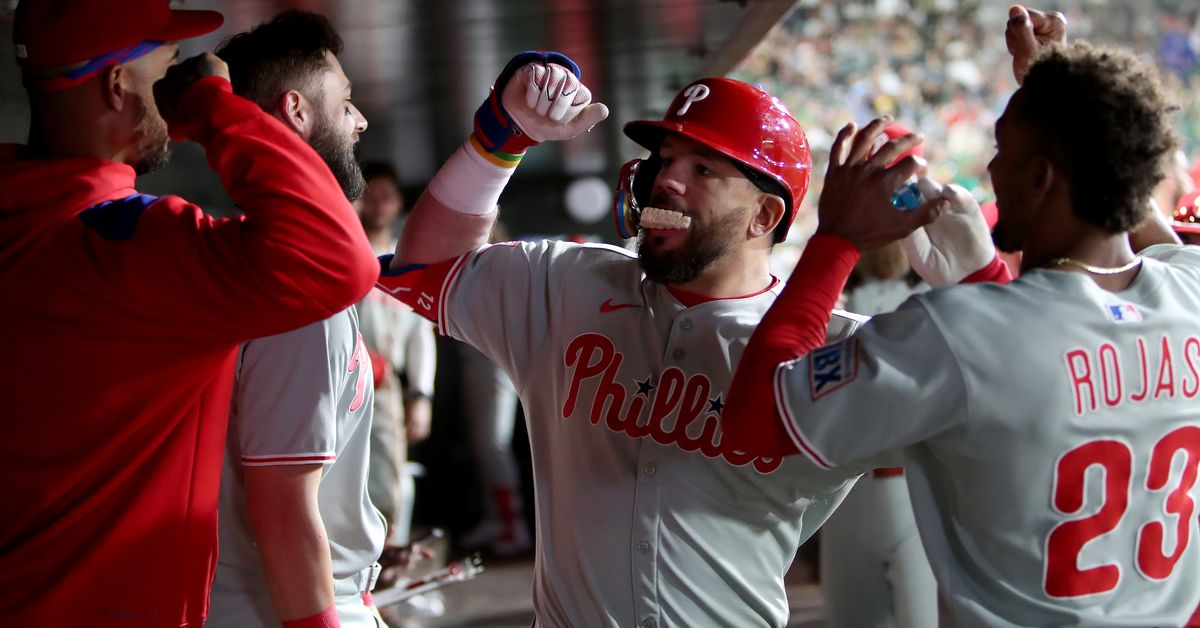
The All-Star break is here, which means we can now focus on how the team has performed in the unofficial first half of the season. One might think that the team was doomed for the cellar based on how they are playing of late, but that might be the result of having watched a team that was looking forward to a break. If we’re going to look at how they’ve done so far, we can use these three questions: what is going right? What is going wrong? Where can they go from here? Analyzing these questions can give us a good temperature check on the team as they prepare for the final two and a half months of the season.
What has gone right for the Phillies?
The starting rotation – It’s already been written about here and abroad: the Phillies have the best rotation in the league and it really isn’t all that close. They have three should be All-Stars in Zack Wheeler, Cristopher Sanchez and Ranger Suarez, a super competent, but of late inconsistent fourth starter in Jesus Luzardo and a fifth spot that has seen some decent performances from Taijuan Walker and Mick Abel. They have a prospect that may or may not be ready to join the team in Andrew Painter and a returning member soon to re-join the team in Aaron Nola. With other contenders desperate for any kind of starting pitching that they can find, the Phillies are fortunate in that they have a plethora of arms that can cover innings and do so at at least a major league average ability.
Break down the starting rotation however you want and you’ll find the Phillies at, or near, the top of the statistical list.
Best WAR for starting pitching? The Phillies with 13.1 fWAR.
Most innings pitched for starting rotation? The Phillies with 545.
Highest strikeout rate? The Phillies, with 26.1% of hitters striding back to the dugout following their at bat.
We could go on and on, but the most basic way of putting it is that the team’s rotation is the best in baseball and will be leaned on the rest of the season.
Trea Turner and Kyle Schwarber – The consistency of the offense has been rightly called into question this year. Running out several platoons each evening means you’re probably not going to get hitters at their peak best, but without the personnel to do so, the team is making due with what they have. What hasn’t been inconsistent is the performance of Turner and Schwarber this year.
Turner comes into the break hitting .289/.343/.433 and leads baseball in hits. While it’s not the most telling way of how well a hitter is doing in a season, one interesting stat is that this marks the first time since April 30 that Turner’s batting average has been below .290. Schwarber started out like gangbusters and has cooled a bit, but his line of .247/.378/.545 to go along with his 30 home runs makes him one of the best hitters in the game right now. His .923 OPS is 5th in the National League, his 151 OPS+ putting him eighth. He’s a dangerous hitter each time he steps to the plate and has all but eliminated the platoon advantage for opposing managers, no matter how hard they try.
What has gone wrong for the Phillies?
Where else is the offense? – Matt Gelb wrote an article on Monday about the team’s lack of power this season. They’ve done all the things that they were supposed to do – don’t chase, use all of the fields, but without the power. That’s all well and good for the regular season. It’s a 162 game grind and they need to get offense however they can. But once the postseason rolls around, should they be a participant, not having power is going to be an issue. Sure, they are fifth in slugging percentage in the National League, but hovering around .400 isn’t going to be enough. Power and slug is going to have to start showing up if the team is going to have hope in the postseason. Can they get by with their current approach? That remains to be seen, but it is probably a better path to success that they start hitting the balls in the gaps and over the fence.
Defense – There have been some bright spots, don’t get me wrong. Trea Turner has picked up his game after a few seasons of slippage. Bryson Stott has been good at second base. But if we’re being truthful, this is a bad defense. The eye test suggests it, the advanced data backs it up and it might be harmful when the lights get brighter.
The bullpen – What else is there to say? There are some good parts there – Orion Kerkering looks to have taken another step in his development, Tanner Banks has been much more than anyone could have expected and some of the younger pitchers, Max Lazar and Seth Johnson, have shown some promise of late.
But Matt Strahm has been leaking oil a bit this season, much less trustworthy than the past two seasons. Jordan Romano’s struggles are well documented. Then you have the suspension that unraveled all of this mess. They’ve already jettisoned two pitchers into the DFA wilderness and are running a bit low on effective depth. It’s the spot that is in need of most upgrading at the trade deadline since, well, if they don’t get one or two high leverage arms, there might not be much of a postseason to have, no matter how good the rotation is.
Where can they go from here?
Try adding a bullpen arm (or two) – The recent rumors that the team is swimming in the deep end of the trade pool is both encouraging and scary at the same time. An elite relief arm is something that this team could use in the worst way. It would help reset bullpen roles throughout the entire group, putting them into spots that they are best suited for, and give them some help in the spot they are weakest.
It could also decimate the farm system.
The team isn’t all that high on minor league talent as the the consensus is that while they have solid group of prospects at the top, it falls off quickly after the first six or seven names. The draft this year reflected that as they added quite a few names that should be able to help them in the higher levels of the minors, but if we’re talking players that can be traded right now, it’s a little thin.
If we wanted to get hypothetical here, let’s say they were able to swing a trade for someone like the rumored names such as Emmanuel Clase or Jhoan Duran or Griffin Jax and do so without adding Andrew Painter? What if a deal of Aroon Escobar, Eduardo Tait and a few other pieces was able to be put together to land one of them? Should the Phillies be doing this?
The National League is winnable – The Dodgers are still the class of the National League, but they have not run away with it like many expected them to. They have had injury issues of their own and are in some serious need of rotation help. The Cubs are one of the surprises of the season, but they too will need some arms to make it to the finish line. The Mets are also struggling to stop spinning their wheels, allowing the Phillies to wrest control of the division. The Braves stink. The rest of the West division players have start and stop moments of their own.
The overarching point is – even with the Phillies having issues of their own, the National League can still be won, particularly if they get hot at the right time. They have the pieces to get it done (just like the other contenders do), so it really might come down to who is playing the best when it means the most.
It remains to be said that the Phillies are a good team capable of winning the National League, possibly even the World Series. The postseason can be something of a crapshoot, so getting into the playoffs is something of a necessity. It’s something we should expect at this point, but right now, there are holes on the team. It would be dishonest to say there wasn’t. The holes in the bullpen can be fixed with a trade and the return of Jose Alvarado (at least to help them get to October). The holes on offense are a bit different, but maybe a little less scary.
Maybe.
Even still, as we sit here at the break, the team is still in first place, is still solidly in the postseason picture and sits in a position to add to the roster in a meaningful way. Let’s see how the rest of the season plays out.