
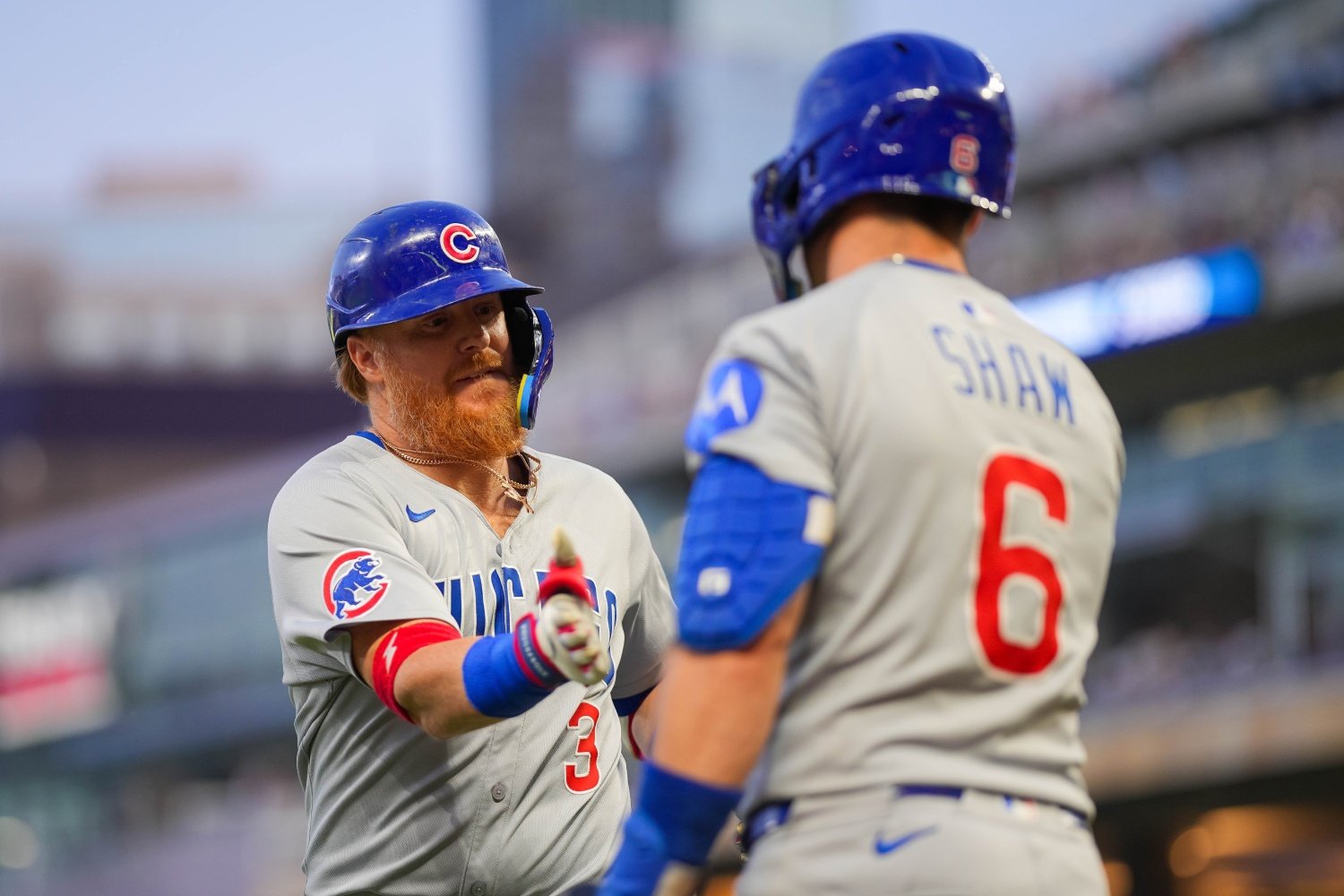
It’s never a bad thing to enter the All-Star break in first place in one’s division, and that’s where the Cubs are this week. They had to scramble for two straight wins in New York to stay ahead of the Milwaukee Brewers over the weekend, but they managed that, and they get a chance to reset the odometers on some of their higher-mileage players with four days off before they resume play Friday afternoon against the Boston Red Sox. They’re clear sellers in good position to make the postseason.
On the other hand, by now, it should be clear to all involved that this team is not a juggernaut. Unlike past years (when, for instance, the Dodgers routinely won 105 or more games), there might not be a juggernaut on the major-league landscape this summer, but if there is one, it’s not the Cubs. Some version of this team—with Seiya Suzuki‘s power exploding onto the scene the way it has; Pete Crow-Armstrong enjoying the biggest star turn in the big leagues; and Matthew Boyd staying both healthy and excellent to date—might have cruised to a division title, but that version of the team also would have needed Ian Happ and Matt Shaw to be consistently productive and their top three starters (Justin Steele, Shota Imanaga and Jameson Taillon) to rack up healthy innings.
As things stand, the fight for the NL Central will be a brawl settled only in the final week, and any deep playoff run depends not only on winning that fight, but on getting reinforcements between now and then to deepen multiple thin places on the roster. The Cubs started 38-22; they’re just 19-17 since. A fairly soft schedule should give them room for error over the final two months, but they have to earn that by getting better, too. They have needs in all four key demographics of the roster—rotation, bullpen, lineup, and bench—and beyond. Let’s rank those needs, from most dire to most manageable, so we know where to direct the bulk of our energy and attention in the fortnight to come.
1. Starting Pitching
Few fan bases love to nitpick the notion of a playoff-caliber starter more than Cubs fans—which is particularly odd, given that the Cubs are not a team who routinely even makes it to October. The idea that anyone should feel nervous about giving the ball to Imanaga or Boyd because of their lack of overpowering sheer stuff, or to Cade Horton because of his lack of experience, is foolish. Still, this comes in as the top need for the team, and it’s not even especially close.
One reason is obvious: the Brewers are mounting a serious challenge, there’s a long stretch without off days coming for the team in August, and the Cubs can’t afford to be short on rotation depth. Ideally, they would go to a six-man rotation for a good chunk of the second half. Right now, that’s a logistical nightmare even in concept. In practice, it would be impossible. They need at least one good buttress at the back end of the rotation, and they would do very well to acquire two capable starters, one of whom is more of a frontline arm. Ideally, that pitcher would have team control beyond this year, since it’s not at all clear that the team will be able to count on more innings from Boyd, Imanaga, Taillon and Steele in 2026 than they’re getting in 2025.
Of course, what I’m describing is wildly expensive. The team could use two good starters, and might even want to get that done, but there’s virtually no chance that they will, because they have other needs to fill. Craig Counsell will, in all likelihood, have to settle for one new arm and hope it’s of the higher-echelon variety—or at least that whoever it is can take the ball whenever injury or exhaustion catches up to Boyd or Horton.
2. Relief Pitching
For the umpteenth year in a row, Jed Hoyer has proved that he knows where to look to cobble together a solid relief corps from scrapheap scoop-ups and under-the-radar homegrown hurlers, even after Opening Day. You remember Tyson Miller and Jorge López from 2024, and Michael Fulmer and Julien Merryweather from 2023, but it goes back much farther than that. This year, it’s been not only offseason additions Caleb Thielbar and Brad Keller, but on-the-run minor-league acquisitions Drew Pomeranz and Chris Flexen.
The thing is, that particular brand of bullpen magic doesn’t even last a full season. Fulmer got hurt. López got hurt. Adbert Alzolay wore down at just the wrong moment in 2023. The cracks are already showing in this year’s group, and even where cracks aren’t showing, they’re forming. The cumulative age of Ryan Pressly, Ryan Brasier, Thielbar and Pomeranz (147) is greater than the length of time since the mound moved back to 60 feet, 6 inches. As good as they’ve been, at times, they’re all significant risks for injury. Keller and Flexen, meanwhile, are candidates for significant regression, even after we acknowledge that Keller’s stuff has ticked up tremendously after his winter transformation and a spring transition to the bullpen.
With Daniel Palencia anchoring the unit, the temptation to slide this need further down the board is there, but it’s important to resist it. The Cubs need bullpen help, if they want to hold enough leads to get to the finish line in front of the pack in the Central. They just can’t afford to pay much for it.
3. A Competent Third Baseman
This is where the real trouble starts, because in July, it’s never your top need that derails you. You can address that, even if it ends up feeling like a watery solution. It’s when you get this far down the checklist and you still feel like the need is pressing that there’s a real problem afoot, and that’s the case right now in Chicago.
Matt Shaw was probably overrated by prospect hounds this offseason. In fairness to the Cubs, they seemed to know that even coming in; that’s why they bid heavily for Alex Bregman. In the end, though, neither the front office nor ownership were willing to flex on the structure of their offer enough to entice Bregman to choose them over the Red Sox, and they’re paying a dear price for that now. Shaw might yet turn into a good big-league player—there’s plenty of reason to worry about that, but it’s far too early to rule out the possibility—but he’s not ready to be that kind of player yet. The team needs to upgrade that position, because they’re not getting enough offense from second base or left field to stomach a .556 OPS at the hot corner. Nor does Shaw look ready to turn the corner.
Unfortunately, this might just not be in the cards. The Cubs have traded for third basemen at each of the last two deadlines, and Hoyer’s track record with those moves is brutal. Shaw is almost exactly the player Nick Madrigal was two years ago, when the team traded for Jeimer Candelario to rotate Madrigal out of the spot—but Candelario played so poorly that the team often ended up sticking with Madrigal and his stellar glove, anyway. That was when they had a healthy Steele, Taillon, and even Marcus Stroman; they didn’t need to go make a splash on the pitching side. Now, they have a thinning farm system and two more pressing needs. Shaw might just have to keep sucking up precious outs at the bottom of the batting order, because the team can’t afford to replace him.
4. A Bench Overhaul
If anything, Hoyer’s track record with building or upgrading the bench is even worse than that with trades for third basemen in July. The team is barely out of the shadow of the Trey Mancini and Tucker Barnhart calamities, and they’re staring at a bench that has managed to be even more dysfunctional: Justin Turner, Jon Berti and Vidal Bruján have been a combined 11 runs worse than average, according to Baseball Reference, even as Craig Counsell has done everything in his power to limit their playing time. You can’t truly hide players on benches as shallow as those run by every big-league team, at this point, and the Cubs need players their manager feels less compelled to hide.
The good news here is that checking this box should be easy. It’s hard to find a frontline starter, an ace reliever or a solid third baseman whose team is willing to trade them at this time of year. It’s relatively easy to be a more useful player than Berti has been this season. Throwing a little money at the problem might help; plenty of bad teams are looking to get a few million dollars cheaper as they slog toward the end of lost seasons. The Cubs have room to absorb some money and acquire a good bench piece without giving up much talent.
5. Organizational Depth at Both Ends of the Battery
This feels like a mere bonus item, but it’s not. The Cubs are too thin at the upper reaches of their farm system, in terms of reliable, big-league-caliber pitchers and catchers. That could bite them even down the stretch, but it’s a problem that will linger into the offseason, too. They should try to find an optionable arm or two and a castoff or blocked catcher whom they can snatch up cheaply, to head off this issue before it becomes a truly glaring problem at a terrible time.
There’s good news about all of these needs: the Cubs are proving to be very good at coaching players at the big-league level. Suzuki, Crow-Armstrong, Carson Kelly and others demonstrate the team’s savvy with hitters, who have tapped into more power under the team’s coaching infrastructure this year. Tommy Hottovy is widely respected throughout the game for his work with pitchers, and Boyd, Colin Rea and Keller are just a few of his success stories this year, alone. Quintin Berry and Jose Javier have them running the bases as well as any team in baseball and positioning themselves quite well afield. Counsell’s coaching staff is doing its thing. That means that, for instance, one should hold out some real hope for a player like Ryan McMahon, should the team acquire him to stop the gap at third base. Chris Paddack of the Twins is a good candidate to be that secondary starting pitching acquisition, using money more than prospect capital, and he would do well under Hottovy.
However, these needs are real, and they’ve shown up on the field recently. The Cubs have the lead, but the Brewers have the momentum in the race for the Central division crown—and if you don’t believe in that kind of thing, then substitute ‘depth’ for ‘momentum’. It comes to the same thing. The Brewers also have a deeper farm system, which gives them more ways to improve between now and the end of the season than the Cubs have. That’s why it’s important for Chicago to nail this deadline, by knowing how to order their priorities and where to allocate their resources.