
Everywhere you look around Major League Baseball, you see former college position players excelling. MLB’s top two hitters so far this season, Aaron Judge and Cal Raleigh, were drafted out of Fresno State and Florida State, respectively. The 2025 All-Star Game MVP, Kyle Schwarber, is an Indiana University alum. Even the Miami Marlins’ All-Star representative, Kyle Stowers, attended Stanford to further his academic career.
Stowers, of course, was not drafted directly by the Marlins. On the heels of the franchise’s first-ever all-college draft class, I was straining to come up with examples of Miami draftees out of four-year universities who developed into productive MLB regulars. Formal research confirmed that their track record has been awful in this area.
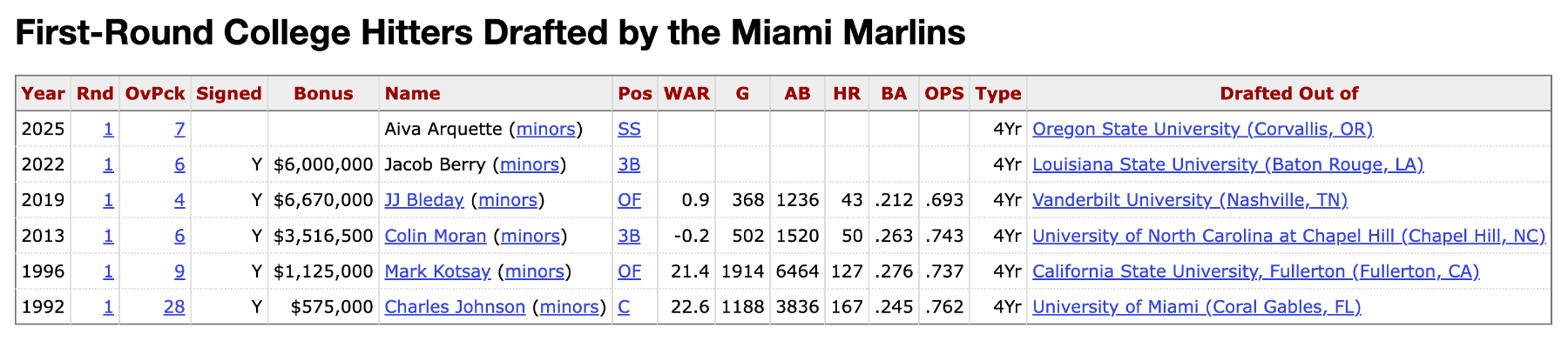
The Marlins hit a home run with their first-ever amateur draft pick, selecting University of Miami catcher Charles Johnson in 1992. CJ was an elite defender and key cog on the 1997 World Series team who is still the Marlins’ all-time leader in games caught. Their 1996 first-rounder, Cal State Fullerton’s Mark Kotsay, accrued 20.5 fWAR across 17 MLB seasons, the vast majority of which came with other clubs. Very good players, but far from generational talents.
Decades later, those two are still the most successful college bats to come through the Marlins organization.
Josh Willingham (North Alabama, 2000) was a sweet find in the 17th round—never an All-Star, but he slashed .266/.361/.472 as a Marlin and amassed nearly 200 total home runs in the majors. They didn’t recognize what they had in Mark Canha (Cal State Berkeley, 2010). Plucked from the Fish via the Rule 5 Draft more than a decade ago, Canha is still bouncing around as a defensively versatile steady source of on-base percentage. Brian Anderson (Arkansas, 2014) had a few above-average seasons before shoulder issues accelerated his decline.
Everybody else from this demographic had—with all due respect—inconsequential careers.

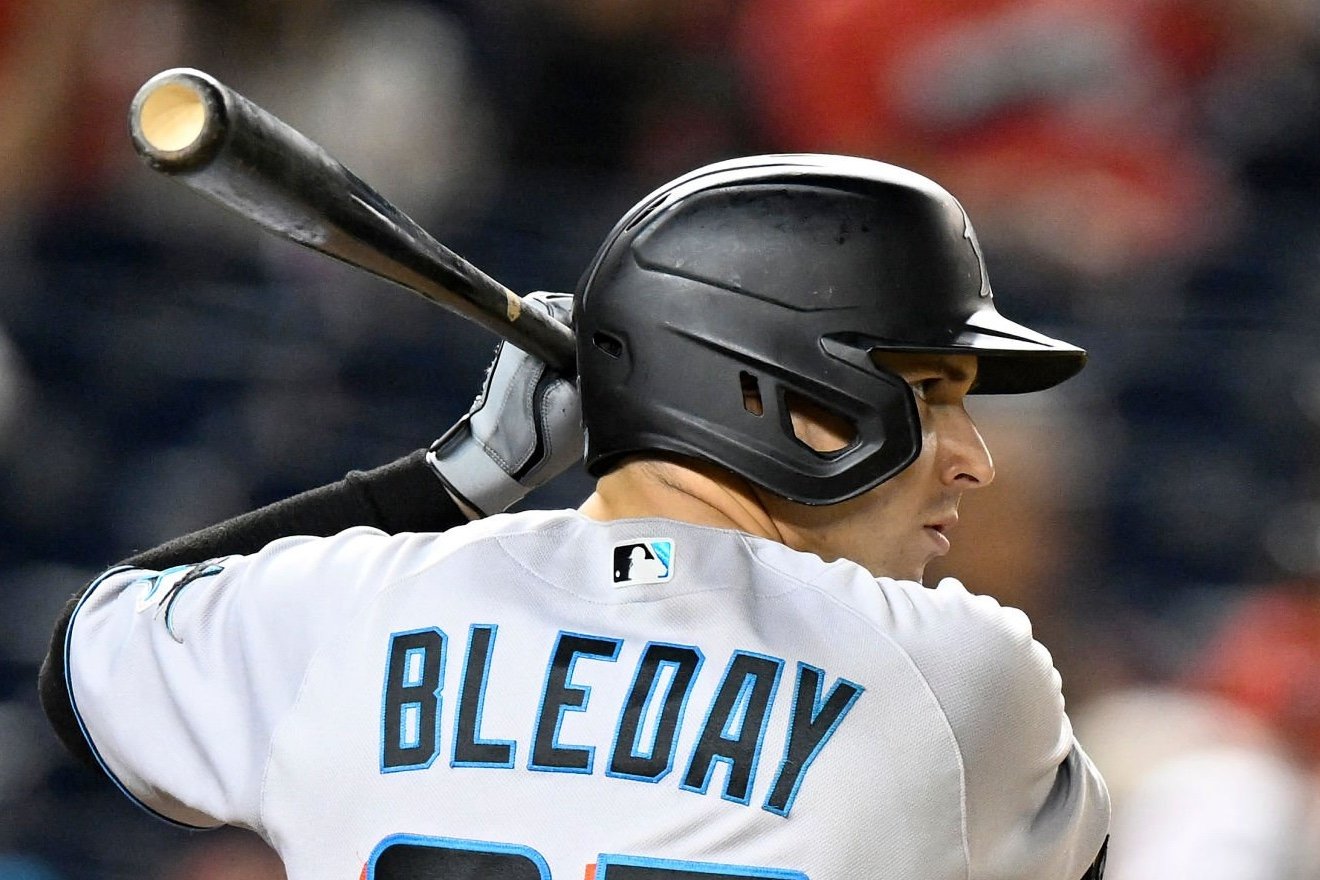
The Marlins’ long-running problem has been whiffing on the “safest” and most expensive college bats. Since Johnson and Kotsay, the only other times they’ve gone back to this approach with their first-round pick were Colin Moran in 2013, JJ Bleday in 2019 and Jacob Berry in 2022. Those mistakes are debilitating for a franchise.
This season, the Marlins have used 19 position players. The only one of them to be drafted out of college and developed by them is 2018 fourth-rounder Nick Fortes. He has value, but it’s marginal.
Unbothered by this history, the Marlins went with back-to-back-to-back-to-back-to-back-to-back college bats atop their 2025 draft class, headlined by Oregon State’s Aiva Arquette.
The Marlins are operating differently under president of baseball operations Peter Bendix and director of amateur scouting Frankie Piliere. Time will tell whether or not “different” is actually better.