
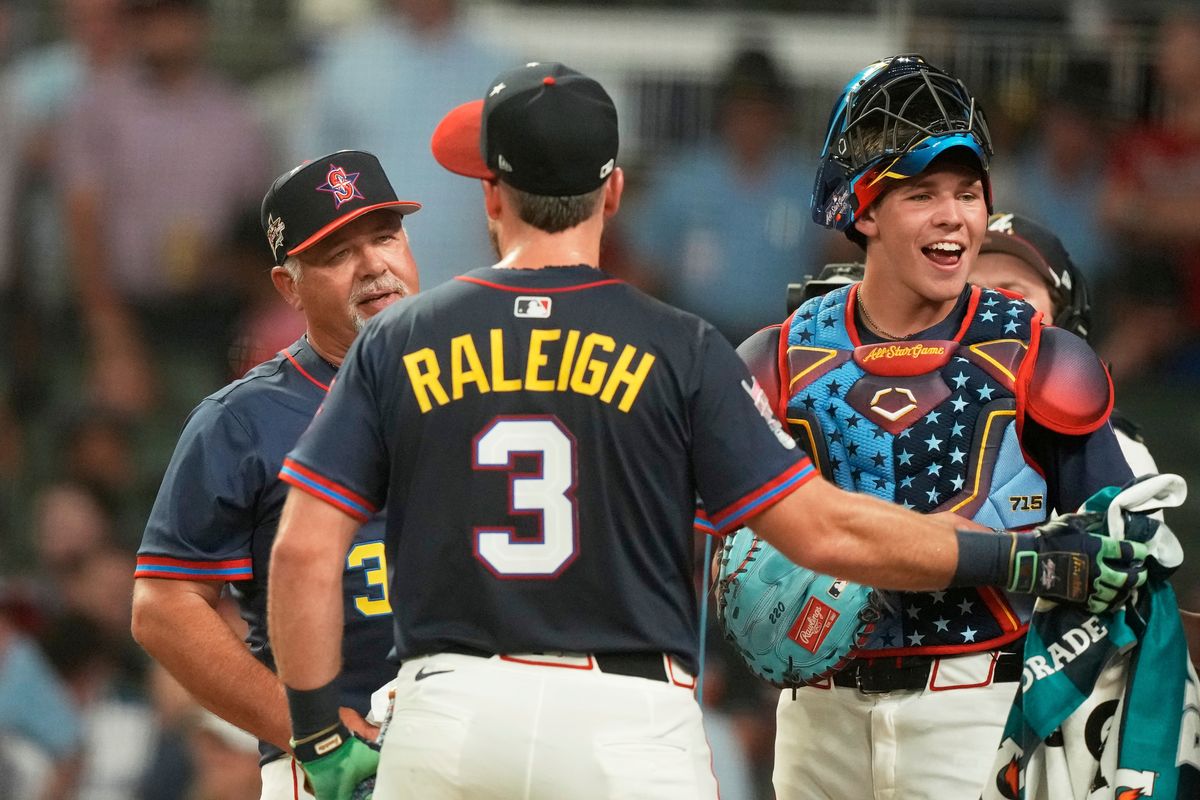
Almost immediately, Justin Turner could sense the bubbling frustration from Cal Raleigh.
A veteran slugger with a World Series ring and an NL Championship Series MVP on his résumé, Turner arrived in Seattle just before the trade deadline in July 2024 and quickly began to form a connection with the Mariners catcher.
They talked next to the batting cage before every game, and Raleigh would pepper his new teammate with questions about his swing, his approach, his process — anything he could think of, really.
“I’m a better (expletive) hitter than this. I need to be better,” Turner remembered Raleigh telling him.
Those initial conversations helped nudge Raleigh on a trajectory that has brought him to the rarefied space he now occupies less than a year later. Raleigh has, simply, become the biggest new sensation in baseball and, suddenly, one of the game’s best hitters, too.
“He really opened my eyes,” Raleigh said. “He’s able to put things in such simple terms, and it really just made sense to me.”
Their conversations continued through the end of the 2024 season, and their friendship grew in the offseason. Raleigh traveled to Cabo San Lucas, Mexico, for Turner’s 40th birthday celebration in November and also stayed with Turner’s family in Southern California, where he met with Turner’s personal hitting coach.
Raleigh is now doing things no catcher has done in the history of the sport. A career .218 hitter with a .740 OPS coming into this season, the switch-hitting slugger has vaulted into the American League MVP conversation with the Yankees’ Aaron Judge while mashing homers at a rate Ken Griffey Jr. never even achieved in Seattle.
“I knew right away Cal was a special guy,” Turner said. “Two things: his desire to be great, and then he’s one of the toughest guys I’ve ever been around. Just seeing him play every day and play through some of the stuff he played with — you don’t see that all the time.”
Baseball’s fascination with “Big Dumper” reached a new apex with Raleigh winning the MLB Home Run Derby on Monday, with his dad pitching to him and younger brother catching. On Tuesday, Raleigh will be the first Mariners catcher to start an MLB All-Star Game.
“The first sign of a great baseball player is a curious baseball player — someone who doesn’t think they have it figured out, someone who wants to continue to grow, wants to continue to be better every single day, no matter how much success they’re having — and that’s him,” Turner said. “He’s curious. He asks questions. He asks questions all the time, which is phenomenal. You just don’t see that from a lot of superstars.”
Raleigh working with Turner
If you were to start from scratch and design the archetype for the modern baseball swing — if you were to ask an AI machine to cull optimized launch, lift and pull data and spit out the ideal mold — the result would be something close to Raleigh’s swing right now.
Consider: No major-league hitter over the past 16 seasons has hit the ball in the air as much as Raleigh is this year.
Consider: No major-league hitter over the past five seasons has pulled the ball as much as Raleigh is this year.
The results: a major-league-leading 38 homers and an OPS north of 1.000 (and, yes, a new $105-million contract signed in March that already looks like a steal for the Mariners).
Here’s the catch: Raleigh doesn’t think of himself as a modern hitter. He doesn’t step to the plate trying to launch the ball through the clouds and pull it off the foul pole.
Ask him and he’ll tell you he’s trying to hit a hard line drive at the center fielder’s head, as Edgar Martinez preaches.
It’s the combination of those competing ideologies — the optimal launch angle lift blended with an up-the-middle mindset — that has triggered Raleigh’s breakthrough.
He has found the sweet spot somewhere between the old and the new.
To find it, Raleigh sought out various ideas in the offseason.
A decade ago, Turner became the face of the launch angle revolution when he remade his swing in his late 20s and then resurrected his career with the Los Angeles Dodgers.
Raleigh wanted to learn from Turner and Doug Latta, Turner’s longtime hitting coach. More than any mechanical swing adjustment, though, Raleigh said his biggest takeaways from those sessions centered more on the mental approach to the game.
“He wants to hear new ideas and he wants to learn, but he’s able to filter things out that maybe aren’t right for him,” Turner said.
Turner signed a one-year deal with the Chicago Cubs in the offseason, after turning down what sources have said was a bigger offer from the Mariners. (In spring training, Turner was openly critical of Mariners ownership’s lack of spending.)
When the Mariners played the Cubs in Chicago last month, Raleigh and Turner met for dinner, and Raleigh will still occasionally send Turner clips of his swing to seek out feedback.
“He’s a really smart baseball player, and he gets it, Turner said. “And I can’t emphasize enough that his superpower is that he’s curious and he wants to continue to get better. He’s not satisfied.”
Raleigh, it seems, has also found the perfect bat to match his swing. Most of his Mariners teammates hated the feel of the new “torpedo bat when they first experimented with it early this season, but Raleigh fell in love with it right away.
Rawlings, the bat manufacturer, has made two custom models for Raleigh — a balanced bat that he uses swinging left-handed, and a top-heavy one for his right-handed swing — and it just feels right. He doesn’t have a deeper explanation than that.
“I wish I had a better answer for you,” he said. “I just picked it up one day and I hit a home run — and I just kept using it.”
Mariners hitting coaches working on Raleigh’s swing
Edgar Martinez put together a Hall of Fame career in Seattle, spending much of it hitting behind another Hall of Fame legend in Griffey.
And even Martinez marvels at some of the things he’s seen from Raleigh.
“Sometimes it feels like I’m watching Nintendo,” Martinez, the Mariners’ senior director of hitting strategy, said recently.
Martinez, Kevin Seitzer and Bobby Magallanes form the Mariners’ trio of new hitting coaches, and Raleigh was one of the first players Magallanes met with in Arizona after joining Seattle’s staff.
Right away, Magallanes noticed Raleigh’s tendency to “drift” out on his front leg during his swing.
“He just couldn’t hold the energy on his backside,” Magallanes said.
To correct that, one day during spring training Martinez suggested a new (and peculiar) tee drill for Raleigh in the batting cage. Martinez pulled the tee up as high as possible, then instructed Raleigh to hit the ball straight up into the netting.
This helped Raleigh move more vertically through his swing — and less horizontally — forcing him to stay strong in his back leg longer.
“We did something drastic with him, and sometimes you have to do something drastic to get a feel of something,” Magallanes said.
Raleigh has been doing that high-tee drill just about every day throughout the season.
“His mechanics are really good right now,” Martinez added. “He’s staying behind the ball, and when you stay behind the ball, actually, you can hit the ball out front without trying to pull it. And that’s what it is. It’s not going forward. It’s actually (staying) behind the ball. And when you hit the ball in front, you’re going to pull it.”