
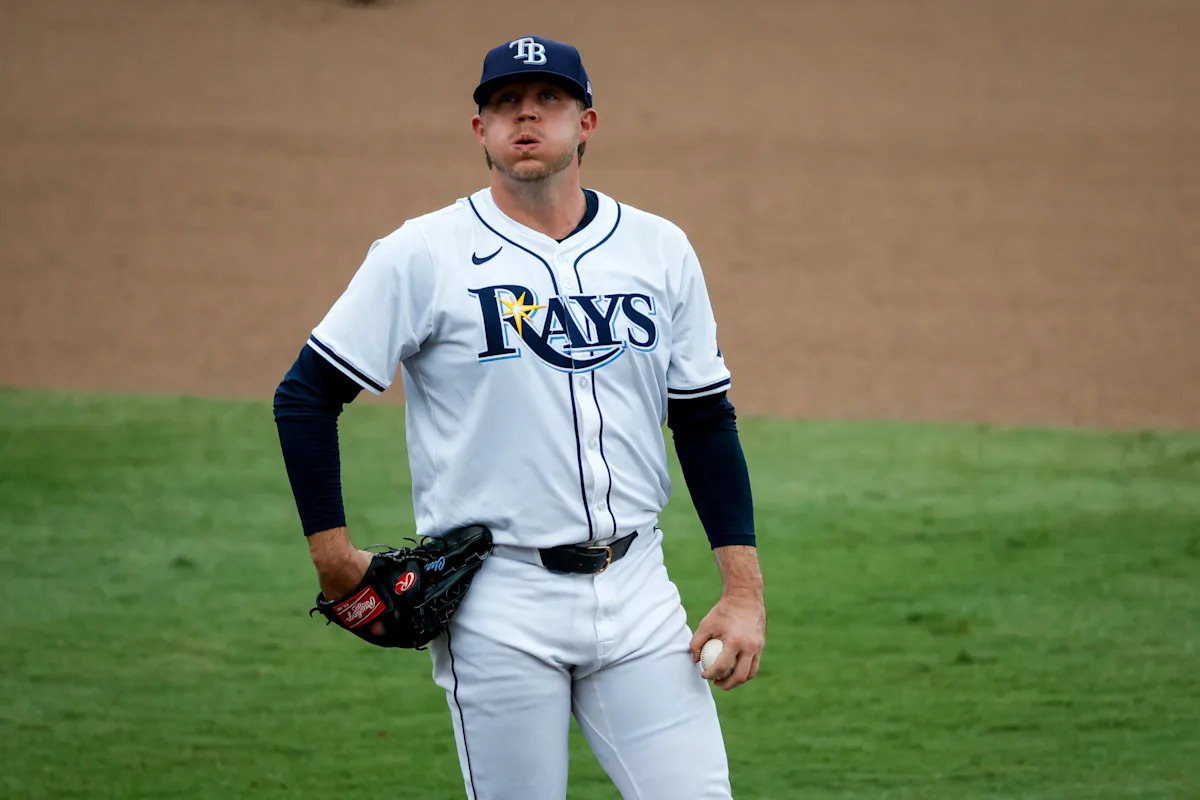
Erik Neander’s first answer Thursday on how the Rays get closer to their previous best-in-baseball level of play rather than their 4-12 stumble into the All-Star break was a good one.
“A two-week amnesia pill,” he said.
Advertisement
Forgetting what went wrong — especially the immense bullpen struggles that were the cause of their collapse — is a good step.
But more important will be remembering what went right as they roared through a 25-9 stretch that got them to 11 games over .500 at 46-35, within a half game of first place in the AL East and into the top wild-card spot on June 26, instead of how they are now 50-47, 5 ½ games back in the division and 1 ½ games out of the three-team wild-card field.
Neander made it clear the four series leading up to the trade deadline — home versus the Orioles and White Sox, then at the Reds and Yankees — will have a major impact on whether they buy, sell, do both or neither.
“We’ve got to make up some ground,” Neander said. “There’s a belief in this team. … But these are really big games that will have some sort of influence on our decision-making as the month draws to a close.”
Advertisement
As the Rays reassemble Friday after the much-needed break, Neander doesn’t see the return to better form as a major hurdle.
“Most of those games, when we were playing well, we were scoring a lot of runs. We were preventing runs. And things were timing up really well,” the president of baseball operations said on a media Zoom call.
“When we gave up four, it seemed like we’d score six. If we gave up seven — which didn’t happen very often — we’d score 10. We were down 8-0 (to the Orioles on June 18), we’d find a way to come back and do that. And then things just got a little out of sync.”
Neander’s confidence is rooted in being able get synced back up.
Advertisement
“I think we’re going to see good starting pitching. We’re going to see the bullpen get back to an accustomed level of ability for those that have it. And Junior (Caminero), (Jonathan) Aranda, the guys have taken the big step forward this year, continue to maintain that progress while the veterans continue to do what they’re doing.”
Here’s a look at some key factors as they go forward:
Trade talk
Neander’s win-or-else trade philosophy is not new — the Rays often base their activity on their chances to win the division and get the seeding benefits, and rarely make big-name additions at the deadline anyway.
Advertisement
Would they be more aggressive this year because of the hardships they overcame in being relocated from hurricane-damaged Tropicana Field?
Or to win in what looks like principal owner Stuart Sternberg’s last season of stewardship, with a sale pending?
Between their current players, shortstop Ha-Seong Kim being ready for regular duty, and top starter Shane McClanahan and others working their way back, they like what they have.
What happens next will be key to how much help they get.
“This is a good team. But in terms of just kind of how aggressive I think we’re likely to be, that’ll be affected some by our wins these next couple of weeks,” Neander said.
Advertisement
“I’d like to think that just about anything I think this group is capable of over these few weeks will lead us in a position where we’re looking to at least improve somewhere on the roster, if not significantly so.
“But we’ve got to go out and play well and win. If we don’t, or if we have a stretch the way we had the last couple of weeks going into the break, that comes with all sorts of additional questions that I’d much rather not think about.”
Here we go again
Though post-All-Star break play is commonly referred to as “the second half,” the Rays already have played 97 games, which is basically 60% of their total.
Advertisement
Of the remaining 65 games, 37 are on the road. That doesn’t seem like a horribly unequal split, but it’s how the games are set up that makes it challenging.
Having played 16 of their 19 games on the road leading into the break, the Rays play their first six post-break games at home.
But then they head into another blurring and taxing stretch of planes, busses and hotel rooms — combined with the stress of the July 31 trade deadline — in which they’ll play 19 of 22 games away from home.
They leave July 24 to play three games in Cincinnati, then four at Yankee Stadium, concluding with a matinee ahead of the 6 p.m. trade deadline. (That could create a potentially awkward scenario such as a player who is on the team plane en route to Tampa being traded).
Advertisement
The Rays will get home around 9 p.m. on July 31 and less than 70 hours later — after playing a much-hyped three-game series at Steinbrenner Field against the star-studded Dodgers — will be back on a plane headed to the West Coast.
And they’ll be gone a while — playing 12 games over 14 days at the Angels, Mariners, A’s and Giants, with an unusual two off-days on the trip.
(The three Angels games originally were slated to be played at home, but were flipped with an April series as part of the slight adjustment MLB made to reduce exposure to the summer weather since the Rays were playing outdoors.)
As taxing as that may be, Neander said it won’t be an excuse, and their players — going back to the impact of the hurricanes — have the perspective to know that.
Advertisement
“It’s an opportunity to play baseball at the highest level,” he said. “We’re well taken care of. Whatever happens this year, it’s not going to be because of that.”
Of some consolation, the Rays’ don’t have an overly-taxing remaining schedule based on an opponents’ winning percentage of .499, ranking 15th overall per the website Tankathon.com.
That includes 22 games AL East foes — seven with the Blue Jays (all in the final two weeks of the season), six with the Yankees (four in New York), six with the Orioles (home and home) and three with the Red Sox (home).
Getting relief
The bullpen issues were widespread, which can both make them troubling but also potentially easier to address since it’s safe to assume they all won’t stay in slumps.
Advertisement
Acquiring Bryan Baker from Baltimore, despite his rough debut, was a solid first move.
With Manny Rodriguez out for an extended period and Hunter Bigge, who had a lat issue before being hit in the face by a foul ball in mid-June, not coming back anytime soon, it seems the Rays need more help. Garrett Cleavinger and closer Pete Fairbanks can’t get the call every key time.
A boost could come through internal improvement if they can get right-handers Kevin Kelly and/or Edwin Uceta to be more (or at least somewhat) consistent, and lefty Mason Montgomery straightened out enough to bring back from Triple A. Moving hard-throwing Joe Boyle to the bullpen is also an intriguing option.
But just like the offense became more productive by adding new players with different skill sets, the challenge is on Neander to find the proper mix and manager Kevin Cash to use them the right way.
Advertisement
Lots of uncertainty
Because they play almost every day for six months, baseball players take great pride in remaining even-keeled and not letting outside factors become distractions.
This season has provided a massive challenge that the Rays have thus far handled well, from the offseason questions of where they would play given the Hurricane Milton damage to Tropicana Field to the concerns over how playing at Steinbrenner Field would work to how much a disruption the weather would be (so far, 53 home games played, none rained out).
Now they face more uncertainty, beyond the concern and speculation that accompanies the trade deadline.
Advertisement
One issue is where they are going to play next season. St. Petersburg officials are planning to have Tropicana Field repaired and ready for opening day, but that’s not a certainty and MLB said it has contingency plans in place.
Another issue is the pending sale of the team to a group led by Jacksonville developer Patrick Zalupski.
The deal that could be finalized as soon as mid-September, and even with Sternberg retaining control through the postseason, there is a long list of questions that arise from a transfer of power. For the players, that includes whether they will have new bosses, and how the way they do things could change.”
As with the myriad other issues they’ve faced this year, Neander doesn’t think the players will be distracted.
Advertisement
“We’ve stayed very present,” he said. “Our players have, our staff have, and we’re going to continue to operate that way.”
• • •
Sign up for our Sports Today newsletter to get daily updates on the Bucs, Rays, Lightning and college football across Florida.
Every weekday, tune into our Sports Day Tampa Bay podcast to hear reporter Rick Stroud break down the biggest stories in Tampa Bay sports.
Never miss out on the latest with your favorite Tampa Bay sports teams. Follow our coverage on X and Facebook.