
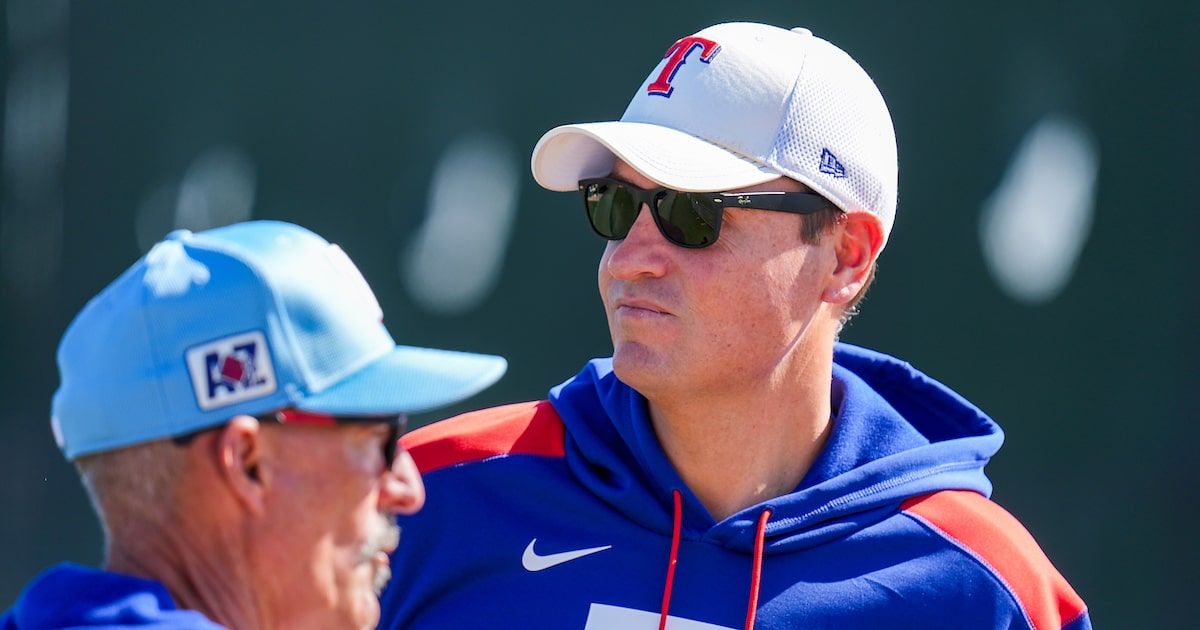
It was a thoroughly enigmatic first half for the Rangers that didn’t inspire confidence in the club’s ability to make a playoff run, but neither did it wipe them out of contention for a spot either.
All that’s really clear as the Rangers begin a nine-game homestand Friday against Detroit, owner of the best record in the American League, is this:
“We have to win games,” manager Bruce Bochy said Thursday. “We have to do what we can to take series. When you are in our position, that’s how you get back in it.”
Beyond that, much is still undecided. The Rangers are 8 ½ games out in the AL West, 3 ½ games out of a wild card, having already lost the season series to one of the wild card contenders. Are they at a selloff point? No. Are they buyers? Probably not. They still need to determine exactly what they are.
Rangers
That said, here’s a second-half primer on where the Rangers stand and what decisions they face:
The math
Everything points to the Rangers needing at least 87 wins to reach the postseason. Since MLB’s most recent playoff expansion in 2022, the last wild card seed has averaged 86.7 wins per season. No team has gotten in with fewer than 84 wins. The current holder of the final wild card in the AL is Seattle, which is on pace for 86 wins. But, even with four games remaining between the teams, the Rangers cannot win the season series, so they’d have to finish a game ahead or would lose out on a tiebreaker.
To get to 87 wins, the Rangers would have to play .600 baseball (39-26) the rest of the way. It’s not a high probability, but it’s doable. Detroit, for example, went 39-26 in the second half last year to capture the AL’s final playoff spot with 86 wins. The problem, of course, is that the Rangers have shown no ability to play anywhere near that caliber of baseball for an extended period of time the last two seasons. Their best 65-game stretch: 34-31 in 2024. They haven’t played .500 baseball for a 65-game stretch this season.
“I don’t think it’s asking something out of the ordinary with this team,” Bochy said. “I’ve seen them do it. We’ve run off some really nice streaks. So why wouldn’t I believe that we can do it? I think this is a very talented team that’s capable of doing something like that. You go back to 2023, there were times we were counted out. But, to your point: We can’t go through the ups and downs like the first half.”
Related:Evan Grant’s 10 thoughts on the Texas Rangers: Trade deadline ideas and a murky futureThe schedule
There are two ways to look at the final 65 games of the season as it pertains to the Rangers’ chances.
The good news: It is loaded with home games. The Rangers play only 29 of their final 65 games on the road. Tampa Bay, the team directly ahead of them in the wild card standings, has 37 on the road. Seattle, holding the final wild card spot, has 31 on the road. Boston, holding the second wild card, has 35 on the road.
The bad: According to Tankathon’s strength of schedule index, home or away, the Rangers schedule is difficult. With their remaining opponents having a .513 composite winning percentage, the schedule ranks as the sixth toughest. The glimmer here: Boston’s is tougher at .516.
It makes the start out of the gates in the second half that much more important. The Rangers have nine straight at home – their longest homestand of the season thus far. By the time the Rangers finish up with Atlanta a week from Sunday, their direction for the rest of the season will be clear. A winning homestand is critical. Winning all three series, a 6-3 record or better, seems imperative.
One other thing about the schedule: A total of 4 ½ games separate the four teams from second wild card seed Boston to the Rangers. The Rangers, however, play only four games head to head against the other three teams, all of them in Seattle. It means they must steadily play well to continue to make up ground.
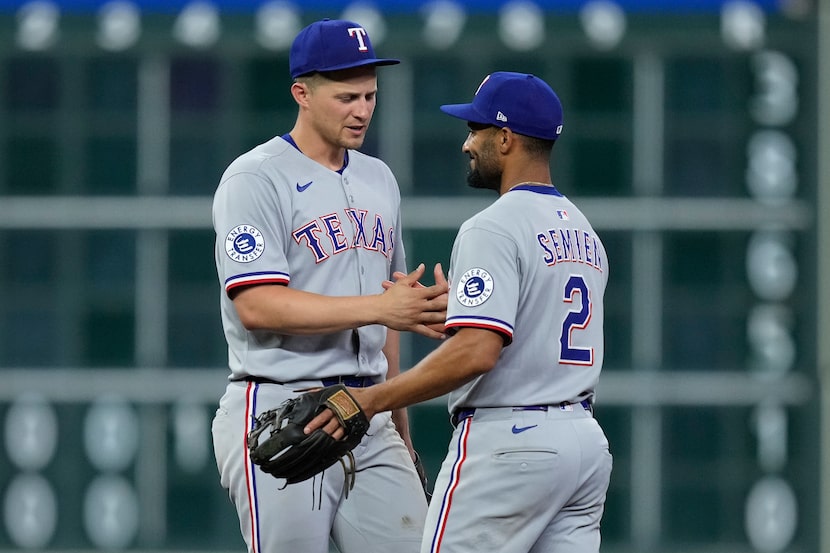 Texas Rangers shortstop Corey Seager (5) and second baseman Marcus Semien (2) celebrate after a baseball game against the Houston Astros, Friday, July 11, 2025, in Houston.(Kevin M. Cox / AP)The payroll
If owner Ray Davis’ sole financial mandate is to stay below the $241 million luxury tax threshold, it seems the Rangers are in pretty good shape. Tyler Mahle’s injury should actually help them there. He was due up to $5 million in incentives if he reached 140 innings, which was the big concern. Now, it looks like he won’t reach even half that much.
While payroll figures are always, at best, estimates, Baseball-reference lists the Rangers’ current payroll for CBT purposes at $233.4 million. A handful of pitchers have already reached incentive levels that raise the payroll by another $1 million or so. And, realistically, there are about another $2-4 million in makeable incentives. That could push the Rangers up to close to $239 million.
The big question here is whether Davis wants to save additional money rather than believe in whatever small chance the Rangers have at the playoffs or if he’s content to let Chris Young add payroll right up to the $241 million threshold. That decision could have as much impact on the Rangers’ direction as how well they play.
The need
The Rangers’ biggest need is for their all-too-inconsistent offense to show up on a regular basis. Beyond that, though, the need is in the bullpen for a late-inning reinforcement, ideally with significant closing experience and a high-octane arm.
The bullpen did fine work in the first half, but the nucleus worked hard. Six different pitchers made at least 35 appearances. Some fatigue showed through in the final weeks of the first half. Also, there is no one with significant closing experience, let alone closing in the throes of high-pressure, late-season games.
If the Rangers were to look for a potential trade acquisition, the prerequisite would likely be no more than $2 million in remaining salary commitment. It puts a class of closers such as Pittsburgh’s David Bednar, Baltimore’s Felix Bautista and Washington’s Kyle Finnegan potentially in their range. Both Bautista and Bednar would come with an extra year of control, which would likely hike the cost in terms of prospects. Finnegan, who has about $2.1 million remaining in salary, is a true rental.
The inventory
Should the Rangers decide to punt on the season, it seems unlikely they’d try to overhaul the team in midseason. President of baseball operations Chris Young has bluntly said he has no interest in trading Jacob deGrom or Nathan Eovaldi, the two pieces that might have the most practical value. Both can front a rotation, both are having good seasons and both are under contract through 2027. Also, both have full no-trade protection, making it more difficult to complete a deal.
Any “sell” trades would likely be about moving some expiring contracts and saving some money. The talent return on the guys who fall into that mix would not be very significant. Guys who fall into that mix: Adolis García, Jon Gray, Jonah Heim and a handful of relievers. But the only reliever with more than $1 million guaranteed in remaining money is Chris Martin. Trading Shawn Armstrong, Luke Jackson or Hoby Milner would amount to saving pennies.
Find more Rangers coverage from The Dallas Morning News here.
Click or tap here to sign up for our Rangers newsletter.