
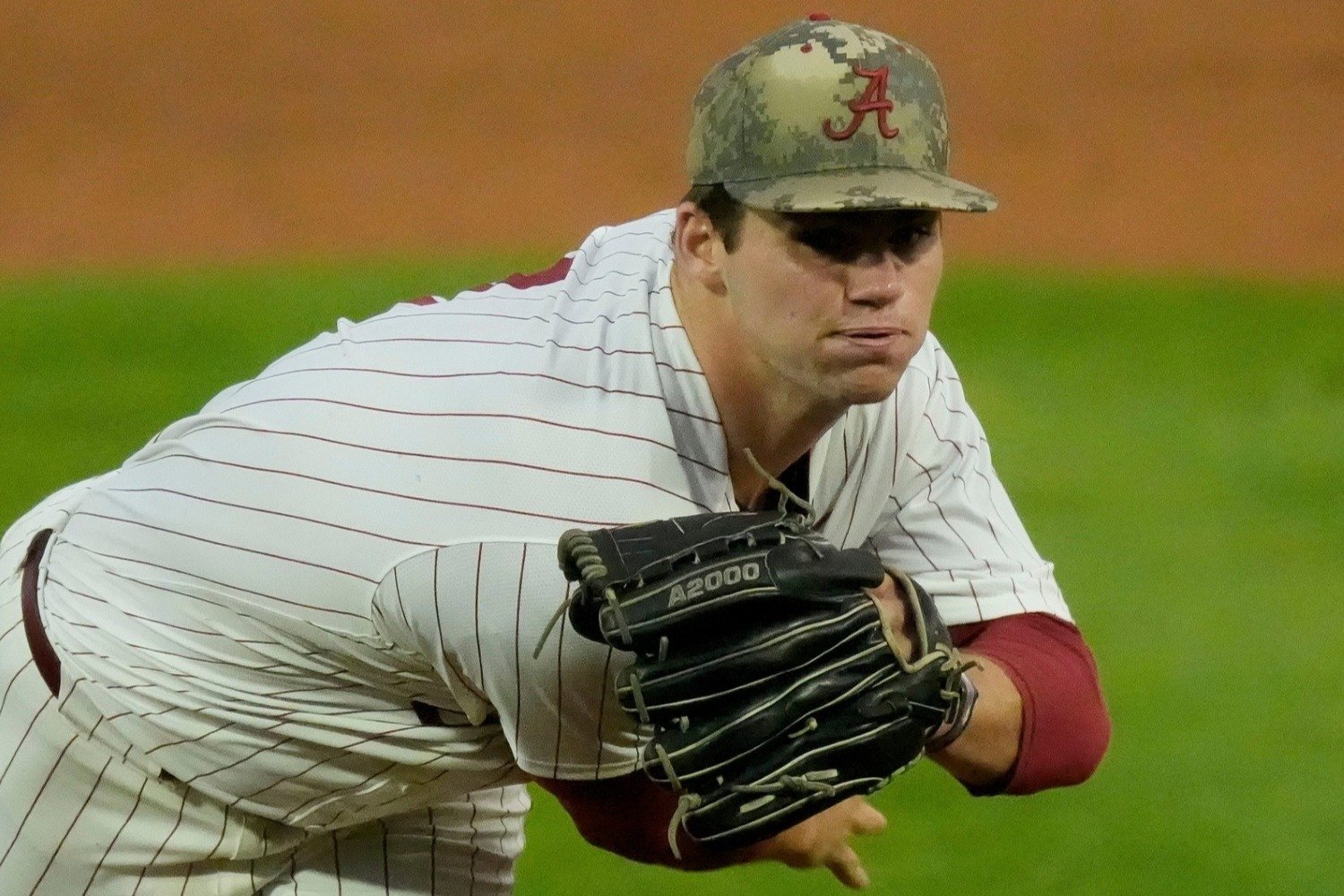
Last Sunday night, the Minnesota Twins (led by Vice President of Amateur Scouting Sean Johnson) selected Alabama Crimson Tide starting pitcher Riley Quick with the 36th selection in the first Competitive Balance Round. In recent drafts, Johnson has shown a proclivity to draft amateur arms in this area, evidenced by the club selecting right-handed high school arm Charlee Soto 34th overall in 2023 and fellow former Alabama pitcher Connor Prielipp 48th overall in 2022.
Ranked 32nd on Jamie Cameron’s MLB mock draft consensus board, Quick was selected in the range draft pundits predicted him to be. It was a reasonable selection from a draft slot perspective for Minnesota, then, but interestingly, Quick bucks a trend in what type of pitching arsenal Johnson and club decision-makers tend to prefer when assessing which young arms to select.
Consider Soto, Prielipp, and fellow recent high draft pick Dasan Hill. Interestingly, all three young arms sport the same arsenal, relying on fastballs, sliders, and changeups as their primary pitches. Quick’s primary three pitches are also his fastball, slider, and changeup. Yet, the type of primary fastballs he throws differentiates him from Hill, Soto, and Prielipp. Instead of relying on a four-seam fastball with plus vertical movement, Quick utilizes a sinker and cutter, two fastball variations that have been uncommon among amateur arms selected by Minnesota.
Now, selecting young pitchers who throw high-velocity fastballs with plus Induced Vertical Break (IVB) is a sound process. Minnesota’s three best starting pitchers (Joe Ryan, Pablo López, and Bailey Ober) all possess fastballs with plus IVB. Also, the best starting pitchers in baseball (Paul Skenes, Tarik Skubal, Zack Wheeler) tend to show that shape. The best pitchers on the Twins and the sport itself rely on pounding their fastballs high in the zone. Yet, there is also another, less common path to being a plus starting pitcher, which is what Quick could bring to Minnesota.
Over the past five seasons, some of the most effective east-to-west starting pitchers who rely on their sinker and cutter as their primary fastball shapes include Corbin Burnes, Max Fried, and Yu Darvish. Despite being unconventional in the modern game, these three pitchers (and others who rely on sinkers and cutters) have been incredibly effective. Burnes won the NL Cy Young Award as a Milwaukee Brewer in 2021, Darvish is a multi-time All-Star who finished second in NL Cy Young voting as a Chicago Cub in 2020, and Fried is presently one of the favorites for the 2025 AL Cy Young Award in his first season as a New York Yankee.
I’m not here to predict Quick will have a career like Burnes, Fried, or Darvish. What I am saying, however, is that there is proof of concept of Quick’s arsenal working in the majors. Given the organization’s willingness to push college arms quickly through its farm system (David Festa and Zebby Matthews, for example), there is reason to believe the 21-year-old could be in the high minors early next season and make his major-league debut just one season after being drafted.
To go into further depth on Quick’s pitch arsenal, here are the IVB and Horizontal Break (HB) profiles of his five-pitch mix, illustrated by the previously cited Cameron below:
Quick used his cutter sparingly. However, there is meaningful data on the pitch, shown below:
93.1 MPH, 8.0 IVB, 2.5 HB, 5.7 ft release height, 28% Whiff, 9% usage rate
He doesn’t rely on his cutter as often as his sinker, slider, and changeup. Yet, given the recent shift in clubs inserting differing fastball variations into starting pitchers’ arsenals for the sake of expanding their pitch mix, even if those pitches aren’t necessarily plus offerings (evidenced by Ryan adding a sinker to his arsenal to use against right-handed hitters this season), there is reason to believe Minnesota’s pitching development program will encourage Quick to continue tinkering with his cutter and using it in-game. Assuming that’s the case, he could (no pun intended) quickly become Minnesota’s first highly-regarded east-to-west starting pitcher since Johnson became Minnesota’s scouting chief in 2022. As the Twins face a crossroads within what they’ve hoped would be a wide winning window, this arm could be one example of the team embracing a different way to succeed on the mound.
Interested in learning more about the Minnesota Twins’ top prospects? Check out our comprehensive top prospects list that includes up-to-date stats, articles and videos about every prospect, scouting reports, and more!