
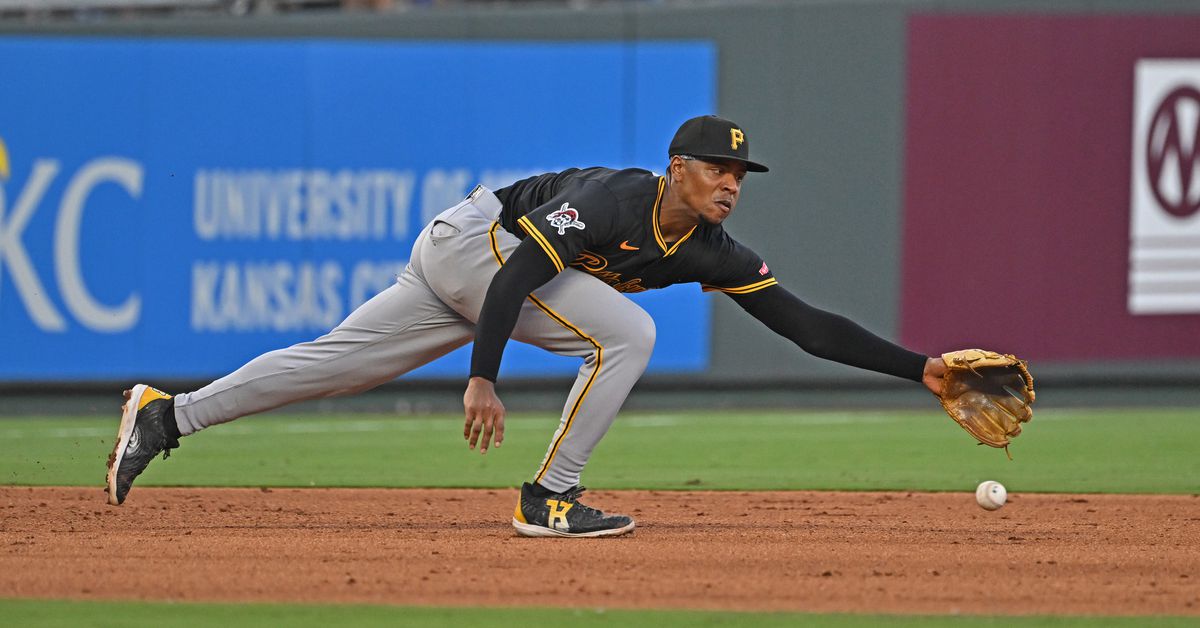
It’s funny, last week I wrote about whether or not the Yankees should deal for Nolan Arenado, a multi-time Platinum Glove winner on the backend of his career. He’s good but not what he was defensively, passable but not exciting at the plate. Now, what if we wanted to talk about arguably the best defensive infielder in all of baseball, albeit one that has befuddled hitting coaches since the first outbreaks of COVID-19?
Ke’Bryan Hayes leads all infielders in OAA since the start of 2021, but sports an 80 wRC+ in that same stretch. It’s at 61 this year. That is bad, and there is no way of getting around that.
But trading for a player isn’t about what they’ve done, it’s about what you can reasonably expect them to do for the term you have them on your roster. When the Yankees signed Tim Hill, it wasn’t about him being dropped by two teams in eight months, it was about engineering his sinker and while the club couldn’t exactly imagine he’d be the third or so best reliever in the bullpen, they could reasonably expect him to become a groundball machine.
The problem with Hayes is that he also is a groundball machine — the 13th-highest rate among qualified hitters. He could stand to walk more but he strikes out less than Anthony Volpe; for now he has a higher batting average to boot and it’s not like he doesn’t hit the ball hard. It’s that when he does, it’s always at the wrong angle. Our old friend Esteban Rivera wrote a couple weeks ago about the Hayes Question and how there are solutions to getting that ball off the ground.
Of course it’s one thing to have solutions, it’s another to put them in action — once again see one Anthony Volpe. This is where I think the Yankees might have an advantage in a potential deal though, as they’re just better than the Pirates at making these kind of changes. Pittsburgh is a wayward organization, allowing the seventh-fewest runs in baseball, thanks at least in part to Hayes’ +10 Fielding Run Value.
The Bucs also need a complete offensive overhaul, and have never really shown the ability to guide hitters into being better. Having Hayes under team control through 2029, at just $8.75 million per, could help with that overhaul if the org was smart enough to implement the kind of solutions Esteban discussed above. I would just trust the Yankees to be able to do it better.
The upside to Hayes for the Yankees is they get the age-27 though 32 seasons of the best defensive infielder in MLB, with the possibility of a representative offensive profile if they can get his hands lower, flatten out his hitting position and get him making contact ahead of the plate. The downside is that you already have one Anthony Volpe on the left side of the infield, and two becomes tough to watch.