

You are what your record says you are — Bill Parcells
A record of 24-75 in what will be the third of three consecutive 100-loss seasons gives a clear sense what the Colorado Rockies are: a broken baseball organization.
In our Mid-Season 2025 State of the Position series, we’ve tried to assess where the Rockies are and understand how they got there. The last step, then, is to review what we’ve found out and make suggestions for improvement. The 2025 season is a wash, but if the Rockies use this moment as a learning opportunity, it can provide a foundation for the future.
Here’s what we’ve learned about the decisions that have led the Rockies to the place at which they find themselves.
The Rockies have been ineffective in drafting players
Evan Lang did the work on this topic last winter in his article “Are the Rockies a draft and develop team?” Here’s what Evan wrote then:
Of the 295 individual players selected by the Rockies in the first-year player draft from 2015 through 2024, only 36 have made their MLB debuts. Of that group, only 30 have done so for the Rockies.
It gets worse.
Those 30 players have an approximate combined fWAR of just 9.5 with just six players owning a career fWAR of 1.0 or greater while playing with the Rockies:
2B Brendan Rodgers (2015): 2.8 fWAR
RHP Justin Lawrence (2015): 1.0 fWAR
OF Sam Hilliard (2015): 1.4 fWAR
RHP Ryan Feltner (2018): 3.7 fWAR
OF Brenton Doyle (2019): 4.3 fWAR
No player from the Rockies’ 2016 or 2017 drafts has.
This is true both of the Rockies first-round draft picks as well as their international signees.
Similarly, Kyle Newman of the Denver Post did a recent deep dive into the Rockies drafting process. He points out that the Rockies are not good at identifying talent — though, in fairness, the draft is, inherently, a gamble.
As Newman explains:
That data suggests the bigger issue for the Rockies is an over-reliance on the draft. The Rockies are the fifth-worst team in baseball when it comes to identifying talent, according to a 2025 Baseball America survey of 24 scouts.
Colorado could supplement its roster by mining the international market and making impact signings through free agency, but neither avenue has been consistently successful. That’s made the margin for error in the draft very slim.
Moreover, the staff that makes the scouting and drafting decisions is largely unchanged from the Rockies early days in the 1990s.
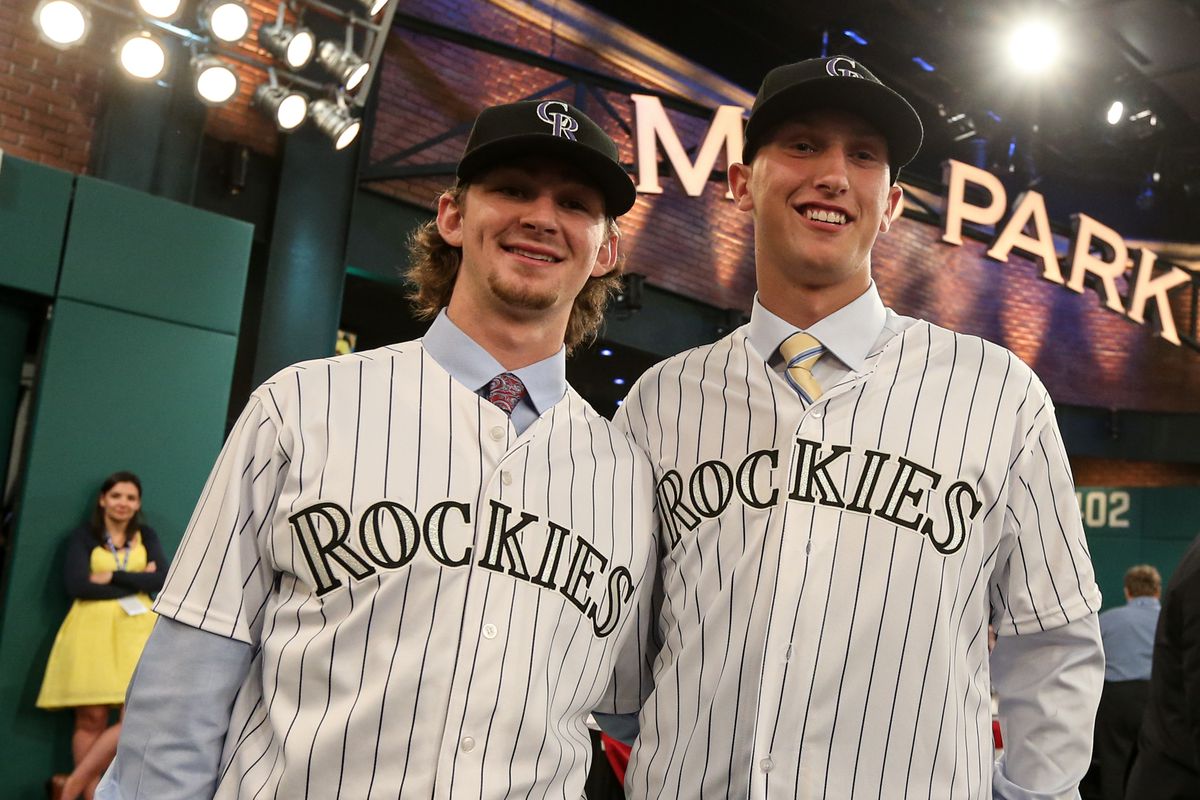
Photo by Rich Graessle/Icon Sportswire/Corbis/Icon Sportswire via Getty Images
Injecting new ideas into any organization is key to successful evolution, something the Rockies have largely failed to do.
In other words, the Rockies are relying on the riskiest way to build a team, and since 2019, that strategy has largely failed, yet those who developed the Rockies approach continue to direct the program. These decisions have contributed to the Rockies being where they are now.
The Rockies have said they rely on draft and development because few players are interested in signing with the team and playing at elevation. Certainly, those reservations are true, but let’s not forget about the financial angle, another underlying theme in this series.
Being a draft-and-develop organization is a cheaper way to build a baseball team than signing more costly free agents. (The Tampa Bay Rays provide a successful draft-and-development model, but they have the analytics to make this system work.)
The Rockies have been ineffective in developing players
Given the Rockies’ philosophy of relying on the draft, they need to have exceptional development strategies and technologies that allow them to use data and analytics effectively.
That has not been the case.
The Rockies have one of MLB’s smaller R&D departments — Newman reports there are 18 employees in that department compared with the Dodgers having an R&D department of 40. And we’ve read enough anecdotal data from players who are no longer with the organization to know the Rockies have been lacking in this area.
Consider the words of these former Rockies:
Jeff Hoffman — “Shoot, in Colorado, we didn’t really have an analytics department. I’m not even sure if they have one right now, judging by how everything’s going there.”
Jake McGee — “[The Dodgers] know their stuff. They’re gonna teach you a lot of new things that you probably didn’t get in Colorado.”
Yency Almonte “He hadn’t heard about [TruMedia] in Colorado or when he was a minor leaguer with the White Sox.”
And, of course, Nick Mears, who told The Athletic:
“But it also doesn’t help that I was tipping pitches for a month and a half and I was never told.”
How, then, did Mears find out?
“A player actually told one of my buddies on the Rockies,” he said. “He came up to me and said, ‘This is what you’re doing. You should probably change it.’”
These are examples of players who improved after leaving the Rockies. Simply put, the Rockies are behind in terms of analytics and player development and communicating that information to players in ways they can use it.

Photo by Kyle Cooper/Colorado Rockies/Getty Images
This, however, is a part of Newman’s article that has stayed with me: “Guys are being allowed to develop in the big leagues and that’s never been done,” former White Sox outfielder Tommy Pham told ESPN last year when the White Sox were claiming the record the Rockies are on track to surpass.
It’s not difficult to think of players who have been promoted before they are ready and then struggled at the major-league level: Chase Dollander, Adael Amador, and Zac Veen provide recent examples.
Or consider the Rockies’ struggling first baseman.
“If you look at Michael Toglia’s minor-league performance, there was nothing there that said, ‘This is a guy who’s established that he’s ready to be a big-league regular,’” JJ Cooper told Newman.
Have the Rockies made strides? Certainly some. For example, they have the pitching lab in Arizona, and they have modestly increased the size of their analytics staff.
But it’s not enough. The Rockies need an infusion of new ideas.
Is this the result of outdated thinking, an unwillingness to spend, or both? Whatever the cause, it is essential the Rockies address their technology and analytics deficits if they wish to be effective in player development.
The Rockies have been mostly ineffective in signing free agents and making trades
The Kris Bryant signing is generally cited as the most glaring example of the Rockies’ failures in free agency, but they have been largely unsuccessful in smaller free-agent signings as well.
A risk-averse Rockies tend to sign inexpensive free agents in a kind of offseason “garage sale” shopping spree in hopes of flipping those players at the trade deadline. Recent examples include Nick Martini, Kyle Farmer, Cal Quantrill, Jalen Beeks, Scott Alexander, Alex Colomé, Jacob Stallings — the list goes on.
Although the Rockies have had some luck with moving pitchers (e.g., Pierce Johnson, Brad Hand, Mears, and Beeks) and an occasional position player (e.g., Mike Moustakas), they have largely been unsuccessful in signing free agents that significantly improve the team.
This is probably the result of two factors:
Dick Monfort appears unwilling to spend money on free agents with the exception of an occasional splash
Players are unwilling to sign with a team that is a perennial loser.
In a 2024 poll of MLB players conducted by The Athletic, the Rockies were ranked the fourth-least desirable signing location. As one player put it, “(Heard from another player that) it’s like going back to the Stone Age.”
Players consistently cited a team’s lack of spending or player development as reasons they did not wish to sign with an organization. Currently, the Rockies meet both of those criteria.
Recommendations
What the 2025 Colorado Rockies represent, then, is the culmination of years of thrift, mismanagement, and insularity. They are a perfect MLB storm.
An owner who fears change and is fiercely loyal to the employees he trusts has created an environment of pervasive stagnation.
What needs to happen?
First, the Rockies need to bring in an external evaluator who is empowered to review all parts of the organization and make changes. And the process needs to start immediately, well before September call-ups. This is a plea we at Purple Row have made before — along with Ryan Spilborghs, Patrick Saunders, and Troy Renck. The Rockies need a fresh set of ideas because the ones they have used clearly no longer work.
After all, a team’s record is the ultimate indicator of that team’s identity — and the Rockies have sported more losing seasons than they have winning ones.
Although Dick Monfort probably considers the promotion of Walker Monfort to executive vice president a change, that should not be a pervasive view. And if Walker Monfort wishes to show that he does, in fact, have a vision for the future, he should be committed to following the advice of an outside evaluator.
Second, the organization needs to adhere to those recommendations, regardless of how uncomfortable they make Dick Monfort.
Third, the Rockies must be active at this trade deadline with an eye to rebuilding for the future. This team will not be competitive for at least three years, and the Rockies should approach this trade deadline with that vision, both with players on the 40-man and in the farm system.
This year, their draft class has been praised, and so much will depend upon Ethan Holliday, a topic we will surely be discussing at length. The Rockies owe it to Holliday, their prospects and players, and Rockies fans to begin a systemic rebuild.
The worst thing that could happen would be for Dick Monfort to delay action until the current CBA expires in the hope that MLB and the MLBPA will negotiate a salary cap and revenue sharing. (He has expressed his belief in the need for this to Mark Kiszla.) Monfort seems convinced that if the Rockies had more money, they would be competitive. However, no amount of money will address the Rockies player development issues, which are largely philosophical. As Adam Peterson wrote yesterday, “The team doesn’t struggle due to lack of funds; they struggle due to lack of ability to identify how to spend funds well.”
The days of the Rockies getting lucky every 10 years and winding up in a Wild Card series are over. The rest of the league has left them behind.
The Rockies have to start over and get caught up.
And the best time to start this is now under the guidance of an external evaluator.
★ ★ ★
Cardinals’ Nolan Arenado reflects on ‘what could have been’ with Rockies | Denver Post ($)
With the St. Louis Cardinals in town, Patrick Saunders asked Nolan Arenado about what “could have been” had Dick Monfort and Jeff Bridich been more active at the trade deadline. “Oh yeah, I think about it,” Arenado said Monday night. “I mean, we’ve talked about it. I’ve talked to DJ about it and (Trevor) Story about it.” Kyle Freeland added, “It was very good. . . . You look at that core of veterans who moved on and what they have done in the game, and you do wonder, ‘What could have been?’ ”
Beck’s near cycle a sign of significant growth | MLB.com
Thomas Harding spoke with Jordan Beck about his improvement over the course of the 2025 season, including managerial changes. Harding stresses that “Beck spoke carefully while saying that he has responded to the Rockies’ major changes,” adding, ““I don’t want to necessarily say there was a change of momentum or how things were done, but there is definitely more communication,” Beck said. “That’s huge when you can openly communicate and have a tough conversation, or not have a tough conversation. We have that dialogue here and that’s been huge for me.”
Nepo Baby Gives Fans New Hope: It’s a Holliday in Denver | Rockies vs. Connor Newsletter
You may remember Connor Farrell from his time writing at Purple Row. These days, he’s turned his attention to a newsletter, and he had some of the best analysis I’ve read about what the addition of Ethan Holliday means to the Colorado Rockies. “I don’t know that there has ever been a draft pick in Rockies history with this kind of immediate marketing power,” he writes.
★ ★ ★
Please keep in mind our Purple Row Community Guidelines when you’re commenting. Thanks!