
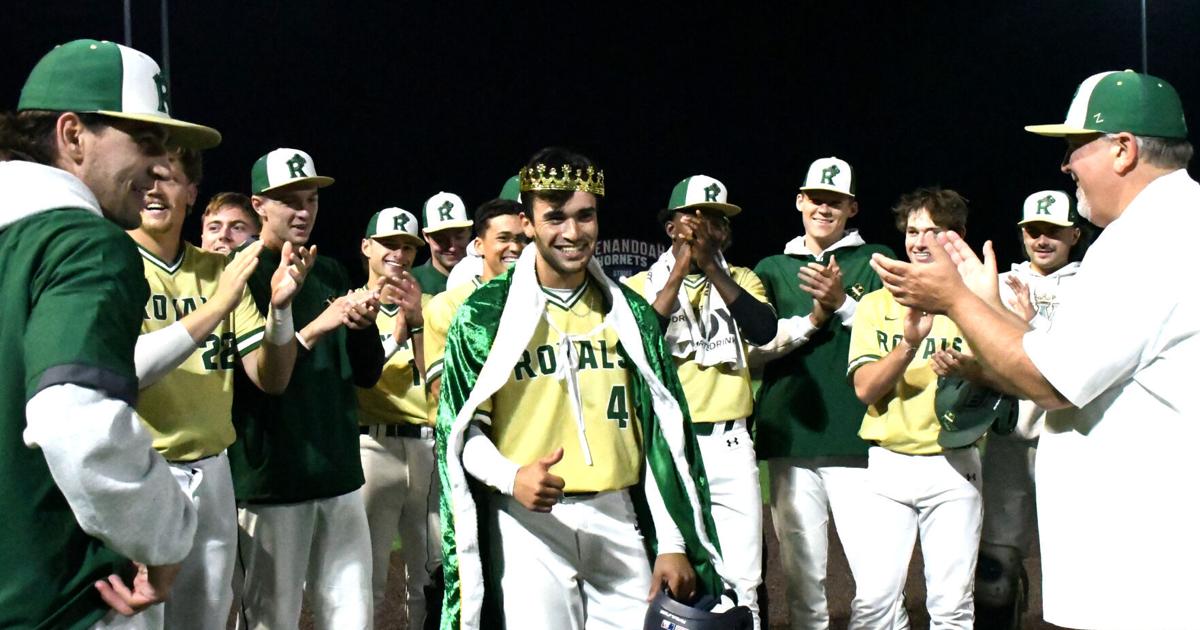
Jaime Padilla dug into the batter’s box for his second at-bat of the game and looked to make a difference for his team on July 5, just as he had done his entire career, but this time it meant more.
He battled through the count until he found the pitch he liked and belted it over the outfield fence. As he rounded the bases, his teammates were in a frenzy in the dugout. The scene was baseball at its finest — emotional, endearing and inspiring, particularly to those who knew what was running through the celebratory hitter’s mind.
Padilla — an All-American for Shenandoah University — had just homered in his first game back playing for the Winchester Royals of the Valley Baseball League, after taking a leave of absence for personal reasons. (Padilla declined to go into specifics about his absence.)
Recipient of the team MVP award this summer, the athletic, stoic center fielder in many ways comprises the backbone of the Royals, acting as a player-coach and mentor to his teammates, whose reactions reflected their appreciation, accordingly.
Royals’ head coach Brian Burke described the moment during his team’s matchup against the Strasburg Express as being cathartic.
“It was one of those goosebumps, cold chill-type feelings,” Burke said. “Everybody knew what he was going through and for him to come back and hit a home run in his first game back, everyone just felt so good for him.”
To Padilla, baseball is a game that requires as much mental training as it does physical, if not more. Coming to this realization was an important development in his baseball journey and helped mature him in a multitude of ways.
The home run against Strasburg exemplified his renewed perspective on the game and on life, in general.
“I really think the mental side of the game is so important, and so is taking care of yourself, mentally,” Padilla said. “I used to put a lot of worth into my baseball self. My mood was determined by baseball and when I started to step away from that and talk to my friends and family about how I was feeling, it helped my mind be clear and allowed me to just go play the game.”
Getting his mental-physical balance squared away not only has improved Padilla’s peace of mind, but it’s also improved his baseball skills. His road to becoming a stronger player, both mentally and physically, has been long and oftentimes difficult, but his hard work has paid off as of late.
Padilla is batting .293 (a team-high 34 hits in 116 at-bats) with 26 runs, 18 RBIs and 12 stolen bases, a .385 on-base percentage and a team-high nine doubles in 29 games for the Royals (20-19 after receiving a forfeit win Tuesday over New Market). He was one of five Winchester players selected for the VBL All-Star game. Padilla returned to the Royals lineup on Sunday after taking another three games away from the team.
As a leadoff hitter this past spring for SU, the 5-foot-9, 175-pound Padilla led the Hornets with a .418 batting average, 71 hits and 52 runs. He also hit five home runs, drove in 42 RBIs, drew 30 walks, stole 14 bases and recorded an OBP of .512.
These numbers earned him ABCA/Rawlings NCAA Division III Fourth Team honors as well as D3baseball.com Fifth Team honors. He also was named First Team All-Old Dominion Athletic Conference.
“He’s brought exactly what he’s done at Shenandoah to the Winchester Royals,” Burke said. “That’s consistent at-bats, consistent play, leading the team in statistical categories all the way around. This kid is just getting it done against elite-level competition.”
Shenandoah University head coach Kevin Anderson said Padilla was integral to the Hornets’ success this past spring.
“He can win a game with his bat, his glove, his arm, and his feet,” said Anderson of Padilla, who served as the team’s leadoff hitter this season. “Not too many players can do all of that. He’s our catalyst.”
Padilla’s production this year both at Shenandoah University and for the Winchester Royals is the result of his devoted work ethic that he has worked hard to develop from an early age.
A native of Yonkers, New York, Padilla played as many sports as he could growing up. At Archbishop Stepinac High School, he was named captain of the football, track and baseball teams. Baseball was his favorite of the three sports, and he had high hopes of playing in college.
He played in several showcase tournaments during his final two years of high school and received a handful of collegiate offers, but his recruiting process was disrupted by the COVID-19 pandemic. Disappointed but not deterred, he continued to work on his game.
After playing in one of his final showcase events, a Shenandoah coach approached Padilla and asked if he was interested in a visit. Padilla could tell SU was the place for him during the recruiting process.
“I loved Winchester; it was, and still is, amazing,” Padilla said. “I loved [Shenandoah] and Coach [Anderson] really made me feel at home. Something that stood out to me that he said during the process was, ‘We’re not necessarily picking you. We want you to pick us.’ I think giving a player that kind of option is really important.”
Anderson’s first impressions of Padilla when he first joined the Hornets’ program were of his multi-sport background that translated into a workmanlike attitude.
“We really liked that he played high school football and ran indoor track,” Anderson said. “The first thing that stood out was his athleticism, competitiveness and willingness to work. In today’s showcase mentality, it’s refreshing to have a player as competitive as Jaime is.”
Another aspect of Padilla’s game that Anderson recognized right away was how hard he played on the field.
“Jaime is a very aggressive player and a very aggressive person,” Anderson said. “What he’s done in his time here is called controlled aggression. As a coach, you like guys who are competitive.”
Burke agrees that Padilla’s playing style has positively impacted his team’s performance, even if it means occasionally having to exercise some restraint on his part.
“Jaime wants to play hard every out of every inning and we love that,” Burke said. “But there are times, especially during the grind of a [VBL] schedule playing six days a week that you have to look him in the face and say, ‘Hey look, we need to give you a couple of innings off.’ While he doesn’t want to hear that, his body has to be telling him something differently.”
Padilla believed his aggressive play style stemmed from his time on the football field in high school.
“Growing up, I wanted to be a football player for a really long time before I realized I was probably a little too small, so I think that’s where it came from,” Padilla said. “I almost get into a flow state when I play aggressively because I’m not thinking. I’m just playing hard.”
This competitive drive has made Padilla the player he is today, but he didn’t always use it to his full advantage. After arriving at Shenandoah as a freshman, he quickly saw that he had ground to make up if he wanted to see the field. Padilla played in only three games in 2023, each time as a pinch-runner.
“That [season] sort of bothered me because it was one of my first times being truly humbled,” Padilla said. “Playing with guys who are much better than me was definitely a reality check.”
Not only did his lack of playing time have an impact, but the grind of his first full college season had worn him down, both physically and mentally.
He went home over the summer and worked out three-to-four times a week to be ready to compete for a starting position, but didn’t touch a piece of baseball equipment for two months in hopes of overcoming his burnout.
During his time off, Padilla went fishing, hiking, took trips to the beach, and focused on spending time with his family. These activities refreshed him and helped reignite the fire that had always fueled him on the baseball diamond.
“When I came back in the fall, I had missed baseball,” Padilla said. “I was ready to go after it. I needed that break because [baseball] is a mental game. You have to have your head screwed on straight and you can’t have all that pressure on yourself all the time.”
In 2024, he got his chance to see the field during the final weeks leading up to the season opener, when the starter ahead of him went down with an injury. Padilla played in 37 of 45 games his sophomore year (starting 35) and batted .319 with three home runs, 31 RBIs, 14 stolen bases and a .415 on-base percentage.
Although his statistics have brought him considerable acclaim, Padilla believes the impact his performance had on team success is more important.
“If I can help my team win, I’ll play well,” Padilla said. “In high school, my coach always told us that if we focused on helping the team, putting good at-bats together for the team, swinging at good pitches, we would automatically become better baseball players. That’s how I’ve always looked at it.”
Padilla’s team-first mentality is perhaps most visible in his eagerness to take on leadership roles for both his teams.
“He’s not a ‘me guy’ at all,” Burke said. “He wants the team to be successful. He’s always communicating information with his teammates as quickly as possible.
“The team sees the way he carries himself in the dugout, how he owns up to any mistakes, and that definitely gets the attention of the younger guys.”
At Shenandoah, Anderson said the program has a built-in mentorship program that is designed to help younger players acclimate to the life of college baseball and receive advice from a more experienced member of the team. Most leaders on the team receive one mentee each to take under their wings.
Padilla gets two.
“We give a lot of latitude to our upperclassmen to teach our system, and that way they have ownership over them,” Anderson said. “He organizes and leads those efforts. The guys look up to him and gravitate toward him.”
Padilla has always embraced the opportunity to play such a significant part in his teammates’ development, and believed his up and down experience at Shenandoah makes him a better leader for his mentees.
“I’ve seen all sides of everything. I’ve had the experience of not playing, of ‘you’re going to play a little bit here and there,’ and being an every-day starter,” Padilla said. “That gives me an edge to help these guys from where they stand in the program.
“Doing things the right way, doing them with intent, and showing others what the right thing to do is what’s most important. I want to help my teammates learn something new, whether that be about themselves, their coaches, or the game itself.”
Padilla sees Anderson as being more than just a coach and has leaned on him for guidance for things beyond the sport, forging a unique relationship that Padilla believed has been integral to his development, not only as a player but as a person.
“We can talk about baseball, school, life, pretty much anything,” Padilla said. “It’s so nice to hear what he has to say because he’s just so knowledgeable and I’ve learned so much from him. Seeing him every day keeps me motivated. I wouldn’t be where I am without him.”
For Padilla, it’s the non-glamorous things that make baseball so compelling, not the awards that come with being a player of his caliber. It’s taking care of the little things, the unpolished details, and the quiet moments that make the most difference to him.
This approach to baseball has translated to his outlook on life in which he encourages others to look after themselves and those around them, above all else.
“You have to take care of your mental health if you want to do anything in your life,” Padilla said. “Your mind is the most important tool you have and if it’s not in the right place, then you’ll struggle. You always have somebody to talk to and there are people who care for you, no matter what.”