
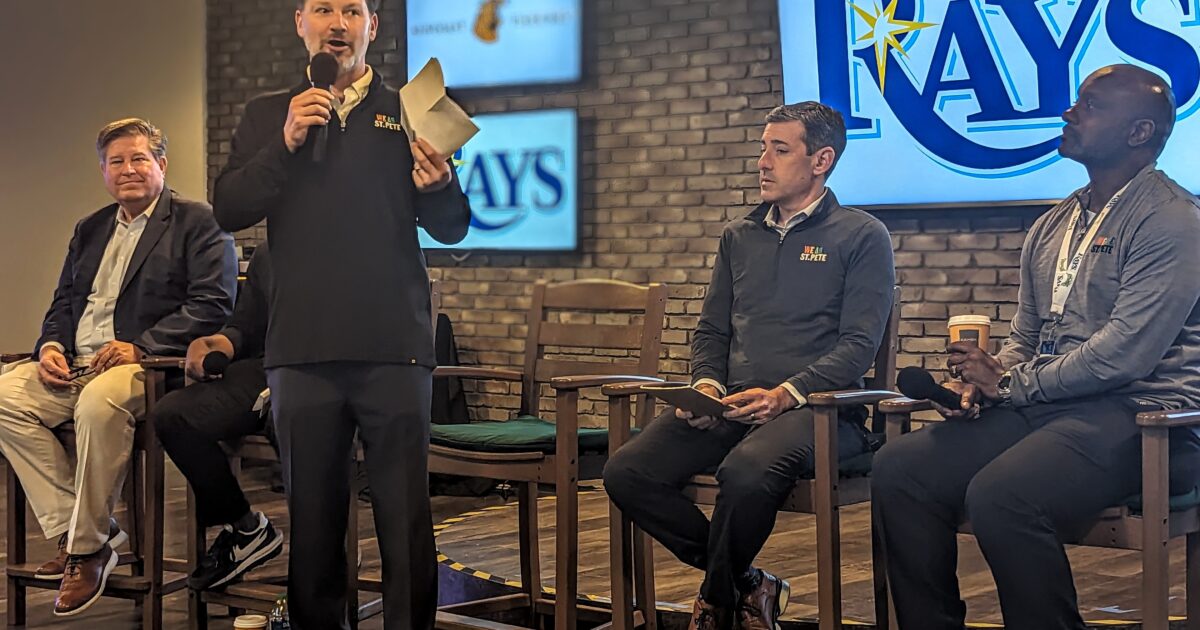
The Tampa Bay Rays made their feelings on storm-damaged Tropicana Field repairs, and fractured relationships with local officials, abundantly clear during a sports radio segment Thursday night.
The prerecorded conversation with Rays presidents Matt Silverman and Brian Auld aired on WDAE-AM and is part of the team’s “Countdown to Opening Day” podcast. The discussion came nine days after Mayor Ken Welch said St. Petersburg would not pursue a new stadium deal “at any cost” and a week following a city council debate regarding Tropicana Field’s storm repairs.
Auld said the aging stadium is “dear to us” and nobody anticipates its reopening more than the Rays. However, he also expressed frustration at hearing city officials suggest they should complete “only the bare minimum” repairs for the Trop to host baseball games. “That doesn’t synch with what I think our community is all about.”
“We recognize the city has a responsibility to be thoughtful with the dollars spent on repairs at Tropicana Field, and we support that,” Auld added. “The bare minimum is just not how we run our organization, and it’s not what our fans in this city deserve.”
Auld noted the Trop also hosts concerts, graduations, free dental clinics for kids, little leagues and nonprofits, amateur gymnasts and an annual celebration for foster children adoptions. Team and tourism stakeholders planned to hold more large-scale events at the stadium, like World Wrestling Entertainment’s (WWE) Royal Rumble, which generated a $47 million economic impact in January 2024.
The team executives reaffirmed their support for the city’s plan to reopen the currently-roofless stadium in time for the 2026 season. Auld said the Rays would play in the home they “love” through “at least” 2028.
“I certainly think it’s also worth thinking about whether or not it makes sense for the community to, at least, consider whether they want Tropicana Field to be useful for several years beyond (that date),” Auld said. “Our city needs a place for all those special events … and potentially as an emergency staging ground for natural disasters.”
That place was supposed to be a new $1.37 billion ballpark that anchors the Historic Gas Plant’s $6.7 billion redevelopment. The presidents did not say – and were not asked – whether they remain committed to the long-negotiated, 30-year project during the conversation with team broadcasters.
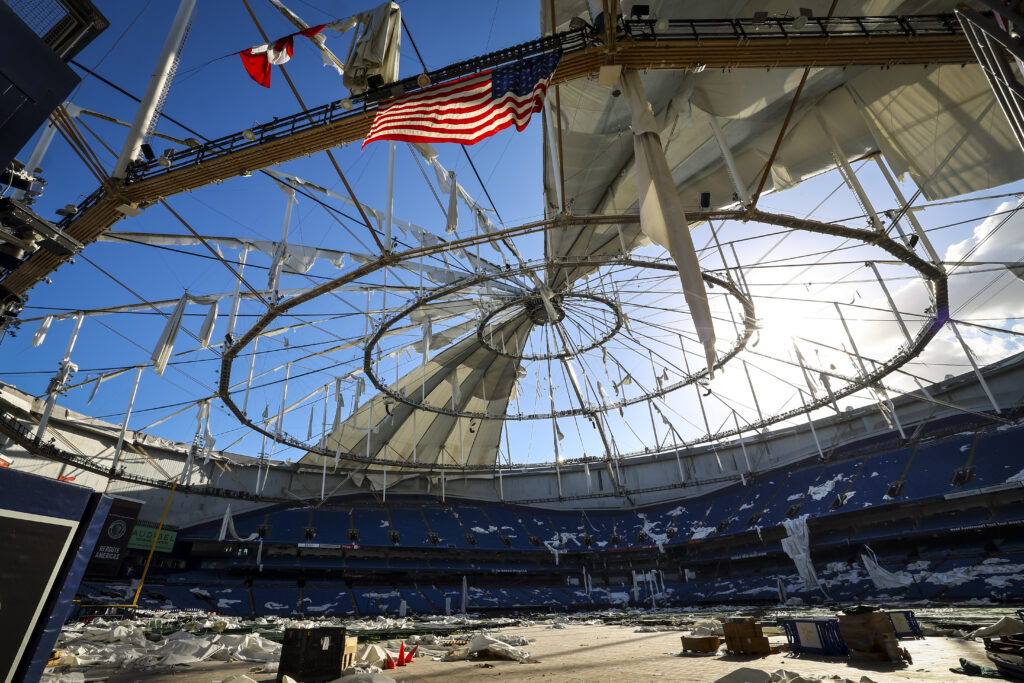
Hurricane Milton caused over $55 million in damage to Tropicana Field. Photo: Will Vragovic/Tampa Bay Rays.
The Trop has remained exposed to the elements since Hurricane Milton shredded its roof Oct. 9, 2024. Auld said new issues arise daily.
He also believes the reconstruction timeline is feasible. Auld said the team’s skepticism is due to the “respect and understanding we have of the democratic process.”
“Every decision, just about, needs to be run through the city council,” Auld continued. “We have a lot of very responsible, thoughtful community members sitting on that council who need to understand the risks, rewards … the likelihood of FEMA (Federal Emergency Management Agency) reimbursement and everything that comes with it – and that can take time.”
He pledged that the team would work to ensure the Rays spend their 2026 season in Tampa Bay, with or without the Trop. While Silverman said staff compiled a list of 50 potential temporary homes in Milton’s immediate aftermath, the goal was always to remain local.
He and Auld reiterated that Tampa’s Steinbrenner Field, a New York Yankees minor league and spring training facility, was the area’s only option for Major League Baseball. Silverman credited the rival franchise’s civic pride for its support.
Pinellas County Commissioners bore the brunt of Silverman’s blame for the team’s uncertain future in St. Petersburg. He noted the Rays acquiesced to several delays during the negotiation process for a new ballpark, and postponing a bond authorization vote in November 2024 “effectively broke” a seemingly done deal in July.
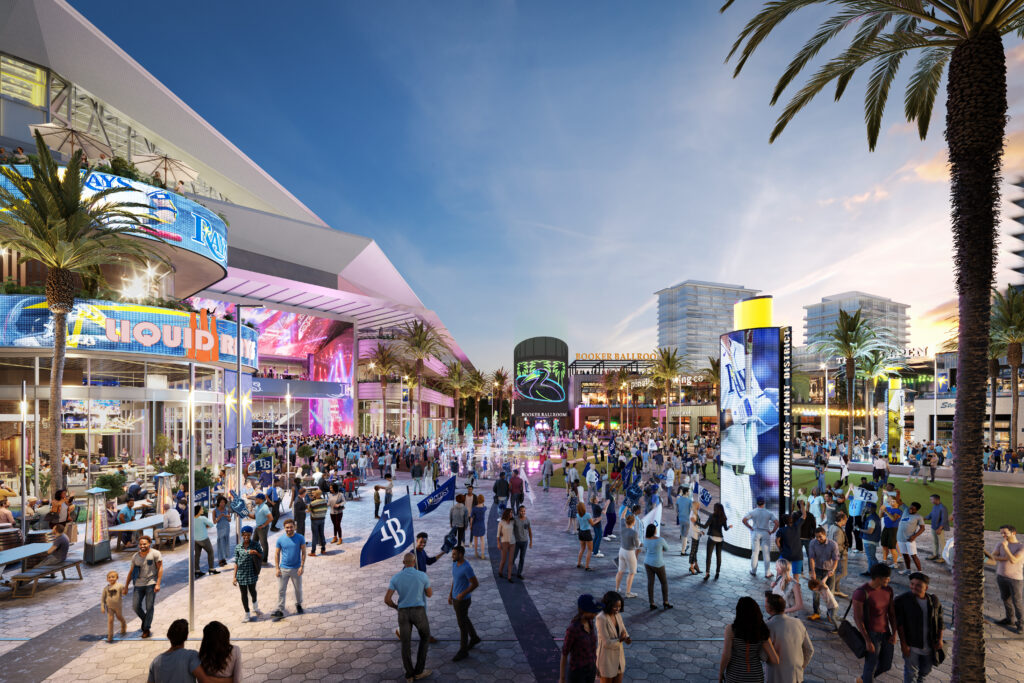
A new $1.7 billion ballpark would anchor the massive Historic Gas Plant District redevelopment project. Renderings: Hines/Rays.
Silverman said county and city administrators understood the timeline’s financial implications for an already risky endeavor. The Rays have taken subsequent insults from politicians and pundits personally. “The emotions have been raw.”
Silverman said they felt surprised, confused, upset and above all, saddened, after committing their “hearts and souls” to a monumental project for the team and area. He believes commissioners reneged on a promise when the organization “needed it the most.”
“We couldn’t justify spending more money on a project whose approval had just been pulled,” Silverman added. “Once you make that decision, you can’t just snap your fingers two months later to restart things.”
He said the team secured the financing needed for its $700 million contribution. The Rays also agreed to cover cost overruns.
However, Silverman questioned if their investment still makes fiscal sense “in the context of Major League Baseball and fielding a competitive team for the next 30 years.” The team has until March 31 to decide.
“We stretched because we really wanted to do this project for us and for St. Pete and Tampa Bay, but when that timeline slipped and when the cost went up, and really when we lost the support our partners at the city and the county – when they said to us not one more cent after they didn’t uphold their end of the timeline – that’s when the reality really started sinking in,” Silverman said.