
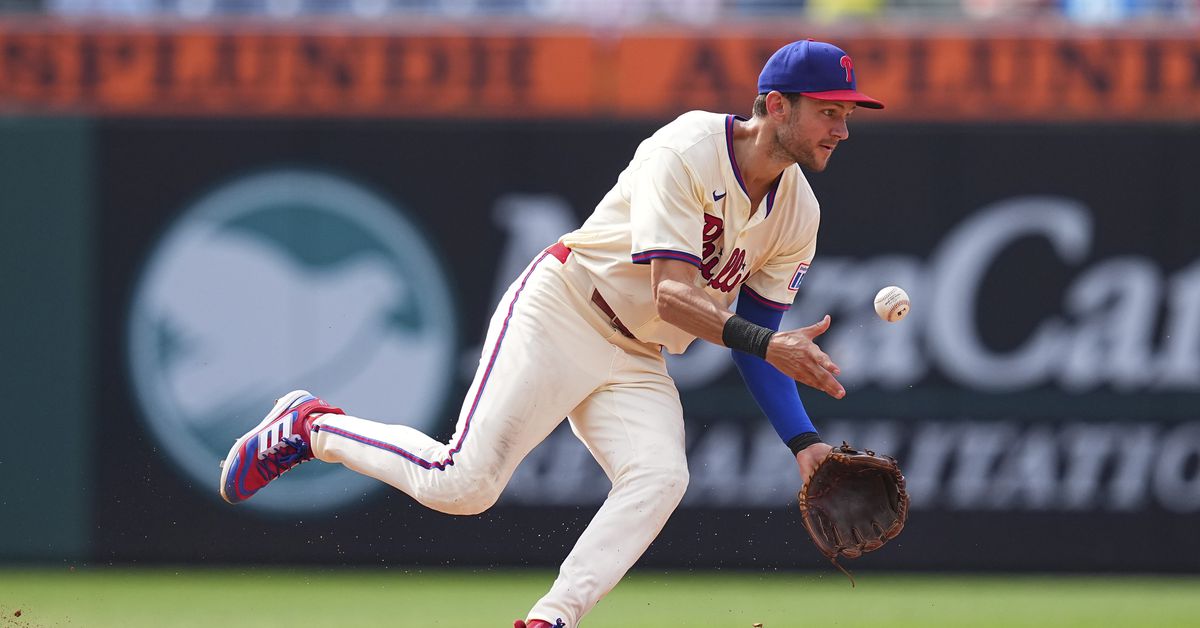
It’s just past the halfway point of the baseball season. And you know what that means: midterm grades. Baseball players aren’t students (the big difference is that, unlike students, baseball players eagerly anticipate their equivalent of finals season), but we can assess them at the midpoint anyway. We’re long past the point where offerings of shiny red apples can help your chances; the grades are in, and the report cards have been printed. That’s no problem for Trea Turner, though. He’s got a report card he can be proud to bring home to Mom and Dad. Last season, Trea Turner posted a fWAR of 3.8. This season, he’s already reached that mark, and there’s plenty of baseball left to play. That puts him on pace to easily surpass his total fWAR from last year, and the 4.1 he posted in 2023 too.
But hold on a moment. Trea’s grades in Sluggology haven’t improved. His batting average of .288 is down .007 from last season. His OBP of .345 is up .007, and his slugging average of .426 is down .043. Two of those are declines, and the improvement is a tiny one. So what’s behind his surging fWAR? Well, part of it is his rebound in Applied Baserunning. Last season he added a paltry 2.6 runs above average on the basepaths, and this season he’s already up to 4.3. That’s pretty good.
But it’s his grade in Advanced Leatherworking that’s really eyepopping. He had posted failing grades in Fielding Run Value, a stat which incorporates both range and arm, for the past three seasons (-2, -3, and 0 FRV, respectively). This season, he’s posting a FRV of 9, putting him 13th among all fielders. If he can hold that through the next semester and finals, it’d be tied for the best of his career, matching his effort from the 2018 campaign.
This is cheerful stuff, the sort of thing that earns you a spot on the Dean’s list (although not, apparently, on the All-Star team). Not to look a gift horse in the mouth, but it’s worth taking a deeper look at precisely how he’s accomplishing his improvement on the defensive side of things.
See, the glove is getting better, but the thing he wears it on isn’t (well, actually it’s the other arm, but roll with it, okay?). Turner’s never had a great arm. Since Statcast started tracking Arm Strength in 2020, he’s been below-average in the category. His arm isn’t dismal— he’s never been in the bottom quartile— but it’s not great. And that has not changed. Right now, he’s in the 36th percentile for arm strength, and per Fielding Run Value, he hasn’t added any runs with his arm (though it ought to be noted he hasn’t lost any with it either). But we know he’s got a total FRV of eight. So what does that mean? Well, FRV combines runs saved with the arm and runs saved with range. So some simple arithmetic (and we are at midterms, I expect you to be able to do it by now) tells us that all eight of those runs were added with his range.
Perhaps that’s not terribly surprising. Turner’s always been fast. Blazingly so; in fact, he ranks in the 100th percentile in sprint speed this season. But while both sprint speed and range draw upon agility, they’re not quite the same skill, and, Turner hasn’t always had terrific range in the field. By Outs Above Average, which measures the outs a fielder adds with his range, he was a negative contributor with his range in 2024 and 2023, at -6 and -3 respectively. He last posted a positive OAA in 2021, but he played a fair amount of second base that year, and his OAA taking only his performance at shortstop was 0. He last posted a positive OAA at shortstop in 2019. It’s been a while.
This season he’s posting an OAA of 11. Most of that improvement is coming from increased ability to make plays to his right; 7 of his OAA came on laterals towards third base. His final OAA on such plays in 2024 and 2023 were -2 and -5 respectively. All of this has made him a better defender against right-handed hitting (since righties are more likely to pull the ball to his right). He’s posting slightly better numbers against left-handed hitters too, year-over-year, but the bulk of his improvement is against his fellow righties.
Now, it should be noted that Trea’s grades are not straight-As. He’s got seven errors on the season, which leads the Phillies. His five throwing errors are tied for third among shortstops leaguewide. So he doesn’t have a perfect report card to take home to Mom and Pop. Nevertheless, there’s real reason to be enthusiastic about Trea’s fielding. He gets a gold star for this semester.