
Today the Baseball Hall of Fame will induct one of its most star-studded classes in recent memory, with Ichiro Suzuki, CC Sabathia, Billy Wagner, Dick Allen and Dave Parker set to take their place in Cooperstown.
Wagner, the longtime closer and one of the most dominant left-handers in history, will don a Houston Astros cap on his plaque but also appeared in 15 games for the Red Sox at the tail end of his career in 2009. That means he’ll be the 39th former Red Sox player enshrined in the Hall of Fame.
Who could be next? That’s tougher to say.
The Red Sox don’t have any clear-cut first ballot legends coming down the pike, but there are a handful of candidates who could potentially receive the call, possibly even in the next few years.
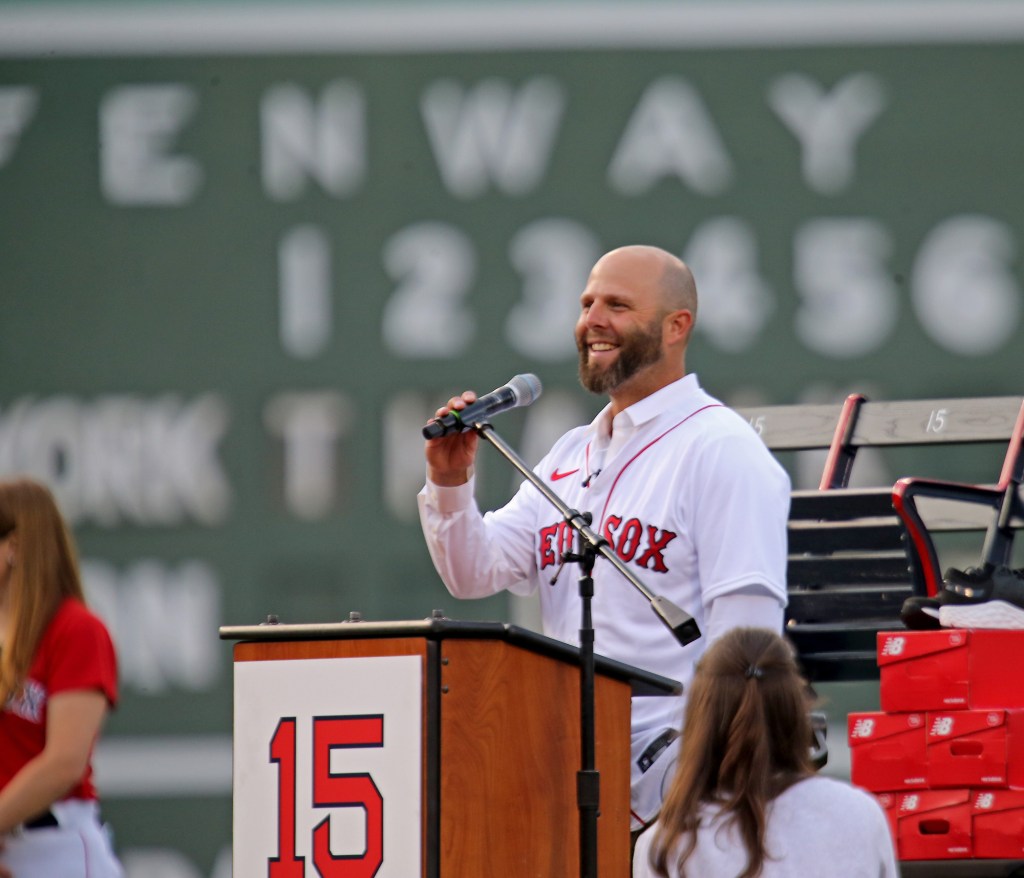
The two names to watch: Dustin Pedroia and Dwight Evans.
Pedroia, who will be on the writers’ ballot for the second time this winter, is a long-shot to earn election next year. The former Red Sox second baseman received 47 votes (11.9%) in his first year on the ballot, which was far short of the 75% needed for induction. He would need a massive surge in support to clear that threshold this year, but if he enjoys a steady increase over the coming years it’s not hard to imagine Pedroia eventually getting in.
Pedroia’s candidacy is complicated. On one hand he was a four-time All-Star, four-time Gold Glove winner and two-time World Series champion who won both an MVP and Rookie of the Year award. He enjoyed a decade-long stretch where he ranked among MLB’s best players, but his career was also cut short due to injury and he played only nine games after his age-33 season. As a result, if Pedroia gets in, his counting stats would rank among the lowest of any Hall of Fame player.
Still, recent voter trends have shifted in favor of players with elite peaks like Pedroia. Evans also stands to benefit from how the game has evolved since his playing days ended.
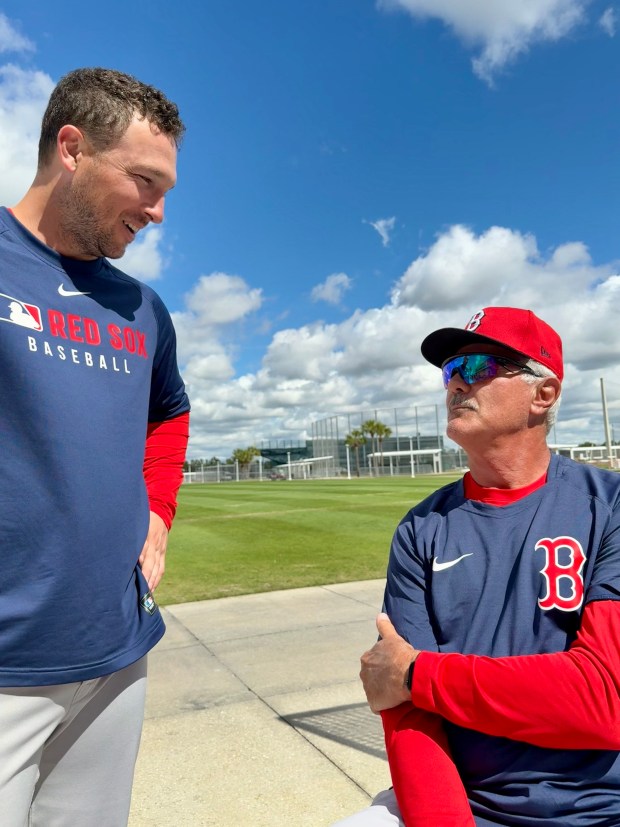 Red Sox infielder Alex Bregman, left, talks baseball at spring training with former Red Sox outfielder Dwight Evans. (Herald photo Gabrielle Starr)
Evans is among those eligible for the Hall’s Contemporary Baseball Era ballot, which considers players who made their greatest contributions from 1980 to the present day. The eight-player ballot will be assembled in the coming months and will be considered by a 16-voter panel in December.
The Contemporary Baseball Era committee last convened in December 2022 and largely dealt with the controversial legends who had recently fallen off the writers’ ballot. Evans was not among the players up for consideration, but Barry Bonds, Roger Clemens and Rafael Palmeiro, all of whom had been shut out due to their connections to performance-enhancing drugs, received fewer than four of 16 votes. Curt Schilling, who fell just short previously on the writers’ ballot due in large part to his hateful comments towards a variety of groups, was also denied with seven votes. Fred McGriff was the only player elected, earning unanimous selection.
This cycle Evans would seem like a prime candidate for consideration.
It’s hard to imagine many players whose candidacies have aged better over the last 30 years. In the 1970s and 80s Evans often flew under the radar, but with modern metrics like wins above replacement and an increased focus on defense and on-base percentage, his greatness really stands out.
In 20 big league seasons — the first 19 with the Red Sox and the last with the Orioles — Evans was an eight-time Gold Glove winner who tallied 2,446 hits, 385 home runs, 483 doubles, 1,391 walks and a career slash line of .272/.370/.470. He received MVP votes in five seasons, including a third-place finish in the strike-shortened 1981 season, and made one of the greatest catches in MLB history in Game 6 of the 1975 World Series.
All of those totals rank among the best in baseball between 1972-91, the years Evans played.
What could ultimately get Evans over the finish line, however, is his 67.2 WAR. That ranks 15th in MLB history among all right fielders, coming just under the average (69.7) of the 30 Hall of Famers at the position. Evans’ total is higher than Dave Winfield (64.2), Suzuki (60.0) and Vladimir Guerrero (59.5), and every right fielder with at least 67 WAR except one — who we’ll get to in a second — is already in the Hall of Fame.
Given how highly respected he is within the game and the fact that he carries none of the steroid or character-related baggage that has dogged other candidates, Evans should be a strong candidate to earn induction if he makes the Contemporary Era ballot.
What about active players?
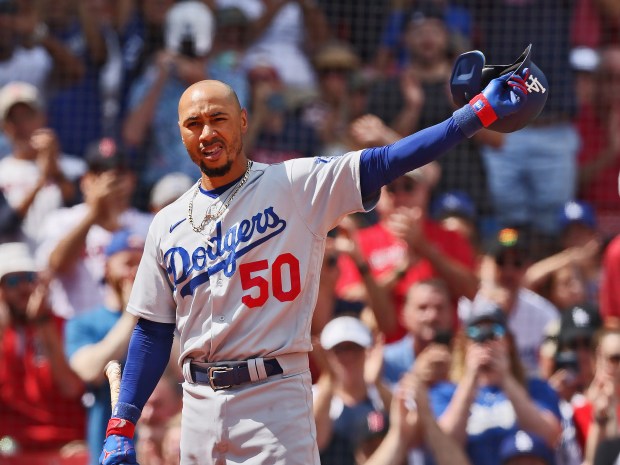 Los Angeles Dodgers outfielder Mookie Betts tips his cap to the Fenway Park crowd as fans give hime a standing ovation during his first game back in Boston since being traded. (Nancy Lane/Boston Herald)
At this point Mookie Betts is a virtual lock to get in, though he’ll wear a Dodgers cap when that day comes, not a Red Sox cap.
Betts is now a three-time World Series champion, an eight-time All-Star, a six-time Gold Glove winner and an MVP whose 72.5 career WAR already ranks above average for all right fielders currently enshrined in the hall (and yes, he’s surpassed Evans’ total in eight fewer seasons). He’s also under contract for another seven years with the Dodgers, so by the time he’s finished he’ll likely have compiled close to 400 home runs and north of 2,500 hits.
Chris Sale’s candidacy is starting to look a lot stronger too.
After battling through injury for more than four years, Sale rediscovered his old form last season and captured the one accolade that had previously eluded him in winning his first Cy Young Award. He was already among the most dominant pitchers of the 21st century — his 55.9 WAR ranks ninth among starters since 2000 and fourth since he debuted in 2010 — and his 30.6% strikeout rate is the best of any starting pitcher in history with at least 2,000 innings, better than guys like Randy Johnson (28.6%), Pedro Martinez (27.7%) and Nolan Ryan (25.3%).
His counting stats won’t be there, obviously, but with older Hall of Fame benchmarks like 300 wins becoming less attainable given how pitchers are used today, Sale will surely benefit from the changing standards voters will inevitably adopt for modern starters.
Who else is out there? Xander Bogaerts and Rafael Devers both reached the majors at age 20 and posted impressive numbers during their Red Sox tenures, but they still have a ways to go and will play out their careers far from Fenway Park in San Diego and San Francisco, respectively.
Kenley Jansen, Craig Kimbrel and Aroldis Chapman all stack up among the most productive closers in MLB history, but even with Wagner’s induction there’s still plenty of debate on what constitutes a Hall of Fame reliever.
Alex Bregman? As a three-time All-Star and two-time World Series champion who has already topped 42 WAR and 200 home runs at age 31 he might have a better chance than you’d think at first glance, but like Bogaerts and Devers he’ll need to continue playing at a high level well into his 30s to have any shot.
Either way, if Evans isn’t elected on this year’s Contemporary Era ballot, it could be a while before another Red Sox player is enshrined in Cooperstown.
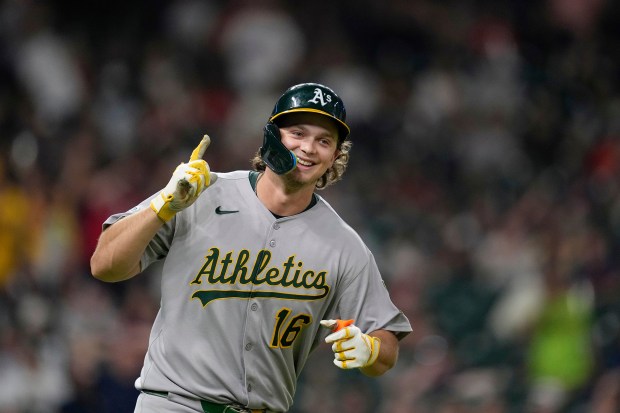 Athletics rookie Nick Kurtz celebrates after hitting his fourth home run of the game on Friday against the Houston Astros. (AP Photo/David J. Phillip)
Kurtz’ monster game
MLB has existed for well over a century, and Friday night Athletics rookie Nick Kurtz delivered what may have been the greatest individual offensive performance in baseball history.
Kurtz, who is 22 years old and was the No. 4 overall pick in last summer’s MLB Draft out of Wake Forest, went 6 for 6 with four home runs, a double, eight RBI and six runs scored in the Athletics’ 15-3 win over the Houston Astros. He became the 18th player in big league history to hit four homers in a game, and the first to do so with six hits and eight RBI.
He also tied Shawn Green’s single-game record of 19 total bases, set when Green also went 6 for 6 with four home runs, a single and a double on May 23, 2002. Green only had seven RBI in that one though.
Though Kurtz has generally flown under the radar playing for the Athletics, he has been mashing ever since he came up in late April. The rookie now has 23 home runs, by far the most in MLB among rookies, along with a .305 batting average, 59 RBI and a 1.060 OPS.
Not bad for a kid who only played 33 minor league games and who was drafted barely a year ago.
Devanney’s hectic month
Former Central Catholic star Cam Devanney has had quite the last few weeks.
On July 8 the 28-year-old native of Amherst, N.H., learned he was being called up to the big leagues by the Kansas City Royals after six seasons in the minors. He joined the team in Kansas City and spent the rest of the week at Kaufman Stadium, but did not appear in a game.
Then over the All-Star break, Devanney was traded to the Pittsburgh Pirates in exchange for veteran infielder Adam Frazier. He was optioned to Triple-A upon his acquisition and is still waiting to make his MLB debut.
Devanney hopefully won’t have to wait much longer. The ex-Elon University star is a versatile infielder who is batting .272 with 18 home runs, 55 RBI and a .915 OPS through 75 games at Triple-A.