
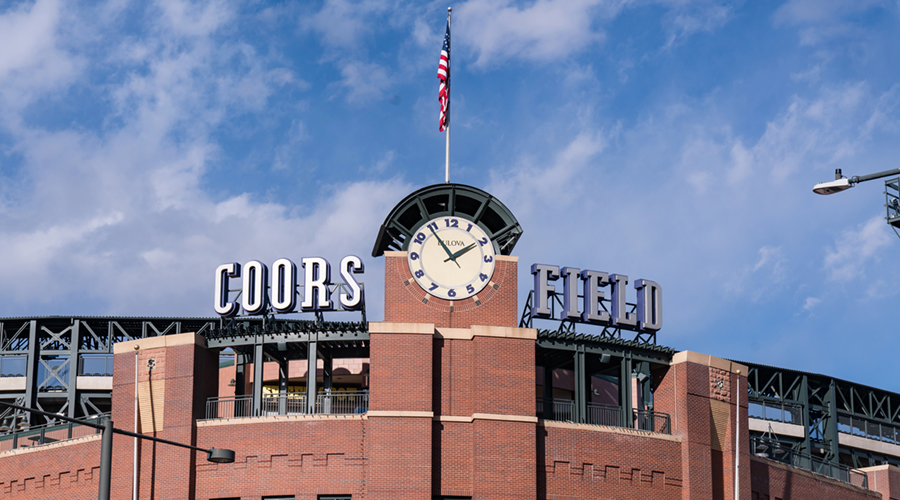
For a lousy Rockies team, Colorado demographics are a gift.
My friend Bob Diddlebock has spent most of his 72 years in Denver, writing for the Rocky Mountain News, editing media industry trade publications and collaborating with former Denver Bronco Karl Mecklenburg on a football biography. He raised two daughters here. He knows by heart the route to My Brother’s Bar on 15th St. He remains buddies with G. Brown, the longtime Denver music critic. Every August, he heads out to a ranch near Grand Junction to help longtime friends muck horse stalls. He’s a Colorado man.
In Brief:
Colorado Rockies attendance buoyed by visiting fans
Nearly half of Colorado residents were born elsewhere
Rockies’ poor record offset by Coors Field‘s tourist draw
Out-of-state loyalties provide crucial team revenue
Except: Not this afternoon. Today the Philadelphia Phillies are in town, and at Coors Field on a sun-splashed Tuesday, my friend is one of the many thousands of fans rocking the visiting team’s colors.
From a distance, the ballpark presents a live-motion display of mismatched hues: Rockies purple-and-black edging up against powder blue shirts, red caps and white jerseys with “Harper” and “Schwarber” stitched across the shoulders in Phillies red. By my guess, half of the 23,000 fans here look to be unabashed Phillies loyalists. Possibly more.
Diddlebock, who grew up in Redding and attended his first Phillies game at Connie Mack Stadium as a seven-year-old, is one of them.
“Of course,” he says. “It’s genetic. It’s in your blood.”
Therein lies the secret ingredient of Colorado Rockies economics: fans of visiting teams.
In the U.S., 17 states plus the District of Columbia are home to any of Major League Baseball’s 30 teams. (California has five; seven others have two; and Toronto accounts for one.) Care to hazard a guess as to which of those enjoys the highest percentage of out-of-state residents?
Sorry, trick question. It’s actually Florida, a mecca for retired New Jersey-ites, Chicagoans weary of cold winters and a large population of foreign-born residents. But Colorado’s close behind: Among MLB states, it ranks second on the people-from-other-places meter. The U.S. Census Bureau’s American Community Survey shows that around 2.7 million of the state’s more than 5.8 million residents, or around 46 percent, were born in another U.S. state. (Another 650,000 or so hail from U.S. territory or a foreign country).
At the opposite end of this spectrum, there’s Michigan, where close to 76 percent of the population is home-grown, the better for festooning Detroit’s Comerica Park with fans wearing Tigers jerseys.
The numbers mean the Rockies team and its ownership are unusually well positioned in terms of drawing out-of-state baseball loyalists, including those from densely populated baseball cities: New York City, Chicago and those annoying Dodgers fans.
It’s one of the saving graces for a team that has achieved startling heights of ineptitude. The Rockies’ 9-44 record as of Memorial Day reflected a team woefully unprepared to play in the major leagues, and one that may well end up on the wrong end of the all-time record books.
Born-and-bred Rockies loyalists, some old enough to recall the grandeur of “Rocktober,” seem to be tiring of the vibe. After 28 home games, attendance at Coors Field was tracking at roughly 25,000 per game, down from the prior season’s 31,360 and well south of the 37,000-ish mark recorded in 2017-2019. (Long gone are the 1990s glory years when the Rockies attracted 45,000-plus fans to a newborn Coors Field.)
But: It could be worse. The failure to assemble a competitive team has been offset by fortuitous demographics. Colorado remains a magnet for individuals and families beckoned by an outdoorsy lifestyle, solid job creation and sunny days. The Colorado State Demography Office tells us that although net migration to Colorado has slowed from the 45,000 newcomers who arrived annually during much of the 2010s, moving to Colorado is still very much a thing. Around 19,000 more people moved to the state than those who exited from July 2022 to July 2023 (the last period for which data are available.) Like my pal Bob, many of these newcomers bring their own hometown loyalties to their new locale, not to mention appreciation for one of the most gorgeous ballparks in baseball.
Thus, population patterns present a gift to the Rockies ownership. Subtract visiting team fans from Coors Field and the results would be ghastly. It’s not outlandish to figure that over 81 regular season home games, one-third or more tickets, let’s say around 900,000 per year, are purchased by visiting team fans. That translates to income that is essential to the team’s ownership, given the awful win-loss record and the collapse of what once was a surefire regional sports network money machine. Gate receipts and food/beverage purchases typically represent around 35 percent of MLB team revenue, a percentage that’s surely climbing as media rights money shrinks.
Although every MLB team is dealing with the same shifting media ecosystem, a select few enjoy a backdoor advantage: Whether the home team is good, bad, or, in the case of the Rockies, miserable, the right demographics can provide the same thing a timely double-play delivers to a fatigued pitcher: a way out of a jam.
This article appeared in the Summer 2025 issue of ColoradoBiz with the headline ‘Visiting Hours.’
e